June 1938: A Superman for the Underdog

On the newsstands in May 1938, browsers had their choice of Tarzan in Comics on Parade, Popeye in King Comics, daredevil aviator Captai...

Showing posts with label Mort Weisinger. Show all posts

Sunday, September 9, 2007

September 1967: That’s Nice, That’s Terrific

Superman editor Mort Weisinger often took his story cues from the popular culture fads of the day, shopping for ideas by scanning movie posters and other such signposts of the zeitgeist.

But in 1967, that could be a little like looking into a mirror. Batman was on TV and a Superman musical had just finished on Broadway. DC superhero cartoons abounded.

And then came the live-action superhero sitcoms Captain Nice and Mr. Terrific, both premiering on the evening of Jan. 9, 1967.

Whatever appeal the superhero comedy concept might have had in 1967, the shows stumbled right out of the starting gate because of their back-to-back network scheduling.

Mr. Terrific starred Stephen Strimpell as Stanley Beamish, a filling station operator whose singular biochemistry permitted him to pop a power pill and become a flying, super-strong superspy for a maximum of 100 minutes.

Captain Nice was police chemist Carter Nash (William Daniels), a mother-dominated fusspot who nevertheless appeared to be the only person with any sense of civic responsibility in Big Town, USA. When goggled and caped, Carter seemed self-conscious but game, smashing through walls, catching bullets, shrugging off artillery shells and zipping around the globe in under 60 minutes.

Both Mr. Terrific and Captain Nice were obviously Superman parodies. In Action Comics 354 (Sept. 1967), Weisinger did a tribute to both shows, splitting the difference by creating a character called Captain Incredible.

Captain Incredible turned out to be a super-robot created by a 27th century scientist to assist Superman. However, the strain of time travel proved too much for the mechanical man, and he became a menace.

Actually, the shows were virtually off the air then, having been cancelled. They were just finishing their summer reruns by the time Action 354 appeared on the stands in July 1967.

“How ironic,” as the comic books used to say.

Looking back, Daniels put his show’s quick demise down to the audience’s disinclination to cheer for an “insecure Superman.”


The super-sitcom rivals: Captain Nice and Mr. Terrific


Wednesday, January 1, 2003

January 1963: Seven Times Superman

In the Kennedy era, having been popularized on TV, radio, movie serials and cartoons and a newspaper comic strip, Superman was featured in seven comic book titles — or eight if you count The Justice League of America, where he was initially downplayed (he tended to upset the balance of power there).

But the Man of Tomorrow was central to the titles Action Comics, Superman, Adventure Comics, Superboy, Lois Lane, Jimmy Olsen and World’s Finest. 

Important additions to the Superman mythos might appear in any one of them — the tiny Supermen in Jimmy Olsen, the Phantom Zone in Adventure, Bizarro in Superboy and Luthor’s sister Lena Thorul in Lois Lane.

The Mort Weisinger-edited Silver Age Superman mythos probably reached its zenith when the Superman Emergency Squad was introduced in 1960.

We’d already seen the arrival of Brainiac, whose shrinking ray gave us the Kryptonian bottled city of Kandor, to be stored in another recent innovation, Superman’s arctic Fortress of Solitude (shamelessly lifted from Doc Savage).

Krypto the Superdog had arrived even earlier, and Supergirl more recently. Her own expanding mythos would give us Streaky the Supercat and Comet the Superhorse. Lori Lemaris, Superman’s lost collegiate love, was available if we happened to need telepathic assistance from a mermaid.

Kandor would be the source of further mythic evolution for the Man of Tomorrow. The tiny city would become the urban bottlescape for Superman and Jimmy’s Batman-and-Robin adventures as Nightwing and Flamebird. 

And, in Jimmy Olsen 48 (Oct.-Nov. 1960), it would give us the Superman Emergency Squad, a silly team I loved.

In this Otto Binder story with art by Curt Swan, we met Superman’s tiny flying army from the Kandor.

After shoving their way out of the corked bottled, they swarmed to the rescue dressed in Superman costumes (which would actually make them uniforms, I suppose). 

Initially someone insisted that they should all look like Superman too, which seems a bit fetishistic even for Silver Age comic books.

Monday, September 9, 2002

September 1962: Time-Traveling Titanic Teenagers

In September 1962, DC marked the 300th issue of Adventure Comics by cover-featuring a team that had begun as almost an afterthought.
Every decade has had its superhero teams — the Justice Society and the All-Winners Squad in the 1940s, the Justice League, the Fantastic Four and the Avengers in the 1960s, the Defenders in the 1970s.
But superheroes were eclipsed in the 1950s, in part because such garish figures didn’t quite fit with a war-weary, nervously conformist American society. Yet the 1950s too had its superhero teams, though stripped-down, muted and shoved into the background in keeping with the spirit of the times.
So you had the World’s Finest trio of Superman, Batman and Robin and two other bands that were probably intended to be one-shot plot devices, but which took on lives of their own.
One was The Batmen of All Nations (Detective Comics 215, Jan. 1955), consisting of the Masked Manhunter’s imitators from around the world, and the other debuted in Adventure Comics 247 (April 1958).
It’s safe to assume that writer Otto Binder, artist Al Plastino and editor Mort Weisinger didn’t know quite what they’d created in The Legion of Super Heroes, a club of teenagers who time-travel back to Smallville to recruit their inspiration, Superboy.
The concept had weird angles that weren’t particularly promising. Why should the super heroes all be teenagers? And why should they each be restricted to a single power — or, as would be the case with several members, the entire virtually omnipotent array of Kryptonian powers?
Yet hidden within the concept were elements that would give it serious legs.
Like the Harry Potter novels 40 years later, the series would combine the fantasy appeal of super powers with the plot-churning drama of high school cliques and romances. The team returned in Adventure Comics 267 (Dec. 1959), and then again and again.  Even if the situations were fantastic, the emotions had to be familiar to the feature’s young readers.


Saturday, July 7, 2001

July 1961: Challenge of the Super Friends

   By July 1961, Superman editor Mort Weisinger’s elaborately developed mythology for his family of magazines enabled him to just throw everything at the wall to see what might stick.  For example, what if the fifth dimensional imp Mr. Mxyzptlk lost his purple derby, but Jimmy Olsen found it and used its magical residue to give himself Kryptonian super powers?

But then what if an invading horde of giant, intelligent, telepathic red ants attacked Lana Lang’s dad on a South American expedition? And then what if the ants’ leader, Mgoro, hypnotized Jimmy into using a green kryptonite meteor to destroy Superman?

But what if that all turned out to be a fever dream induced by red kryptonite dust in the derby’s hatband?

Why giant ants? Because Weisinger believed in recycling, and had a good memory for pulp magazine gimmicks that had worked in the past. The story was inspired by Howard V. Brown’s cover for the December 1938 issue of Thrilling Wonder Stories, a magazine edited by Weisinger.

Another of Superman’s close friends gained his powers in Jerry Siegel’s “imaginary” story The Wife of Superman! in Superman’s Girl Friend Lois Lane 26 (July 1961) — not Lois, but Lana.

Superman gives his bride super powers, and because Lana’s not from Krypton, she’s also invulnerable to kryptonite. In the context of 1961 sexual politics, that happy outcome turns out to be tragic.

As Super-Lana repeatedly rescues her husband from kryptonite traps, his attitude shifts from gratitude to depression.

Finally, Lana decides she must sacrifice herself for Superman’s fragile ego. Tearfully, she flies away into space, never to return.

“One of Weisinger’s most common themes was that of rejection, by no coincidence the radioactive core of childhood anxiety,” observed comics historian Mark Engblom. “Lana ‘being better’ than Superman hit young boys right where they lived … and, like a young boy would think, she needed to quit. Immature? Of course … but RESONANT with a child who experienced similar feelings.”

July 1961: This Is Your Life, Superman!

In 1961, the Superman title had an average monthly circulation of 820,000 — second only to Disney’s Uncle Scrooge, with its 853,928 head count.

The rich, stingy duck was self-explanatory, but a good number of those nearly a million Superman readers weren’t entirely clear on who this strange visitor was and how he came to be. His origin was not constantly referred to, neither in 1950s comics nor in The Adventures of Superman TV series.

To introduce the biography, artist Al Plastino provided a nice little five-panel summary of Superman’s typical daily non-journalistic activities — saving a city bus from plunging into the river, shrugging off a nuclear blast, spying on a jewelry robbery with his x-ray vision, smashing Lex Luthor’s giant robot and razing slum dwellings.

Editor Mort Weisinger used this opportunity to summarize those elements of increasingly elaborate Superman lore that had been added to the superhero’s background since 1938 — the indestructible baby blankets that became his costume, his dog Krypto, his cousin Supergirl, his foster parents’ general store, his career as Superboy in Smallville, kryptonite, Jimmy Olsen, Perry White and Lana Lang.

I was generally aware of Superman’s origin because my grandmother told me what she recalled of it from the 1948 movie serial, in surprisingly vivid detail.

But the issue included a house ad for a related title that would be published the next month — the 25-cent giant Secret Origins. That one included the provenance of the Flash, Green Lantern, Wonder Woman, the Martian Manhunter, Green Arrow, the Challengers of the Unknown and the Superman-Batman team — absolutely irresistible.

I had just turned 7 when my grandfather dutifully took me to the local newsstand in Effingham, IL, to pick up Secret Origins the week it came out. 

But it wasn’t there. It had sold out instantly.

I was so crestfallen I burst into tears on the spot, then I was ashamed of myself for having cried. But I rarely remember ever having been more disappointed.

And here's the 1948 version by Wayne Boring.

Friday, February 2, 2001

February 1961: Frankenstein Meets Superman (Sort Of)

Superman editor Mort Weisinger was always alert for the latest child-pleasing trends. He scanned movie posters while strolling on his lunch hour in order to spark story ideas. 

So an encounter between Superman and “Frankenstein’s Monster” was probably inevitable.

Why? Because Weisinger’s editorial reign coincided with the Baby Boomer children’s discovery of the Universal monster movies released 20 years earlier. Kids were seeing the various horror film series on the late night and afternoon local TV movies.

Shock Theater, a package of 52 pre-1948 Universal Studios horror films, was released for television syndication in 1957 by Screen Gems, the television subsidiary of Columbia Pictures. Dracula, Frankenstein, the Mummy, the Invisible Man and the Wolf Man were prominently represented.

That, in turn, prompted the publication of a one-shot magazine, Forrest J. Ackerman’s Famous Monsters of Filmland. But because the first issue, published in February 1958, was popular enough to require a second printing, the magazine took off and continued for 191 issues. The magazine’s success spawned spinoffs that included Screen Thrills Illustrated, Creepy, Eerie, Spacemen, Favorite Westerns of Filmland and Vampirella.

Written by Otto Binder and penciled by Wayne Boring for Superman 143 (Feb. 1961), Bizarro Meets Frankenstein! actually recorded an encounter between Superman’s imperfect duplicate and an actor playing the Frankenstein Monster. The 1954 Comics Code — banning vampires, werewolves, ghouls and zombies, among other things — may have made Weisinger skittish about including the “real” Frankenstein Monster in a story.

Finally, in Superman 344 (February 1980), the Man of Steel would battle the actual Frankenstein Monster, along with Count Dracula.

By the way, that same month Superman 143 shared newsstand space with Famous Monsters of Filmland 10, featuring the Phantom of the Opera on the cover and an article by Robert Bloch. 

Pricier than a 10-cent comic book, Famous Monsters would cost you three whole dimes and a nickel.


Monday, January 1, 2001

January 1961: Showcasing the Sea King

By 1960, the Flash and Green Lantern had already been revised and revamped in DC Comics’ Showcase. So why not Aquaman too?
Unlike those characters, Aquaman had never ceased publication at the end of the 1940s. Readers remained familiar with him from his appearances in the popular new title Justice League of America, and from backup stories in Adventure Comics in a feature that had, since 1951, been graced with the sumptuous pencils of one of the few female artists in comics, Ramona Fradon.
Although the publishers didn’t need to reintroduce Aquaman, they could use the freedom of a full-length story to expand his scope of operations. So in Showcase 30 (Jan.-Feb. 1961), Fradon and writer Jack Miller treated us to The Creatures from Atlantis.
Aquaman’s brief stories had done little with Atlantis before Showcase 30. In fact, Aquaman had never even visited his exiled mother’s birthplace until that issue, when scaly amphibious aliens seized control of the domed underwater city. They threatened to take control of the whole planet with flying submarines armed with heat rays that could melt skyscrapers, so Aquaman and Aqualad had to try to stop them, despite the long odds.
“From 1958 on, the Superman family under (Aquaman creator Mort) Weisinger's editing started building up a complex mythos,” recalled comics historian Michael E. Grost. “There are signs that during 1959-1960, something similar was attempted for Aquaman.”
“Just as Superman came from the advanced planet Krypton, so do Aquaman's ancestors hail from the advanced civilization of Atlantis, although Aquaman himself was born on the Earth’s surface. Just as the bottled city of Kandor represents a survival of Krypton on Earth, one that can be visited by the characters, so does the domed undersea remnant of sunken Atlantis represent a continuation of that magnificent civilization.”
Scenes like that seemingly endless army of loyal sea creatures parading past teenaged Arthur Curry were arresting to me in 1960, and remain vivid in memory even now.


January 1961: The Sadness of Superman


Many were the times stories written by Superman co-creator Jerry Siegel left his brainchild ineffectual, impotent or dead.

The world’s most powerful man, powerless. How ironic, as they used to say in the comic books.

The 1950s and 1960s were a sad, sketchy period for Siegel, so maybe it’s understandable that he’d have his most famous creation share his despair. Or maybe the having Siegel write such stories was some kind of punitive joke arranged by Superman editor Mort Weisinger. 

But whatever the reason, there they are. The pattern is unmistakable.

His energy duplicate Super Menace defeated Superman, but then vaporized himself along with his own evil foster parents in Superman 137 (May 1960).

The Man of Tomorrow was unable to repair yesterday by preventing the destruction of his home world in Superman’s Return to Krypton (Superman 141, November 1960). 

A super-powered Lana Lang was forced to exile herself from Earth because her powers overshadowed the despairing Superman’s in The Wife of Superman! (Superman’s Girl Friend Lois Lane 26, July 1961).

And The Death of Superman (Superman 149, November 1961) speaks for itself.

One of these stories introduced me to the Legion of Super-Heroes, in fact. 

Lightning Lad rescued Superboy and Krypto from the young Lex Luthor’s Army of Living Kryptonite Men in Superboy 86 (Jan. 1961).  

Using a telekinetic helmet of his own invention, Luthor had buried Superboy in kryptonite on an asteroid. Krypto fell into the death trap trying to save him.

But the Legion of Super-Heroes was watching through their time viewer, so they sent a boy from tomorrow to save the doomed Boy of Tomorrow single-handedly —a deus ex machina if there ever was one.

One of the more insightful comics writers once remarked that as Batman stories are thematically concerned with light and darkness, Superman stories are about power and weakness. 

Superman’s first stories celebrated his power. Twenty years later, they explored the many ways in which power couldn’t save him.

Tuesday, October 10, 2000

October 1960: The Signal in the Sky

Ah, the mysterious, looming Bat-Signal. What a fascination it held for readers.

Batman’s flashy-cool accoutrements — Batmobile, Batplane, Whirly Bats, the Batcave with its massive weird trophies, the ever-so-useful utility belt and especially the Bat-Signal — formed a serious part of his long-term appeal, I think.

Introduced in Detective Comics 60 (Feb. 1942), the Bat-Signal had, of course, been inspired by the Phantom Detective pulp magazine of the 1930s in which a red beacon atop a newspaper skyscraper was used to summon the crime-fighting Phantom. Batman editors Jack Schiff and Mort Weisinger had edited that magazine, and were well aware of the gimmick.

My only disappointment with Batman’s sales-boosting “New Look” in 1964 was the addition of a telephone “Hot Line” to Commissioner Gordon. I thought that undercut the importance of my beloved Bat-Signal.

When the TV show debuted as an instant hit in January 1966, I was pleased to see the producers had been smart enough to include both the Batphone and the Bat-Signal.

Here, in Batman 135 (Oct. 1960), we have one of those rare stories in which the Bat-Signal plays a central role. Criminals summon a super-powered sky creature to battle Batman and Robin using a sorcerer’s lantern as a sort of evil Bat-Signal.

The issue includes one of my favorite sub-series, Alfred’s fictional adventures of the second Batman and Robin team. Dick Grayson has become Batman II, and Bruce Wayne and Kathy Kane’s son has become an earnest, ginger-haired Robin whose inexperience drives the plot.

In the third story, gambling-ring gangster “Wheels” Foster becomes the Wheel, one of those costumed obsessives who were forever being inspired by Batman’s own costumed obsessiveness concerning bats. Like the sorcerer’s lantern, this satisfied the readers’ well-established taste for mirror-image reversal themes.

Meanwhile, that same month over in Detective Comics 284, Robin accuses Batman of being too negative, and he’s right.


Tuesday, April 4, 2000

April 1960: Wolf Man Jimmy

Superman’s pal may have been mystified about how he became a Wolf Man (Jimmy Olsen 44, April 1960), but I knew why.

Beginning in 1957, a package of Universal monster movies from the 1930s and 1940s was sold to television. By the end of the year, the films could be seen on 78 TV stations across the country, and by the next year, they had their own magazine — Famous Monsters of Filmland. 

So the tragic old menaces became familiar to a new young audience, who found themselves also loving what their parents had loved.

What puzzles me, though, is how DC Comics got this past the Comics Code, which explicitly stated that “Scenes dealing with, or instruments associated with, walking dead, torture, vampires and vampirism, ghouls, cannibalism and werewolfism are prohibited.”

“This is one of the most gripping of (writer Otto) Binder’s transformation stories,” observed comics historian Michael E. Grost. “This story recalls Binder’s earlier The Witch of Metropolis (Lois Lane 1, March-April 1958). In both stories, the protagonist undergoes a frightening transformation into a sinister mythological creature. In both stories, the transformation happens only at night, with the hero or heroine reverting to their normal selves during the day.

“There is something about becoming a wolf-man that echoes the real changes boys go through when they grow up and become men,” Grost noted. “When a boy grows up, he becomes large, hairy and awkward — and his fate now depends on being romantically involved — all elements of Jimmy's Wolf-Man experience. So most male readers can immediately identify with Jimmy’s transformation. It evokes all sorts of powerful and even frightening real-life emotions.”

The emphasis here though, as in so many Superman stories under editor Mort Weisinger, is really on loneliness and abandonment rather than fright. Jimmy is explicitly required to find ways to “fit in” in this story.

Sales must have been satisfactory, because Wolf Man Jimmy returned a year later in Jimmy Olsen 52 (April 1961).

Saturday, October 10, 1998

October 1958: The Misunderstood Monster in the Mirror

Intended to be a one-shot foe of Superman, he survived to become a household word.

Emblematic of superheroes’ tendency to fight mirror images, Bizarro was introduced in 1958 in — appropriately enough — twin forms.

In Bizarro — The Super-Creature of Steel (Superboy 68, Oct. 1958), writer Otto Binder and artist George Papp showed us how Prof. Dalton created a doomed, imperfect duplicate of Superboy.

“Bizarro was a pathetic, quasi-living creature, who had come into being when a device supposedly capable of duplicating physical objects was used on Superboy,” noted comics historian Don Markstein. “It proved not quite up to the task, and the result was a brain that functioned at a child’s level behind a face that looked like crumpled-up paper. Bizarro (who took his name from hearing the word ‘bizarre’ applied to him) had all of Superboy's wonderful powers, but no real spark of life — a fact he was just bright enough to understand. He returned to oblivion on the final page, and was no doubt happier that way.”

Meanwhile, in the Superman newspaper strip, another tragic version of Bizarro was introduced by writer Alvin Schwartz and artist Curt Swan. This one was an imperfect duplicate of the adult Superman, and distinguished from the comic book version by the fact that he sported a B on his chest in place of the S insignia.

Bizarro was not an evil version of Superman, but a confused one — a powerful figure deprived of Superman’s intellectual and moral clarity.

In the Superboy story, like the Frankenstein monster, the ugly, innocent creature is hurt by the fact that Smallville residents fear and shun him. The tale has that throb of pathos achieved in some of the best of the Superman stories in the 1950s and 1960s.

Mort Weisinger-edited titles often play on children’s fears of rejection, isolation and abandonment. Here, Bizarro is flatly rejected even by the woman he regards as his mother, the ordinarily kindly Ma Kent.

“Funny books,” indeed.

Friday, September 9, 1994

September 1954: Golly, Mr. Kent, My Own Title!

The popularity of Jack Larson as Jimmy Olsen on The Adventures of Superman elevated the character’s prominence in the comics.
The television show debuted in 1952, and DC Comics rewarded Jimmy with his own comic book in 1954.
“I was a big Superman comic book fan,” Larson recalled in an interview with the Archive of American Television. “My dad said to me when I was doing the Superman television show, ‘Hell, they’re not paying you anything. You’re just getting back the dimes I gave you for that comic book.’
“I think it has always been successful because, until E.T. — which was a good alien, which came many years later — Superman was the first alien who came to Earth to be what the Greeks called a deus ex machina — to save mankind, to do good for mankind.
“Always it was H.G. Wells’ invasion from Mars, and the aliens come to destroy us. They’re always monsters, even in the film Alien. They always come to do bad — except in The Day the Earth Stood Still, Bob Wise’s film, I left that out too. But Superman came before.
“And I think it’s because he comes with all these super powers to do good to mankind, to help us out, that it captures the fancy. And besides that, you know, all of the derring-do, leap tall buildings in a single bound. And the actual motto of it — ‘truth, justice and the American way’ — that has always led to this popularity. And as a boy I was crazy about Superman.”
As comics historian Mark Engblom observed, “Although Jimmy Olsen has been banished to the status of window dressing for the past three decades or so, he was clearly a major star from the late ’50s through the (Mort) Weisinger years… It’s hard to fathom today how a cast member could carry a solo series, to the point where I can’t think of anything comparable since the Jimmy and Lois Lane series.”

Saturday, January 1, 1994

January 1954: A Surprising Number of Giant Turtle Men

You can thank — or blame — Mort Weisinger for all the giant turtle men who used to wander around tearing up highway bridges.
The first was cover-featured in the July 1940 issue of the Weisinger-edited pulp magazine Thrilling Wonder Stories, an illustration for Out Of The Depths by H.L. Gold.
In 1941, Weisinger moved from Standard Magazines to National Periodicals as editor of the Superman titles. That’s why Superman’s pal became a giant turtle man in Jimmy Olsen 53 (June 1961).
Superman might have had a sense of déjà vu, because he had also confronted a giant turtle man in Superboy 30 (Jan. 1954).
In the Curt Swan/Bill Finger story The Giant Who Came to Smallville!, a local scientist named Willis complains that no one in Smallville takes his growth serum seriously.
“They all think my giant turtle is just a freak — an accident!” he says. “And they call me a crazy scientist!”
Can’t imagine why. It’s not like he would leave his growth formula in a temptingly shiny test tube next to the baby crib where his infant son could drink it.
Oops. He did.
Superboy has his hands full trying to protect the innocent child from being killed by military planes while shielding the public from the giant. With characteristic compassion, he does so by finding a way to befriend the giant boy, not by frightening him.
Cross-index this one under Monster Toddlers, a category that includes the Fantastic Four’s Infant Terrible and Captain James T. Kirk’s Squire of Gothos.
The story worked a little better here than when it was retooled for Jimmy Olsen. After all, Jimmy had to be not merely expanded into a giant turtle man but also “babyfied” in the brain.
It’s also easier for readers to accept the idea that a toddler might drink a dangerous super-scientific freakish-transformation serum than that Superman’s friends Jimmy Olsen, Lois Lane, Lana Lang and Perry White would do so.
Repeatedly.
And, of course, delightfully.

Tuesday, February 2, 1993

February 1953: Of Fat and Phantoms

Hurt feelings, loss and embarrassment loomed large in editor Mort Weisinger’s Superman titles, and a certain amount of fat-shaming went along with that.

It may well have all started here, in Superboy 24 (Feb.-March 1953). In The Super-Fat Boy of Steel, drawn by John Sikela, all Smallville’s teenagers mysteriously become obese while Clark Kent is off on vacation.

The major characters in Weisinger’s Superman titles — Jimmy Olsen, Lois Lane, Lana Lang, Supergirl and Superman himself — all got plumped up at one time or another. 

In the Julius Schwartz-edited title The Flash, the same thing once happened to the Scarlet Speedster. But it wasn’t presented as an embarrassment to Barry Allen, merely a predicament for him to think his way out of.

As superheroes faded in the early 1950s, horror comics flourished.

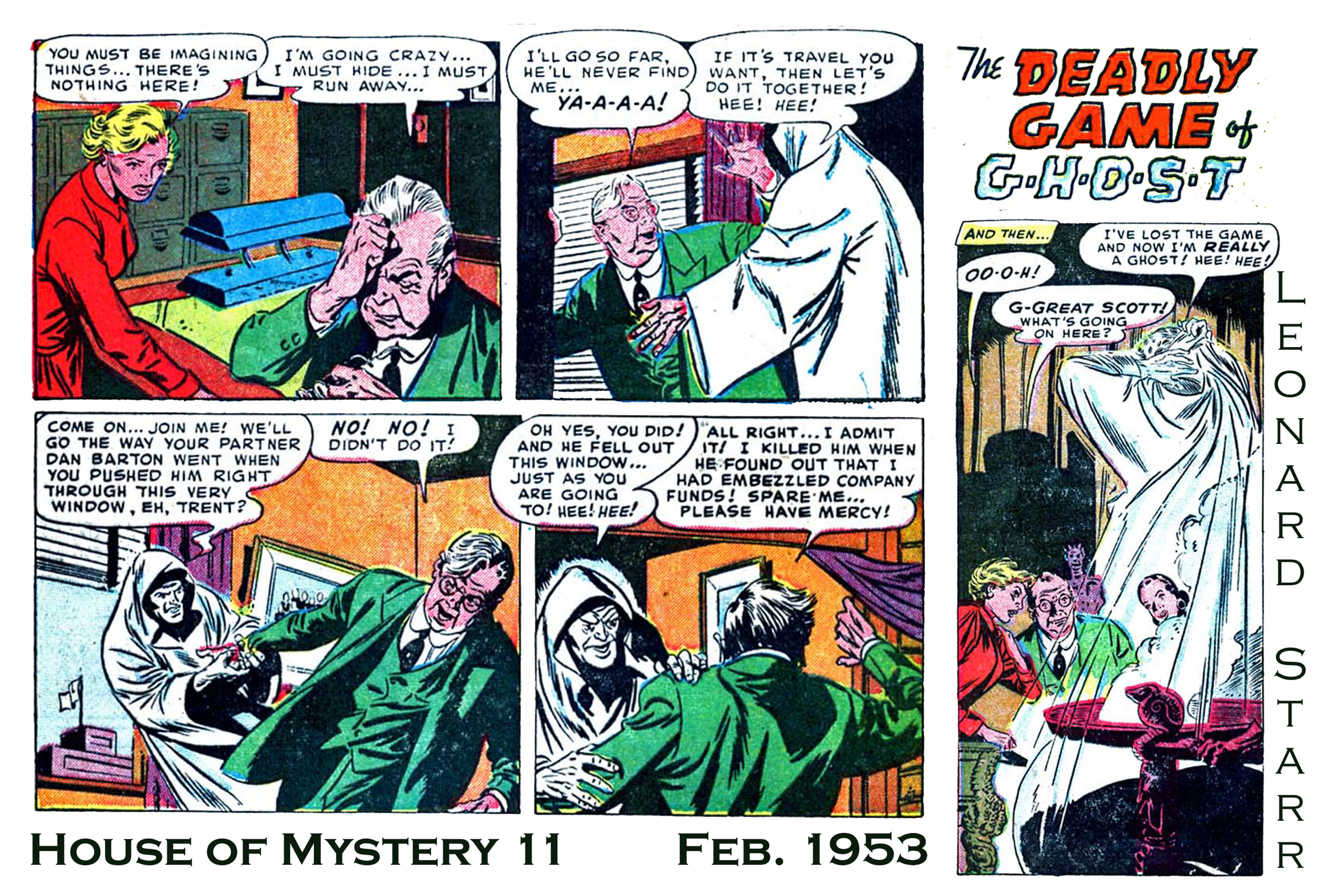
“What about National horror?” wondered Bill Schelly in American Comic Book Chronicles. “There was actually none. Editor Jack Schiff’s House of Mystery 1 (Dec.-Jan. 1951) was National’s first such title in the ‘mystery’ genre, the closest the firm came to a horror comic book. The company that published Superman didn’t want to taint its cash cow by associating with anything approaching Grand Guignol, and National wasn’t temperamentally suited to produce that kind of material, anyway. 

“In House of Mystery, everything supernatural is a hoax or has a scientific explanation.”

And so it was here in the Leonard Starr story The Deadly Game of G-H-O-S-T (House of Mystery 11, Feb. 1953). The “ghost” turns out of be part of an extremely elaborate, highly unlikely but nevertheless ultimately successful scheme to expose a murderer. 

Scooby-Doo would have seen through that hoax at once.


Sunday, June 6, 1982

June 1942: Batman with a Bow

I wonder if Batman ever thought of installing a people-catapult in the Batmobile?

Borrowing an idea from the Green Arrow would only have been fair, since the Emerald Archer lifted so many from him.

“Except for the archery motif, the ‘Green Arrow and Speedy’ series sounds like a direct swipe of Batman and Robin,” noted comics historian Don Markstein.

The Green Archer — a 1923 Edgar Wallace novel that became a movie serial in 1925 and again in 1940 — was also an obvious influence. 

“In that Columbia Pictures chapter play, the title character ‘mysteriously appears with his deadly bows and arrows whenever needed,’” noted author Ron Goulart.

“Green Arrow was created, if that’s not too strong a word, by Mort Weisinger, editor of DC’s More Fun Comics, who introduced the crime-fighting archer in the 73rd issue of that title (Nov. 1941) — the same one that first featured Aquaman. George Papp illustrated that initial outing, and remained the character’s principal artist for many years,” Markstein said.

“Green Arrow was never as strong a character as the one he was modeled after. Whereas Batman appears intensely motivated — driven, even — Oliver Queen, the man who masqueraded as Green Arrow (Roy Harper, his ward, was Speedy), seemed merely to dabble in crimefighting. Still, Green Arrow was a modest success. Six months after his introduction, he ousted Dr. Fate from the cover of More Fun, and held it, with a few exceptions, until 1946, when he lost that spot to a humorous pair of identical twin detectives, Henry Boltinoff's Dover & Clover.”

Instead of a Batmobile, this then-brown-haired Green Arrow got about in an “Arrowplane” (which, despite the name, functioned as a car).

“Although Weisinger was on record as having said he ‘wasn’t remotely influenced by Batman’ when thinking up the Green Arrow and his boy sidekick Speedy, the feature itself actually looked and sounded like Batman and Robin in Robin Hood costumes, right down to the archery team’s car,” Goulart wrote.

Friday, June 6, 1980

June 1940: A Tale of Two Futures

He was the other Captain Future.

The first, created by Better Publications editor Mort Weisinger and written by Edmond Hamilton, was a science fiction hero who appeared in his own pulp magazine from 1940 to 1951. 

The interplanetary exploits of that Captain Future, Curtis Newton, were initially set in the far future of 1990. The red-headed adventurer shared them with the intelligent robot Grag, the android shape-shifter Otho and the living brain Simon Wright, who cared for Newton after his parents’ death and raised him to fight for justice.

The second Captain Future appeared several months later in the same publisher’s comic book division, Nedor, but shared only a name with the first. 

In fact, the distance between the two provides a thumbnail sketch of the differences between the superhero conventions that were typical in pulp and comics at the time. 

The pulp Captain Future was a smart, athletic adventurer who had high-tech vehicles and capable aides, like Doc Savage and the Shadow. The comic book Captain Future was a Superman clone, Nedor’s stock in trade.

While some comic book companies like MLJ tended to offer Batman-like heroes who were costumed bruisers without powers, Nedor’s heroes routinely ran to Superman types — super-strong guys who could shrug off bullets and also fly, usually. The Black Terror, Doc Strange, the Fighting Yank, the American Eagle and Captain Future all fell into that category.

By “crossing the infrared band with the gamma ray,” research engineer Dr. Andrew Bryant accidentally gave himself an array of electromagnetic powers, including sufficient super strength to pick up and throw a criminal’s car (now where have I seen that before?). 

His “radio mind” can hear broadcasts, distant sounds and even the “thought flashes” of others. Flying at a speed of 500 miles per hour, he can repel bullets with an invisible magnetic field.

Drawn by Kin Platt, the character debuted in Starling Comics 1 (June 1940) after Weisinger suggested the publisher recycle the name.