June 1938: A Superman for the Underdog

On the newsstands in May 1938, browsers had their choice of Tarzan in Comics on Parade, Popeye in King Comics, daredevil aviator Captai...

Showing posts with label Monsters. Show all posts

Tuesday, March 3, 2009

March 1969: Dark Shadows in Four Colors


Dark Shadows
was neither fish nor fowl, though it might arguably have been bat. 

Neither a traditional soap opera nor a prime-time broadcast fantasy program, the show had a quirky freshness that attracted the ardor of America’s children.

That success seemed accidental. Beginning on June 27, 1966, on ABC, Dark Shadows was at first just a gothic story of the type consumed in paperback form by the housewives who still made up most of the audience for daytime soaps. 

The brainchild of producer Dan Curtis and a descendent of the Jane Eyre/Turn of the Screw school of literature, the show featured a mysterious Maine mansion and a vaguely imperiled governess named Victoria Winters. 

Curtis purportedly came up with the idea for the show in a dream about an enigmatic young woman on a train. But it wasn’t until 200 episodes into its run that kids began to race home from school to catch the show, which aired at 3 p.m. central time. That’s when vampire Barnabas Collins (Jonathan Frid) arrived to kick the show’s outré elements into high gear. 

The Universal monsters of the 1940s were popular with children through late show airings and the Famous Monsters of Filmland magazine, and the show capitalized on that, offering not only a vampire but witches, werewolves, ghosts, zombies, time travel and parallel universes.

The show had various reincarnations in other media, including a contemporaneous Gold Key comic book series illustrated by long-time Martian Manhunter artist Joe Certa. Frankly, the soap, with its cheap production values and windy plots, was never quite as good as we wanted it to be. The comic book, freed from the show’s protracted story lines, was better, and in fact outlasted the TV show by five years, running through 1976.

The semi-sympathetic portrayal of Barnabas marked something of a milestone in popular culture, pointing the way toward all the subsequent stories that would present vampires not as mere monsters but primarily as tragic victims.
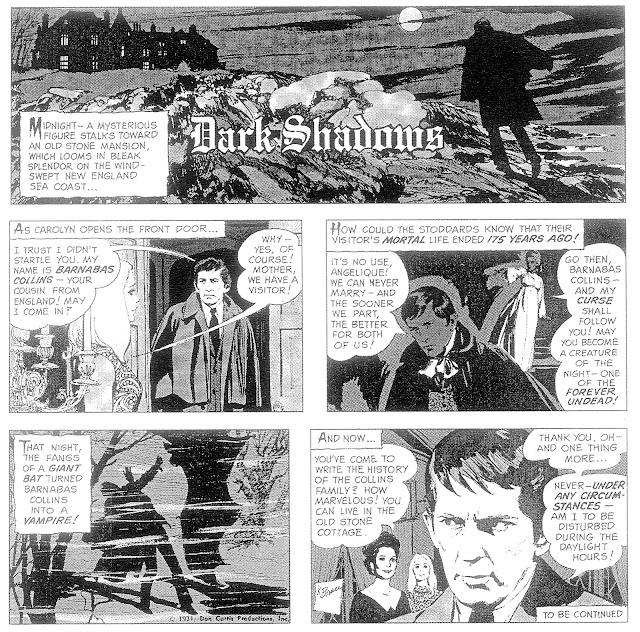

Dark Shadows became a newspaper comic strip as well as a comic book.


Saturday, May 5, 2007

May 1967: The Thing that Kept Coming Back

I loved this particular story, and I wasn’t alone.

The tale’s popularity was demonstrated by the number of times it was reprinted — in Superman Annual 2 (Winter 1960), in Superman 196 (May 1967) and in The Best of DC 42 (Nov. 1983), among other places.

In The Thing from 40,000 A.D.!, first published in Superman 87 (Feb. 1954), a shape-shifting blob monster from Earth’s bleak far future invades Metropolis, generally wreaking havoc and finally duplicating even Superman, complete with super powers. 

Writer Bill Woolfolk and artist Wayne Boring gave us a super-battle that remained a thunderous standoff until the Man of Tomorrow maneuvered the Thing to a nuclear test site. In 1938, Superman could be knocked for a loop by a “bursting shell,” but by the 1950s he could shrug off H-bomb blasts. 

The Thing, however, could not.

Science fiction menaces had begun challenging Superman with more frequency during that era — among them The Three Supermen from Krypton in Superman 65 (July-Aug. 1950), It from Action Comics 162 (Nov. 1951), The Machines of Crime from Action Comics 167 (April 1952), the dragon-like Beast from Krypton in Superman 78 (Sept-Oct. 1952), the Return of Planet Krypton in Action Comics 182 (July 1953), the asteroid Menace from the Stars in World’s Finest 65 (Jan.-Feb. 1954, a story also featured on TV as Panic in the Sky).

I suspect it was Hollywood that put the science fiction back into Superman’s stories. Once relegated to movie serials for kids, the genre had reemerged in popular, critically acclaimed films like The Day the Earth Stood Still (1951) and The War of the Worlds (1953). 

Superman’s Thing, specifically, owed a lot to the 1951 Howard Hawks film The Thing from Another World. The menace there was an extraterrestrial vegetable monster played by James Arness, but in the 1938 story on which the film was based, John W. Campbell’s Who Goes There?, the Thing is an alien shape-shifter from 20 million years ago.

Tuesday, April 4, 2000

April 1960: Wolf Man Jimmy

Superman’s pal may have been mystified about how he became a Wolf Man (Jimmy Olsen 44, April 1960), but I knew why.

Beginning in 1957, a package of Universal monster movies from the 1930s and 1940s was sold to television. By the end of the year, the films could be seen on 78 TV stations across the country, and by the next year, they had their own magazine — Famous Monsters of Filmland

So the tragic old menaces became familiar to a new young audience, who found themselves also loving what their parents had loved.

What puzzles me, though, is how DC Comics got this past the Comics Code, which explicitly stated that “Scenes dealing with, or instruments associated with, walking dead, torture, vampires and vampirism, ghouls, cannibalism and werewolfism are prohibited.”

“This is one of the most gripping of (writer Otto) Binder’s transformation stories,” observed comics historian Michael E. Grost. “This story recalls Binder’s earlier The Witch of Metropolis (Lois Lane 1, March-April 1958). In both stories, the protagonist undergoes a frightening transformation into a sinister mythological creature. In both stories, the transformation happens only at night, with the hero or heroine reverting to their normal selves during the day.

“There is something about becoming a wolf-man that echoes the real changes boys go through when they grow up and become men,” Grost noted. “When a boy grows up, he becomes large, hairy and awkward — and his fate now depends on being romantically involved — all elements of Jimmy's Wolf-Man experience. So most male readers can immediately identify with Jimmy’s transformation. It evokes all sorts of powerful and even frightening real-life emotions.”

The emphasis here though, as in so many Superman stories under editor Mort Weisinger, is really on loneliness and abandonment rather than fright. Jimmy is explicitly required to find ways to “fit in” in this story.

Sales must have been satisfactory, because Wolf Man Jimmy returned a year later in Jimmy Olsen 52 (April 1961).

Wednesday, July 7, 1999

July 1959: It Came from the Drive-In Movie

In Blackhawk 138 (July 1959), the elite paramilitary team fought a “seething, unrecognizable mass.” But readers could recognize it.

It was the latest incarnation of the surprise hit film that had premiered on Sept. 12, 1958, earning $4 million on a $110,000 budget. The Blob featured the screen debut of Steve McQueen as a teenager fighting an amorphous extraterrestrial monster.

“Strong performances and ingenious special effects help The Blob transcend the schlock sci-fi and youth delinquency genres from which it originates,” notes the Criterion Collection.

“The picture is infamous for its theme song, written by none other than Burt Bacharach,” noted comics historian Jeff Rovin. 

With Sputnik fresh in the public mind, the film tapped into a whimsical attitude toward space monsters prevailing at the time. Sheb Wooley’s novelty song The Purple People Eater had topped the Billboard charts during the summer of 1958.

In The Menace of the Blob, the Blackhawks’ jet engine test accidentally cracks a “weak spot in the fourth dimension,” freeing their own version of the Blob. The roiling black cloud radiates intense cold, heat and lightning, and even generates a tsunami before the Blackhawks hit it with various stimuli from four ways at once, vaporizing it.

Elsewhere in that issue, the Blackhawks encounter The Saturnian Blackhawks, an extraterrestrial team of alleged admirers calling themselves the Black Ravens, and an Invasion of the Rock Creatures in South America.

Blob-inspired beasts weren’t confined to DC Comics. Over at Marvel, Tales of Suspense 11 (Sept. 1960) offered a monstrous amoeba in I Created ... Sporr! The Thing That Could Not Die! Despite its advance billing, it did, in fact, die.