June 1938: A Superman for the Underdog

On the newsstands in May 1938, browsers had their choice of Tarzan in Comics on Parade, Popeye in King Comics, daredevil aviator Captai...

Showing posts with label 1950s. Show all posts

Saturday, May 5, 2007

May 1967: The Thing that Kept Coming Back

I loved this particular story, and I wasn’t alone.

The tale’s popularity was demonstrated by the number of times it was reprinted — in Superman Annual 2 (Winter 1960), in Superman 196 (May 1967) and in The Best of DC 42 (Nov. 1983), among other places.

In The Thing from 40,000 A.D.!, first published in Superman 87 (Feb. 1954), a shape-shifting blob monster from Earth’s bleak far future invades Metropolis, generally wreaking havoc and finally duplicating even Superman, complete with super powers. 

Writer Bill Woolfolk and artist Wayne Boring gave us a super-battle that remained a thunderous standoff until the Man of Tomorrow maneuvered the Thing to a nuclear test site. In 1938, Superman could be knocked for a loop by a “bursting shell,” but by the 1950s he could shrug off H-bomb blasts. 

The Thing, however, could not.

Science fiction menaces had begun challenging Superman with more frequency during that era — among them The Three Supermen from Krypton in Superman 65 (July-Aug. 1950), It from Action Comics 162 (Nov. 1951), The Machines of Crime from Action Comics 167 (April 1952), the dragon-like Beast from Krypton in Superman 78 (Sept-Oct. 1952), the Return of Planet Krypton in Action Comics 182 (July 1953), the asteroid Menace from the Stars in World’s Finest 65 (Jan.-Feb. 1954, a story also featured on TV as Panic in the Sky).

I suspect it was Hollywood that put the science fiction back into Superman’s stories. Once relegated to movie serials for kids, the genre had reemerged in popular, critically acclaimed films like The Day the Earth Stood Still (1951) and The War of the Worlds (1953). 

Superman’s Thing, specifically, owed a lot to the 1951 Howard Hawks film The Thing from Another World. The menace there was an extraterrestrial vegetable monster played by James Arness, but in the 1938 story on which the film was based, John W. Campbell’s Who Goes There?, the Thing is an alien shape-shifter from 20 million years ago.

Monday, August 8, 2005

August 1965: Astral Avenger and Blonde Bombshell


In 1965, Murphy Anderson’s resplendent renderings turned a pair of pairs into a winning hand.

Although the team-ups of Hourman and Dr. Fate in Showcase and of Starman and Black Canary in The Brave and the Bold failed to develop into superhero revival series at the time, they remain highly prized by collectors decades later.

The North Carolina-born Anderson’s smooth, fine-lined work evolved because he’d been influenced by “…many of the slickest artists in the field, including Will Eisner, Lou Fine and Alex Raymond,” observed comics historian Jerry Bails.

In The Brave and the Bold 61 (Aug. 1965), Anderson and writer Gardner Fox gave us Mastermind of Menaces!, a tale in which Starman and Black Canary teamed up to tackle the Astral Avenger’s unforgettable fog-foe, the Mist (who’d first appeared in The Menace of the Invisible Raiders in Adventure Comics 67, Oct. 1941).


The two members of the newly reactivated Justice Society of America had seen some changes since the team’s last adventure in All-Star Comics 57 (Feb.-March 1951). 

Florist Dinah Drake, who began her costumed career as a sort of Robin Hood-like outlaw, had finally settled down and married her boyfriend, private detective Larry Lance.

And somewhere along the way, astronomer Ted Knight upgraded his original “gravity rod” into a more potent “cosmic rod,” underlining the character’s similarity to Green Lantern.

“He first put this new instrument to use against the Crime Syndicate of America of Earth-Three, when he returned to action with his fellow-JSAers Hawkman, Dr. Fate, Dr. Mid-Nite and Black Canary,” noted a two-page text feature in Brave and the Bold 61. “This was the first time he had worked with the Blonde Bombshell, for he had retired before she began her crime-fighting career.”

Later, via retroactive continuity, the pair’s comradely relationship would be recast as an adulterous affair. 

Because the audience for superhero comics had shifted from largely children to largely adults over the intervening decades, that plot twist was fairly predictable.


Friday, August 8, 2003

August 1963: Reflection of a Bat


“I leaned over the sink, closer to my reflection, and stare at myself hard,” wrote Nina LaCour. “I don't know what I see. I don’t even know what I want to see.”

We tend to associate mirrors with the mysteries of human identity, and Batman’s archenemy Mirror-Man exemplified that theme.

Mirror-Man — Floyd Ventris — became pretty well convinced that he’d penetrated the secret of Batman’s identity, and came close, more than once, to proving that the Masked Manhunter was Bruce Wayne.

Apparently as omen-prone as Wayne, Ventris was able to escape from prison using the fragment of a broken mirror to dazzle a guard. 

“I broke a mirror, and it brought me luck!” he thinks. “I’ll do a lot of research on mirrors — because from now on I’m going to use them for crime!” (The Mysterious Mirror-Man, Detective 213, Nov. 1954).

Using a “two-way electronic mirror” to see through Batman’s cowl, the mirror-spectacled criminal only gets ridiculed by his gang when he announces his discovery. 

Batman has defeated him with preemptive PR, having written a newspaper article as Bruce Wayne about ridiculous past occasions when people claimed he was Batman.

Mirror Man’s return in Batman 157 (Aug. 1963) began with a storytelling flourish from writer Bill Finger. Four of the characters — Batman, Batwoman, Vicki Vale and Ventris — were shown considering their images in reflective surfaces.

Mirror-Man’s mirror-themed crimes include the use of reflective billboards and a U.S. Army “solar mirror” and the theft of a giant telescopic mirror intended for installation at the Mt. Malador Observatory. 

Twice, Ventris trapped Batman and Robin in mirrored rooms.

Mirror-Man’s impact was undoubtedly diluted by the fact that he was “reflected” in a contemporaneous Flash super villain.  The Mirror Master, who also employed esoteric mirror tricks, debuted in Flash Comics 105 (Feb.-March 1959).

The first line of Wikipedia’s entry on Mirror Man is, of course: “Not to be confused with Mirror Master.”

Friday, June 6, 2003

Summer 1963: The Fastest Men Alive

As wish fulfillment, speed rated high with kids.
Speed, fueled by their boundless energy, was after all the one area where children could outdistance the somewhat worn-out adults who talked down to them, punished them and generally looked after them.
But just imagine what you might do with some real speed…
Created by writer Gardner Fox and artist Harry Lampert, the Flash was among the first of the shtick superheroes.
In just two years, Superman, Captain Marvel and their various copycats had already covered the ground of the all-purpose superhero who wielded an array of powers. By 1940, to get ahead, a super being had to have a gimmick. So the Human Torch burned and the Submariner swam, Hawkman could fly, Doll Man could shrink, Wonder Woman could be female and the Flash could run really, really fast.
College student Jay Garrick was one of only three characters I can name who became a superhero by smoking, by the way.
In a chemistry lab, while breaking football training with a cigarette, Jay accidentally knocked over some beakers and further polluted his lungs by breathing in fumes that turned him into the Flash.
The Flash could run up the sides of buildings and across water. He could catch bullets, create multiple images of himself, become invisible and — eventually — even vibrate through walls. His one power turned out to make him nearly as omnipotent as Superman’s many.
For me, the early adventures of this seminal superhero are difficult because of the underdeveloped, cartoony art.
But by All-Flash 31 (Oct.-Nov. 1947), an artist named Carmine Infantino had arrived to make the Scarlet Speedster’s adventures a pure pleasure. Infantino would carry the character, in his second and even more successful incarnation of Barry Allen, through the 1950s and 1960s.
By 1963, the new Flash was popular enough to have earned his own giant annual, which included an adventure of the original Flash and this feature page spotlighting famous Flash covers.

Wednesday, January 1, 2003

January 1963: Seven Times Superman

In the Kennedy era, having been popularized on TV, radio, movie serials and cartoons and a newspaper comic strip, Superman was featured in seven comic book titles — or eight if you count The Justice League of America, where he was initially downplayed (he tended to upset the balance of power there).

But the Man of Tomorrow was central to the titles Action Comics, Superman, Adventure Comics, Superboy, Lois Lane, Jimmy Olsen and World’s Finest. 

Important additions to the Superman mythos might appear in any one of them — the tiny Supermen in Jimmy Olsen, the Phantom Zone in Adventure, Bizarro in Superboy and Luthor’s sister Lena Thorul in Lois Lane.

The Mort Weisinger-edited Silver Age Superman mythos probably reached its zenith when the Superman Emergency Squad was introduced in 1960.

We’d already seen the arrival of Brainiac, whose shrinking ray gave us the Kryptonian bottled city of Kandor, to be stored in another recent innovation, Superman’s arctic Fortress of Solitude (shamelessly lifted from Doc Savage).

Krypto the Superdog had arrived even earlier, and Supergirl more recently. Her own expanding mythos would give us Streaky the Supercat and Comet the Superhorse. Lori Lemaris, Superman’s lost collegiate love, was available if we happened to need telepathic assistance from a mermaid.

Kandor would be the source of further mythic evolution for the Man of Tomorrow. The tiny city would become the urban bottlescape for Superman and Jimmy’s Batman-and-Robin adventures as Nightwing and Flamebird. 

And, in Jimmy Olsen 48 (Oct.-Nov. 1960), it would give us the Superman Emergency Squad, a silly team I loved.

In this Otto Binder story with art by Curt Swan, we met Superman’s tiny flying army from the Kandor.

After shoving their way out of the corked bottled, they swarmed to the rescue dressed in Superman costumes (which would actually make them uniforms, I suppose). 

Initially someone insisted that they should all look like Superman too, which seems a bit fetishistic even for Silver Age comic books.

Thursday, December 12, 2002

December 1962: A Small Problem for the Martian Manhunter

Superheroes shrank from sight in the early 1950s, and then in the late 1950s the remaining ones shrank literally.

Turning superheroes tiny is, after all, a good way to offset the advantages of their super powers for dramatic purposes, one that offers strong visuals. And the readers were then mostly small people who could presumably identify.

I’m guessing that several of these stories were inspired by Richard Matheson’s 1956 novel The Shrinking Man, which had been adapted into the film The Incredible Shrinking Man and released in February of 1957.

Superman and Superboy shrank a few times even before the process became routine with the arrival of the Bottled City of Kandor in the Fortress of Solitude.

Batman and Robin had early experience with this strange turn of events, having been miniaturized in both Detective Comics 127 (Sept. 1947, an illusion) and Detective Comics 148 (June 1949, for real). But then a dramatic size differential was virtually baked into the feature by Bill Finger, who frequently introduced giant props of everyday items that played a role in the Dynamic Duo’s crimefighting activity.

Wonder Woman tackled giants many times during the period.

Archie Comics’ new superhero the Jaguar slugged it out with fearsome-looking microbes in The Battle of the Bacteria Brutes! (Adventures of the Jaguar 2, Oct. 1961). And Archie’s Fly and Fly Girl traveled to a planet where germs were gigantic, so that amounted to the same thing. 

Even Harvey Comics’ Casper took a shrinking pill in Casper the Friendly Ghost 61 (Oct. 1957). And Tom Terrific’s pal, Manfred the alleged “Wonder Dog,” shrank in the wash in Tom Terrific 2 (Fall 1957). 

Then the Martian Manhunter was miniaturized in Detective Comics 310 (Dec. 1962). Criminal inventor Victor Vance shrank J’onn J’onzz to doll size, and the Martian had to fight off a hostile squirrel before he could get on with the job of saving the day.

Thursday, June 6, 2002

June 1962: King Kong vs. Batman

Batman has a history of tackling challenges outside his weight class that long predates the Batman vs. Superman movie.
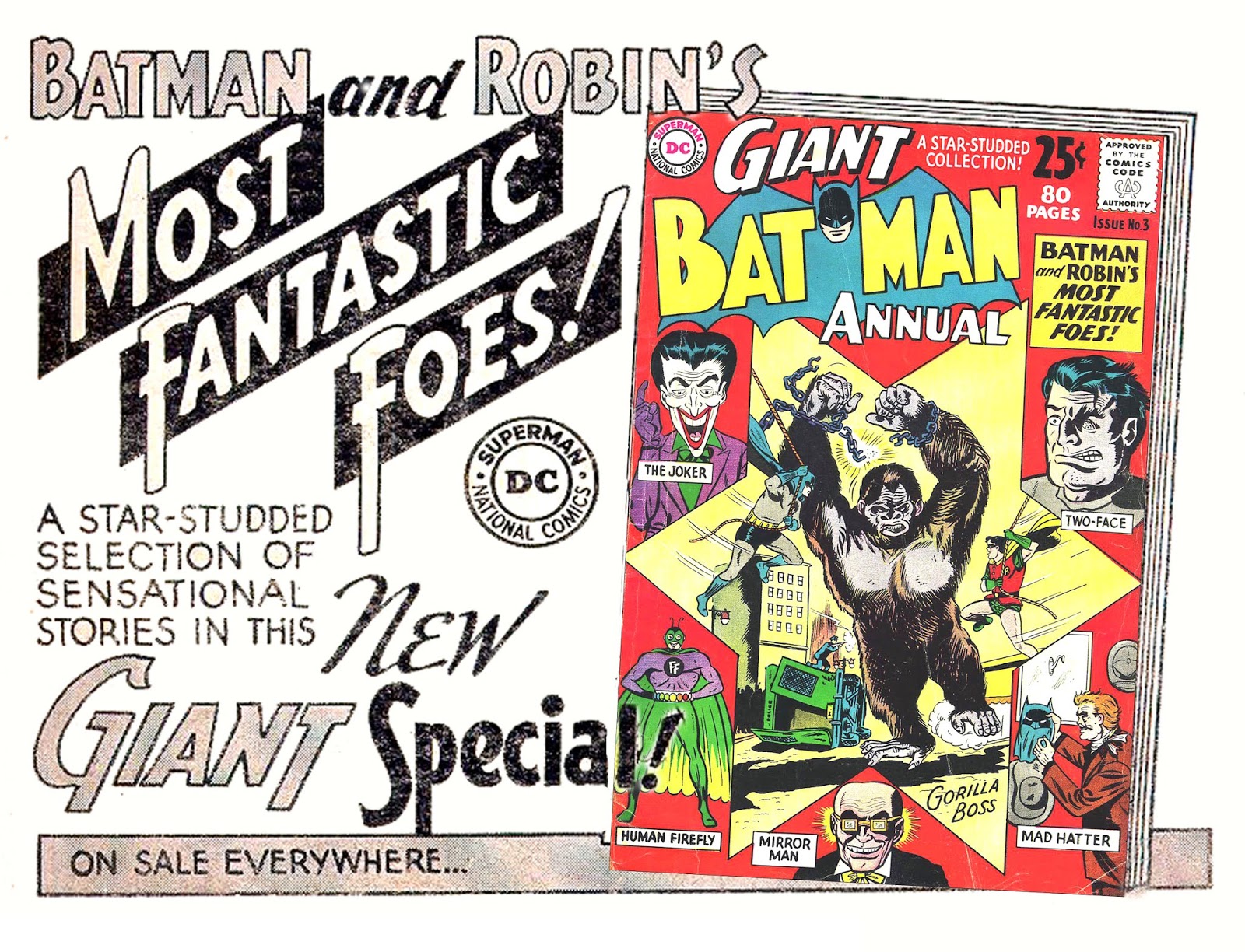
For example, how about King Kong vs. Batman? What kid could resist that? Few, as it turns out, either in 1953’s Batman Comics 75 (The Gorilla Boss of Gotham City) or in 1962’s third Batman Annual, where the story was reprinted (and slightly censored to accommodate the Silver Age Comics Code).
Why was the Masked Manhunter fated to fight a giant ape in 1953? I’m going to suggest it was because in 1952, RKO had re-released their 1933 hit film King Kong. Advertised on TV, the movie became a tremendous smash again, generating more box office receipts than the original 1933 release had. Cinema owners named it Picture of the Year.
Okay, but exactly how do you pit an acrobatic detective against a titanic simian, story-wise? By putting a human criminal’s brain into the ape.
Executed for murder, George Dyke has his brain transplanted into a giant ape’s body, then goes on a rampage of larceny with his super strength, intending to lure Batman out and steal his body in turn.
Seems a villain more suitable to Superman, but it would be years before the Man of Tomorrow tackled his own giant ape foe, Titano, in 1959’s Superman Comics 127.
By that time, Batman would be up to his cowled neck in giant monsters and bizarre aliens.
Of course, that’s only in the comic books. In 1942, Superman captured a giant gorilla in the Paramount movie cartoon Terror on the Midway, the ninth in the Fleischer Studios series.


Sunday, November 11, 2001

November 1961: Uncanny Underwater

When this underwater uncanny team debuted in Showcase 27 (July-August 1960), Lloyd Bridges was already starring as former United States Navy frogman Mike Nelson in the popular syndicated series Sea Hunt, and CBS was about to give the idea a try with the program The Aquanauts.
The Sea Devils were “…conventional adventurers — no secret identities, no super powers, no gaudy costumes, just ordinary human beings,” noted comics historian Don Markstein. “And they were the last such conventional adventurers to achieve any degree of success at DC until Captain Storm (1964).”
“This issue was written by Robert Kanigher (Viking Prince, Rex the Wonder Dog) and drawn by Russ Heath (Marvel Boy, Haunted Tank), and starred a team of four scuba divers.”
Comics historian Joe Brancatelli noted that the New York City-born Heath’s work on “…Arizona Kid and Kid Colt Outlaw stands as some of the finest western work ever done in comic books. It was amazingly realistic and Heath’s ability to draw the ‘nuts and bolts’ aspects of costumes, scenery and weapons was unsurpassed… His storytelling style was straightforward and direct, never stooping to gimmicks or frills.”
The realism of Heath’s illustrations helped sell the feature’s more fantastic elements when the Sea Devils were pitted against sea gods, sea serpents, undersea gorillas and giant octopus men.
“The theme was somewhat reminiscent of Frogmen (no relation), which had appeared in one Showcase issue four years earlier before sinking without a trace, but these were new characters,” Markstein noted. “They were Dane Dorrance (handsome, brainy, designed to look like a leader), Biff Bailey (big n’ strong, street-smart, ruggedly good looking), Judy Walton (Dane’s love interest) and Nicky Walton (Judy’s younger brother).”
The most basic formulation of the uncanny team was Leader Guy, Strong Guy, Boy and Girl. The formula worked for Sea Devils, and — combined with super heroics by Stan Lee and Jack Kirby — spectacularly well for the team of four explorers that kick-started the Marvel Age of Comics. 

Saturday, November 11, 2000

November 1960: That Thing You Doom

As thrilled as I was by Superman’s first annual in 1960, I was even more excited to see this “All-Menace” issue — finally, foes worthy of Superman’s stature and some real super-powered action!
For the bargain of a mere quarter, you got Metallo, the Invulnerable Enemy, Titano the Super-Ape, Bizarro, Brainiac and my favorite, the Thing from 40,000 A.D.
Oddly, despite his science fictional origins, Superman went for a long stretch of his early career having few science fictional adventures. Mundane criminals and crusades against social injustice and political corruption occupied much of his day.
By the time Superman 87 arrived in February 1954, things had started to change.

Tuesday, August 8, 2000

August 1960: The Devil You Say

“Hot Stuff was the third, last, and least famous of a series of Harvey Comics characters designed as cute versions of beings traditionally regarded as horrors,” noted comics historian Don Markstein.
The least famous, perhaps, but the most entertaining, I thought — certainly more fun than those rather dreary goody two-shoes Casper the Friendly Ghost and Wendy the Good Little Witch.
Like Casper’s cousin Spooky the Tuff Little Ghost, Hot Stuff was a hobgoblin whose cuteness was spiced up by devilment.
Hot Stuff the Little Devil 1, where the li’l imp made his debut, was dated October 1957,” Markstein noted. “His creation is officially attributed to Alfred Harvey, one of the owners of Harvey Comics, though much of the early tone of the series was set by cartoonists Howard Post, who did a majority of the stories, and Warren Kremer, who drew most of the covers. The comic’s long-running back-up feature, Kremer’s Stumbo the Giant, made its first appearance in #2. Hot Stuff was spun off into a second title, Hot Stuff Sizzlers, in 1960; a third, Devil Kids Starring Hot Stuff, in 1962; and even, briefly, a fourth, Hot Stuff Creepy Caves, in 1974.”
“Certainly the success of Casper — another fanciful creature based on the otherwise unsavory underworld of the dead — was an influence on the Harvey staff,” noted comics historian Jerry Beck. “One year before Hot Stuff’s debut, Famous Studios released a Casper animated short, Fright From Wrong (1956, written by Larz Bourne), in which the Ghostly Trio force the Friendly Ghost into downing some ‘mean pills.’ This turns Casper into his polar opposite, a raging red devil aching to wreak revenge. To this day, it’s the closest thing to a Hot Stuff animated cartoon.”
Given their corporate taste for supernatural cuteness, I always kind of wondered why Harvey Comics never licensed Mary Chase’s famed pooka for a comic. A six-foot-tall invisible rabbit would have seemed a natural fit.
He was, after all, named “Harvey.”


August 1960: A Whiff of Tear Gas No 5

In August 1960, Batman’s exploits included yet another alien jaunt in Batman's Interplanetary Rival! (Detective Comics 282).
Over in his own title, the Masked Manhunter embarked on The Voyage of the S.S. Batman, thwarted the Crimes of the Kite-Man and watched as the secondary characters Bat-Mite and Batwoman took center stage in Batwoman's Publicity Agent! (Batman 133).
Some have suggested that Batwoman and the first Bat-Girl were introduced to mute McCarthy-era allegations that Batman and Robin were a homosexual wish fulfillment fantasy.
If so, then the 21st century reintroduction of Batwoman as a lesbian brought the whole situation full circle, ironically.
Batwoman, Bat-Girl, Ace the Bat-Hound, Bat-Mite and various other batty ideas were discarded with Batman’s streamlined “New Look” in 1964, purportedly in the interests of “realism.” But a mere three years later, the Batwoman concept was revisited and revamped for another visual medium, providing a boost for the Batman TV show.
In comics and on the show, Commissioner Gordon’s daughter Barbara became the mysterious Batgirl (no hyphen). She’s by far the best known of the surprisingly numerous Bat-females (a group that also includes Catwoman, the Huntress and yet another Batgirl, Cassandra Cain).
The original Batwoman was Kathy Kane, a wealthy former circus daredevil with a yen for adventure. Swinging from a trapeze, she muses, “I wish I could be like Batman, the greatest acrobat of all! He uses his skill, not for shows, but against crime!”
Donning a yellow-and-red costume and riding a Bat-cycle, she was an effective crime-fighter, although her tactics were weirdly “girly.” She captured crooks with feminine gadgets from her “utility purse” — expanding hairnets, charm bracelet handcuffs, “Tear Gas No. 5,” etc.
Given the tenor of the times, Batman, Robin and Superman were, of course, perpetually condescending to her.
“This is no place for a girl,” Batman told her in her debut adventure. “Please let me handle it!”
“No, I’ll stay, Batman,” she replied saucily. “I might have to save YOU again!”

Saturday, January 1, 2000

January 1960: Trading Capes for Coonskin Caps

Tomahawk was a Revolutionary War-era pioneer woodsman created in 1947, just as superheroes were fading.
The character anticipated and undoubtedly got a boost from the Davy Crockett craze of 1954-55, kicked off by Disney’s version of Crockett’s life. The Ballad of Davy Crockett was probably the most-sung song of 1955, recorded by Bill Hayes, Fess Parker, Tennessee Ernie Ford, Steve Allen, Burl Ives and Fred Waring.
Graduating from a back-up feature to his own title in 1950, DC’s Tomahawk was a cross between Davy Crockett and Batman.
With his boy sidekick, Dan Hunter, he fought British troops, tyrannosauruses rex, a frontier Frankenstein monster, aliens, Indians  and alien Indians (don’t ask). Like Batman, he occasionally gained super powers and encountered a female masked champion of justice — Miss Liberty.
“Toward the latter part of the ‘50s, practically all DC comics ran aliens, monsters and other goofy sci-fi stuff on the covers, no matter how badly it clashed with the title's subject matter — even war comics often sported dinosaurs in that position,” observed comics historian Don Markstein. “And so, all through the late 1950s and early to mid ‘60s, Tomahawk fought gigantic tree men, miraculously surviving dinosaurs, mutated salamanders and other menaces that seem somehow to have escaped the history books. There was even a giant gorilla among them, and putting a gorilla on the cover was also a contemporary trend at DC.”
“The character was created by writer Joe Samachson (who also scripted the first J’onn J’onzz, Manhunter from Mars story) and artist Edmond Good (whose work also appeared at Quality and Fox) — but the man most closely associated with his development was Fred Ray, a cartoonist who was also a Revolutionary War buff,” Markstein noted.
“Tomahawk got his name from the fact that he was raised by Indians, thus absorbing their lore — a definite asset in the forest-based guerilla warfare he carried on against the British — combined with the fact that his name actually was Tom Hawk.”

Sunday, December 12, 1999

December 1959: The Terrific Trio’s Double Trouble

A guy who can double himself would hardly seem to pose much of a challenge to the foremost superhero team of the 1950s — Superman, Batman and Robin.

But because Duplicate Man’s power had a built-in teleportation aspect (and because of Bill Finger’s clever writing), he managed to give the Terrific Trio a run for their money in World’s Finest 106 (December 1959).

Batman artist Dick Sprang was particularly fond of drawing World’s Finest stories because of the outlandish science-fictional high jinks prompted by the presence of Superman. After all, it’s a rare character that offers you the opportunity of showing him mopping up a massive spill of pancake syrup with his hair. 

Whether the stories were silly, somber or both, Sprang’s art made them prized little gems for seven years, from 1955 to 1963.

At one of Gotham City’s innumerable exhibitions featuring giant props, the Dynamic Duo encounters a man in a blue-and-orange costume stealing a valuable telescope. When they try to stop him, they find he’s twins, and that one of his selves can merge into the other.

Finger comes up with interesting uses for the power. For example, when Batman and Duplicate Man fall off a tall building locked in battle, Duplicate Man can vanish to the safety of his other self. And luckily, Batman had Superman looking out for his welfare.

A criminal scientist who steals inventions, the Duplicate Man wisely decides to keep one of his selves in a lead-lined cavern hideout so that the other can always dematerialize while committing crimes. 

But the superheroes manage to capture him anyway by following Batman’s plan and using hypnotism and a phony teleportation device.

When banner headlines proclaim the Duplicate Man’s capture, a man on the street says of Superman, Batman and Robin, “What a trio! No one can ever duplicate them — or their feats!”

And why a “Duplicate Man?” Probably because that same year, Xerox went to market with something called a “photocopier.”

December 1959: How the Blackhawks Evolved

Part of my fascination with comic book house ads is seeing what was inside the titles I did not get to buy, but only caught intriguing glimpses of in advertisements.

For example, what was the Blackhawk team doing fighting a huge theropod dinosaur on the cover of Blackhawk 143 (Dec. 1959), and how would they manage it? They didn’t have superpowers, after all (except every now and then).

The answer to the dilemma in The Time-Monsters involved a steam shovel and a giant spool of telephone cable, as it turned out.

In the issue’s other two stories, we learned that Lady Blackhawk had a rival in Queen Penelope of the island Kingdom of Xenovia, and how Olaf and Hendrickson found themselves in a feud.

“As I got older and I read those older monster and alien issues, I now realize how far Blackhawk had strayed from his original roots,” recalled Paul Zuckerman. “My friend’s brother had collected Blackhawk in the early ’50s and in the mid-’60s. My friend sold me an issue or two for a buck each. What a revelation! The team were true cold war warriors, but it felt so much more organic to the character as freedom fighters. Every issue seemed to have another Eastern European country with a strange name with a threatened Communist takeover, and every issue the Blackhawks would thwart the Reds. DC quickly ejected those storylines from the book when it acquired the strip from Quality.”

Bruce Kanin observed, “I always enjoy reviewing the evolution of DC’s comic books in the ’40s-’60s, especially in that many followed the same path, i.e., solid tales revolving around their time period and nature of the heroes; gradual introduction of fantastic elements like big gorillas, dinosaurs and, er, blobs; aliens arrive; new costumes; Neal Adams arrives (heh); back to gritty, realistic stories before cancellation.

“That applies more or less to Blackhawk, Sea Devils, Challengers Of The Unknown, Doom Patrol and Tomahawk — perhaps others.”


December 1959: Lightning Strikes Twice

Born in an era that valued science, the Flash’s foes tended to embody various scientific fields: temperature, aerodynamics, sonics, gyroscopic effects, the periodic table — and meteorology.
In Flash 110 (Dec. 1959), the Scarlet Speedster faced The Challenge of the Weather Wizard — a John Broome/Carmine Infantino tale that introduced the super-criminal Mark Mardon, whose “electro-vibrator wand” gave him complete control over the atmosphere.
“Broome especially concentrated on origin tales during the period September 1959 to September 1960,” noted comics historian Michael E. Grost. “This was the period in which he built and put into place all the main elements of his Silver Age Green Lantern revival: Green Lantern himself, Carol Ferris, the Guardians of the Universe, and Thomas Kamalku. These Green Lantern tales appeared in Showcase and Green Lantern. During this same period, he was prolifically inventive in adding new characters in The Flash.”
Though an enduring member of the Flash’s rogue’s gallery, the Weather Wizard wasn’t even the most important character introduced in this issue.
In the backup story Meet Kid Flash!, another unlikely accident turned Iris West’s nephew Wally into a pint-sized version of the title’s protagonist.
“The relationship between Flash and Kid Flash is a universal one, one in which an experienced person mentors a younger one,” Grost observed. “This relationship is a positive one, and one that is part of standard human experience. Mentoring is often done by one person teaching another a job or profession. Here both Flashes have the common job of being super-fast super-heroes.”
But unlike the Boy Wonder Robin, Kid Flash would sort out the majority of his adventures without his mentor’s help. In that, he anticipated Spider-Man, a fully independent teenage superhero who would debut two years later.
Whether set in the Flash’s Central City or Kid Flash’s suburban Blue Valley, the stories fairly glowed with the assured, lustrous art of Infantino inked by Murphy Anderson and Joe Giella.
Together, they could somehow make absurdities seem appealingly matter-of-fact.


December 1959: Let’s Give Jimmy a Hand

Jimmy Olsen may not have been the brightest bulb in the Daily Planet building, but he was irrepressible.

For example, most people would be nonplussed by the discovery that they’d suddenly acquired more arms. Even Peter Parker was freaked out by it, and he was no stranger to strange situations. But Jimmy took it all cheerfully.

In Jimmy Olsen 41 (Dec. 1959), the cub reporter absent-mindedly eats a fruit Superman has brought back from space, having confused it with a pear, and grows four extra limbs overnight.

Momentarily panicked, Jimmy quickly becomes impressed by the ease with which he does push-ups and cooks breakfast.

However, his ability to write three news stories simultaneously gets him in trouble with the Newspaper Guild union reps. But I’m not clear how he could do that anyway — he had six arms, not three brains. 

“Curt Swan’s depiction of a union representative at the Daily Planet is interesting — he is wearing a suit and tie and is very smooth and sophisticated-looking,” observed comics historian Michael W. Grost. “Clearly this is intended as a sympathetic portrayal. This is one of the few union leaders I recall seeing anywhere in a Silver Age comic book.”

As Jimmy’s multi-limbed difficulties mount, it turns out Lucy Lane is unenthusiastic about the possibility of someday having six-armed children. By the story’s end, we’re not quite sure whether Jimmy has been hallucinating all this nonsense.

“This is a light-hearted comedy tale,” Grost noted. “Curt Swan does a good job with the art, making the actions of Jimmy's arms seem plausible and natural.”

The cartoonish nature of many of Jimmy’s exploits was nicely balanced by the magazine-illustration realism of Swan’s art. Seeing is believing, and Swan could make you believe almost anything.

Thursday, November 11, 1999

November 1959: The Year of the Catty

DC characters tended to share certain bizarre experiences — accidentally acquiring Superman’s powers, getting trapped in the Phantom Zone, traveling in time and space, pretending to die, pretending to turn evil, turning invisible, developing futuristic brains, becoming elastic, attaining giant size, instantly becoming fat, instantly growing older or younger.

 And, unlikely as it might seem, acquiring the head of a cat.

In Superman’s Girl Friend Lois Lane 13 (Nov. 1959), writer Bill Finger and artist Wayne Boring present us with a mystery for Superman to solve. Why does Lois show up at the Daily Planet for a tearful goodbye to her friends with her head encased in a lead box?

In the vanished reporter’s diary, Superman reads that Lois had confronted a vaudeville sorceress calling herself Circe, only to find that she wasn’t dealing with a fake — that her head had been transformed into a cat’s.

Passing a circus sideshow where people are laughing at freaks, Lois thought, “I can never go back to the normal world I once knew — not with my freakish face. (Sob!) And I could never be Superman’s girl friend again! I knew that though Superman would try not to show it, he’d be repelled by my face!”

Superman discovers that Lois doesn’t have the face of a cat, but only thinks she does — thanks to a drugged lemonade and some hypnosis practiced by the fake Circe.

Despite Lois’s traumatic experience, Superman’s sympathy only extends so far. At dinner that night at a restaurant, he orders Lois a saucer of milk to mock her cat-like curiosity.

The story is a reversal of what happened to Superman 15 months earlier in Action 243’s The Lady and the Lion!, when the real Circe gave the Man of Tomorrow a lion’s head.

It might have seemed to readers that Superman’s writers and editors were spinning in Circe circles.

November 1959: The Destroyer Within

“Are you sure that what you wish is what you want?” asks Cinderella’s mother/tree in Stephen Sondheim’s Into the Woods.
As a science-fictional variation on the Aladdin theme, the Silver Age Green Lantern was wish fulfillment with a vengeance. But wishes can be scary things, something writer John Broome understood and explored in more than one story.
“The first superheroes, of course, are the parents themselves,” observed children’s television host Fred Rogers. “There is a very natural stage in the development of the human personality in which we believe that we ourselves are omnipotent, and that our parents are omnipotent, and that we’re able to do anything. But we have to help children gently along the way to realize that nobody is omnipotent … Because even though children would love to think that they could take on the world and win, it can also be very frightening to they to think that they are omnipotent — and that what they think will, indeed, happen.”
The idea that the unconscious mind could make such powers immensely dangerous was the premise of the film Forbidden Planet, and tripped up Green Lantern more than once. Hal Jordan’s errant wish created a giant monster (The Leap Year Menace, Green Lantern 3) and his dream turned his mechanic pal into a seagull (Wings of Destiny, Green Lantern 7, July-Aug. 1961 ).
And in The Invisible Destroyer (Showcase 23, Nov-Dec. 1959), the Emerald Crusader confronts an elusive caped super villain sprung from the unconscious mind of scientist Dr. Phillips. This energy-projecting tulpa, which feeds on radiation, plans to obliterate Coast City in a nuclear detonation. Luckily for Green Lantern, his wish-fulfilling ring can create anything, including “anti-energy.”
“Green Lantern's powers were unusual in that they could explore the inner workings of the human mind,” observed comics historian Michael E. Grost. “Many stories center on the ring's exteriorizing people's thoughts, giving them bodily shape outside a person's mind.”

Tuesday, November 9, 1999

September 1959: This Lantern Earth


Throughout the 1950s, cinemas and ubiquitous drive-in theaters featured numerous science fiction movies, and it’s safe to say that DC Comics staffers Julius Schwartz, Gil Kane and John Broome saw some of them.

And I’m betting that one of those was This Island Earth, a critically praised 1955 Universal International film that starred Jeff Morrow, Faith Domergue and Rex Reason and was based on the novel by Raymond F. Jones. Prominent elements of the film would be paralleled in DC’s revival of the Green Lantern character in Showcase 22 (Sept.-Oct. 1959).

Nor I am the first to note that. Film buff Heath Holland observed, “As a lifelong comic book fan, I’m struck by the similarities in this story to the comic book title Green Lantern, which follows the adventures of test pilot Hal (versus this movie’s pilot Cal) who commands enormous power with his Green Lantern ring (this movie features a powerful green energy beam) for an alien race (Cal’s adventure leads him beyond Earth’s boundaries).”

Even more pointedly, both science fiction adventures begin with a plane, or something resembling a plane, being seized and transported by a powerful alien force.

A mysterious green glow saves Cal Meacham’s life as his Lockheed jet is about to crash in the 1955 film, and whisks Hal Jordan’s flightless trainer away to meet the dying interstellar patrolman Abin Sur in Showcase 22.

To retool the magically powered Aladdin-like superhero of the 1940s into the streamlined jet-age Emerald Crusader of the 1950s, the creators built science fiction elements into the concept, including a corps of alien police officers commanded by a lofty, dispassionate race of “Guardians”  — an idea borrowed from a 1952 Captain Comet story in Strange Adventures. 

Inspiration for both the Captain Comet and Green Lantern stories can be traced to Edward Elmer “Doc” Smith’s 1930s Lensman series of SF novels, which featured telepathically powered space patrolmen guided by “guardians” in the form of the peace-loving, staggeringly ancient Arisians.