June 1938: A Superman for the Underdog

On the newsstands in May 1938, browsers had their choice of Tarzan in Comics on Parade, Popeye in King Comics, daredevil aviator Captai...

Showing posts with label Justice League. Show all posts

Wednesday, August 8, 2007

August 1967: No More the Boy Wonder

In the 1960s, readers loved the Justice League’s annual “Crisis” team-ups with the Justice Society, but wondered where the 1940s Superman and Batman were.

The parallel Earth was created as a way to revive the distinctly different versions of superheroes that had ceased publication more than a decade before — the Flash, Green Lantern, Hawkman, the Atom — as well as those older crimefighting champions who had no analog in the newer continuity — Hourman, the Sandman, Mr. Terrific, the Spectre, Dr. Fate, Black Canary and so forth.

But Superman, Batman and Wonder Woman had been published continuously, and were in some sense the “same character” all along. That seemed to make them problematic to DC, though in Wonder Woman’s case the problem was simply ignored.

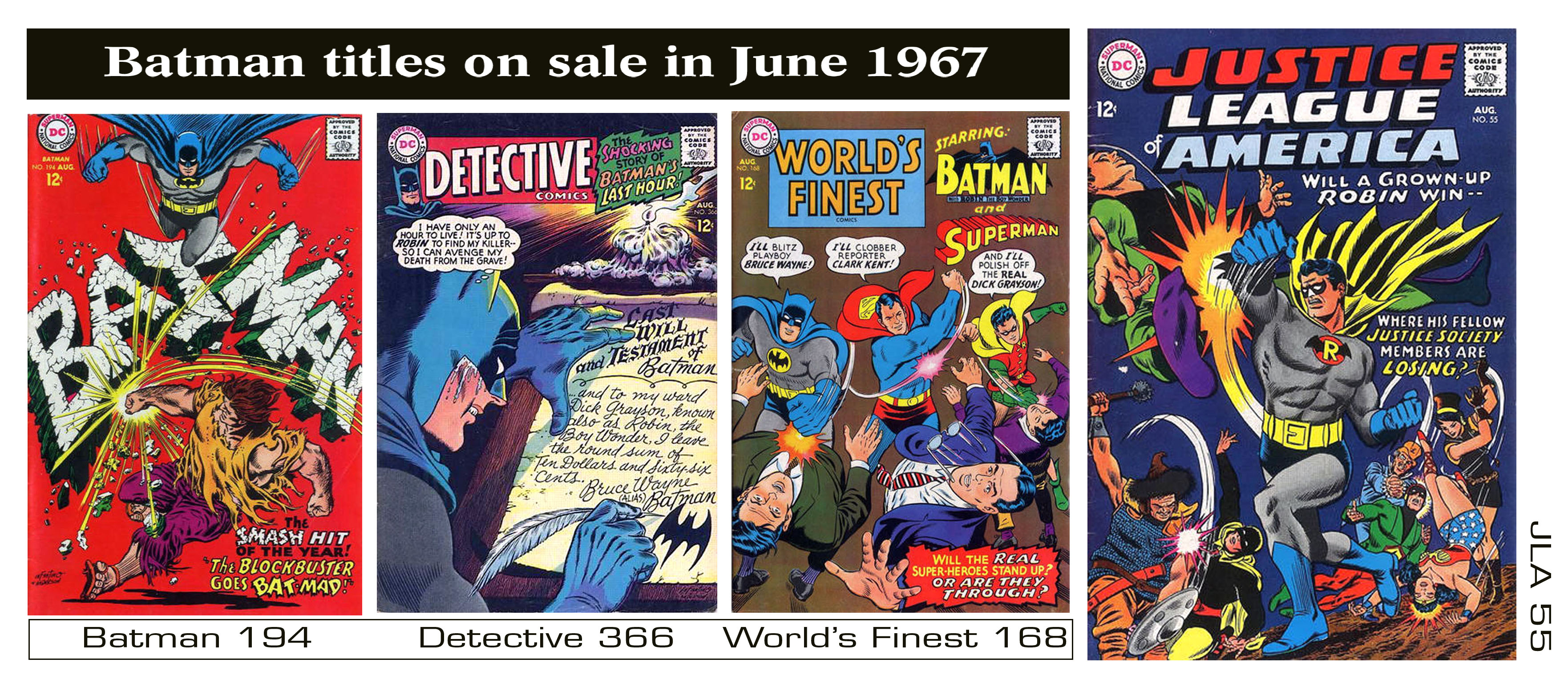
In 1967’s Justice League of America 55-56, though, the adult Earth-Two Robin appeared as the newest JSA member, with Batman “semi-retired.” Robin’s costume was an eye-catching amalgam of his Boy Wonder duds and Batman’s outfit.

“Why the Batman look in the ’60s?” asked Tim O’Keefe. “Easy. All connected to sales. The Batman TV series was at its height of popularity and DC was cashing in. Batman trading cards, Batman plastic models, Batman clothing. It was everywhere. If you notice, most Justice League of America covers of the era overemphasized Batman. It was pure marketing. That said, JLA 55 was the first comic I had as a kid and it hooked me on the JSA. After that, I felt that the Earth-2 Robin was the most underutilized hero of the group.”

The Man Wonder joined JSA and JLA members in thwarting the menace of black alien “energy spheres” that conferred super powers while causing moral derangement.

“(P)erhaps either (writer Gardner Fox) or (editor Julius) Schwartz (or both) just thought a grown-up Robin was a cool idea,” suggested comics historian Alan Stewart. “Which, actually, it was; although the costume could have used more work (and would, thankfully, be overhauled for the Earth-Two Robin’s later appearances.)”

From JLA 91


Wednesday, June 6, 2007

June 1967: The Luck of the Drawing

I suppose DC thought if one Joker was successful, why not put a whole deck of criminal cards into play?

But the Royal Flush Gang struck me as a rare misdeal by writer Gardner Fox and artist Mike Sekowsky. People dressed up like playing cards never seemed like they should be much of a menace when pitted against the immensely formidable Justice League of America.

This playing-card pack was the creation of the portly Prof. Amos Fortune, who had attacked the Justice Leaguers’ “luck glands” (?) in Justice League of America 6 (August–September 1961). Fortune turned his childhood criminal cronies into the Royal Flush Gang in Justice League 43 (March 1966), and played the same cards again in Justice League 54 (June 1967).

The latter issue actually has an intriguing setup, with Hal Jordan mugged, hospitalized, comatose and close to death. Only his invisible power ring (which had a standing order to automatically protect him from mortal harm) was keeping him from death — temporarily.

Also on the plus side was Sid Greene inking Sekowsky, a team that produced what I regard as some of the best-looking issues of the JLA in the 1960s.

By then, you could see from DC’s promotional page that the company was hearing Stan Lee hot on its heels, coming up fast from behind. The whole “what’s up Tiger Lily” tone of their pitch for this issue is a somewhat strained imitation of Lee’s breezy, cheeky editorial voice.

The Martian Manhunter was then slowly being eased out of the DC universe. His solo feature would soon be discontinued (House of Mystery 173, May–June 1968). And the Manhunter would appear only twice more in new JLA adventures before issue 71, when Denny O’Neil would banish him to outer space with other surviving Martians. 

The JLA always seemed a bit deflated for me after J’onn J’onzz left. In retrospect, it was one of those milestones marking the end of the Silver Age.

Saturday, September 9, 2006

September 1966: This Looks Like a Job for Spiritual-Magnetic Attraction


In Justice League of America 47, writer Gardner Fox was undoubtedly aware of the thematic similarities between Solomon Grundy and Blockbuster. He’d created one of them and scripted the other. 

The swamp zombie Grundy and Blockbuster, DC’s version of the Hulk, were both super-strong, dim-witted brutes who had an idée fixe about a superhero — Green Lantern in Grundy’s case, Batman in Blockbuster’s.

Fox created Blockbuster for The Blockbuster Invasion of Gotham City! in Detective Comics 345 (Nov. 1965). And he’d previously scripted Solomon Grundy, a character created by Alfred Bester, in All-Star Comics 33 (March 1947) and Showcase 55 (March-April 1965).

The spotlighting of a Batman villain is a signpost of the era. When you’ve got a giant Batman on the cover of the JLA, that means the Batman TV show has already premiered (in January that year) and is a big hit in the ratings. 

Once upon a time, the JLA tended to leave poor powerless Batman behind. No more. 

Still, this situation is something more than a utility belt can handle. Even when supercharged by Dr. Fate’s magic, the Spectre can no longer hold the two Earths apart. 

So who’s the only one who can help DC’s biggest superhero? DC’s smallest superhero, naturally.

Using his dwarf star technology, the Atom shrinks the Spectre down to an inch in size and then suddenly explodes him back into cosmic vastness, seemingly destroying the Ghostly Guardian in the process, but hurling the Earths back into their proper places.

Luckily, to the Atom’s surprise, the Spectre is able to reform himself.

“Though the psycho-matter of my spirit body was explosively flung to all corners of this warped universe, I still maintained control of its elements,” the ghost tells the Atom. “Just before I exploded the smithereens, I imbued my body with spiritual-magnetic attraction — so that no matter how far apart  it was flung, it would be drawn back to normal after a while.”

Glad he straightened that out.

Tuesday, September 9, 2003

September 1963: The Justice League of Marvel


Although the Fantastic Four was inspired by the Justice League of America, even as a child I could see that the Avengers were conceived as a direct answer to the JLA.
A big part of the power and charm of the Justice League, like the Justice Society before it, was that it was a team composed of superheroes who already had their own preexisting features.
Did they inhabit a shared universe of continuity before the JLA appeared in 1959? Maybe yes, maybe no. The textual evidence is contradictory.
But suddenly, here were those characters you’d seen haunting the back pages of Detective Comics and Adventure Comics — the Martian Manhunter and Aquaman — teaming up with the cover-featured stars of Wonder Woman, World’s Finest and The Flash, along with that new guy spotlighted in the pages of Showcase, Green Lantern. That was quite a thrill to see on the newsstand, I can tell you, and the magazine’s sales reflected it.
Chasing those sales led to the creation of The Fantastic Four and, in turn, The Avengers (Sept. 1963) — a team that, like the JLA, was initially composed of the superhero stars of preexisting Marvel features.
Thor, Iron Man, Ant Man, the Wasp and the Hulk didn’t organize themselves into orderly little pairings to fight fairly cerebral menaces, the way the JLA did. They were brooders and brawlers whose founding membership lineup lasted only two issues.
Nevertheless, their title was clearly the stepchild of DC’s JLA. And sticking to that formula — teaming up superheroes only after they have already all been introduced in their own features — is what Disney-Marvel did for its 2012 film The Avengers, which was a breathtaking success.
Each earlier movie helped create audience anticipation for the big event to come, and the fact that each character's personality had already been well defined meant that director Joss Whedon needed to waste no time introducing anyone. They all arrived ready to interact in witty, suspenseful, crowd-pleasing ways.


Sunday, May 5, 2002

May 1962: The Man Who Bested the Justice League

In Justice League of America 4 (April-May 1961), the Flash proposed Adam Strange for membership, despite the fact that no one on Earth appeared to be aware of the secret spaceman’s interplanetary heroics.

Readers who questioned this got their answer in Mystery in Space 75 (May 1962), and this prequel proved to be one of the better stories in the archeologist-adventurer’s run.

“Adam Strange teams up with the Justice League to fight Kanjar Ro, a villain who uses Rann's triple suns to give himself Superman-like powers,” noted comics historian Michael E.  Grost.  “This is a sequel to (Gardner) Fox's The Slave Ship of Space (Justice League of America 3, February-March, 1961). That tale introduced Kanjar Ro, and his battle with the Justice League.”

Kanjar Ro’s powers are, in fact, greater than Superman’s. Justice League superheroes throw themselves against him uselessly while the powerless Strange just stands around, seemingly at a loss.

In fact, Strange is concentrating on the problem at hand. 

Just as the alien despot is about to destroy him, Strange hurls one of Kanjar Ro’s old tools, instantly overcoming the tyrant. Strange had reasoned if material from Superman’s home planet weakened him, the same might be true for metal from Dhor, Kanjar Ro’s world.

Strange’s brains bested the JLA’s brawn, prompting Wonder Woman to remark, “To think I felt sorry for you, seeing you standing there — so helpless.”

The spaceman replies, “I had no super powers to fight with, so I had to take some time out and — think!”

As Mike W. Barr observed, “It’s hard not to be impressed by a guy with no super powers who nevertheless does a job the entire JLA can’t.”

“I've been so frequently disappointed by many of the modern day appearances of Adam, in which the writers downplay his intellect and basically just make him a Shoot-First-And-Ask-Questions-Later space cowboy,” wrote comics historian Gene Popa. “They clearly did not read and grasp his original stories, sad to say.”


Sunday, November 11, 2001

November 1961: Don’t Listen to 7-Year-Olds, Stan

I wrote my first letter to a comic book when I was 7.
I’d read the third issue of a new comic called Fantastic Four, and told the editor that I liked it a lot, but wished the team members wouldn’t bicker and fight each other so much.
I wanted them to be more like the oh-so-gentlemanly Justice League.
Stan Lee and Flo Steinberg sent me a nice thank-you note in reply, blue and about the size of a business card as I recall. I wish I’d had sense enough to keep it.
And I’m glad Stan had sense enough to ignore my suggestion.
In Fantastic Four 1 (Nov. 1961), Lee had originally intended the Thing to be “the heavy” of the FF. Embittered by his monstrous appearance, the Thing was to be a loose cannon, always in danger of turning on his partners and society. I suspect that his status would’ve been similar to the hero-villain role that the Sub-Mariner played with the FF when he emerged from his amnesia.
But the Thing evolved into the most popular member of the FF, a lovable, howling “baby” in a surrogate family that also included a father figure, a mother figure and a teenager.
That worked, but I was sorry to see that he also evolved into a rock-like being, though. I preferred the original, spookier-looking, dinosaur-skinned Thing.
The idea of a monstrous hero-villain was too good to waste, however, and Lee and Jack Kirby didn’t. They used it as the springboard for their second Marvel title, The Incredible Hulk (May 1962).
In 1961, the company that would be Marvel was so marginal that Stan Lee had to write his house ads for new titles in the page margins. This one’s from Journey into Mystery 77 (Nov. 1961), underneath the disguised ghost who has just protected his spectral kin from discovery in I Don't Believe in ... Ghosts!
Maybe the phantom was off to get his copy.


Wednesday, April 4, 2001

April 1961: How the JLA Grew

Arrowcar, Arrowplane, Arrowcave, Arrow Signal. For every “Bat-This,” Green Arrow had an “Arrow-That.”
Copybat though he was, Green Arrow could introduce some improvements. For example, the Arrowcar launched Green Arrow and Speedy into the air spectacularly with its ejector seats. I used to wonder why the Batmobile wasn’t similarly equipped with Batapults.
“Green Arrow is certainly in the tradition of Batman, a costumed crime fighter with no super-powers, but with a lot of technological gimmicks,” observed comics historian Michael E. Grost.  “Unlike Batman, Green Arrow’s world is not grotesque or bizarre, and Green Arrow is not an alienated figure.”
Green Arrow and Batman were, however, similar enough that they could easily trade enemies. Take the Clock King, for example — a Green Arrow opponent in World’s Finest 111 (Aug. 1960) and a Batman villain a little later on TV, played with gleeful scenery-chewing gusto by Viennese character actor Walter Slezak, decked out in a showy black cape and a top hat with a clock on it.
In both his incarnations, the Clock King trapped the superheroes inside giant hourglasses.
But even though I wasn’t clamoring for Green Arrow to join the JLA when that event happened in Justice League of America 4 (April 1961), the prospect did excite me for another reason — it proved that the membership of such superhero groups could change. That opened up all kinds of possibilities for the imagination.
That was almost as exciting as what we’d learn later in Flash of Two Worlds (Flash 123, Sept. 1961) — that there existed another, earlier version of this superhero group, with some parallel characters and others we’d never heard of.
The mind reeled — or at least this child’s mind did.
The JLA adventure began trillions of miles out in space.

Saturday, March 3, 2001

March 1961: For Whom the Gamma Gong Tolls

World War II was only 16 years past when Justice League of America 3 was published in February-March 1961. And Gardner Fox’s plot makes it clear that dictatorship can cause not just world wars, but wars between worlds. 

The Slave Ship of Space!, drawn by Mike Sekowsky, was the second JLA exploit I was able to buy (those early issues sold out quickly on the newsstands). 

I would have picked this one up in late December 1960, a holiday treat. I must have read it dozens of times.

The theme of dictatorship against liberty was echoed in Murphy Anderson’s striking cover scene, which depicts the Justice Leaguers as space galley slaves.

The plot forced the JLA to face not just one but four colorful, warring alien despots — an insectoid alien, a metal being, a plant woman and a lizard humanoid.

Fox comes up with some creative uses of the heroes’ powers, having the Flash employ the falling rocks scattered by an explosion as stepping-stones to reach the endangered Green Lantern. Aquaman uses his control of alien undersea creatures to effectively counter Hyathis’ command of all plant life.

As is usual with Fox, the Martian Manhunter functions as a green Superman here, what with his super-strength, super-breath and “Martian super-vision.” 

Early on in his Detective Comics feature, he didn’t seem to be able to fly at all, but here J’onn J’onnz is zooming around the planet literally at missile speed. Fox ignored the bulk of the Martian Manhunter’s unique powers, maybe because he was unfamiliar with them.

“This is one of the most science fictional of the Justice League tales, and it benefits from this,” wrote comics historian Michael E. Grost “All of Kanjar Ro's poetic sf concepts are created here: his galley ship that rows across space, his immobilizing Gamma Metal gong, his wand. These will recur in this story's immediate sequel: the Adam Strange tale The Planet That Came to a Standstill (Mystery in Space 75, May 1962).”

Tuesday, October 10, 2000

October 1960: Goldfish, Hummingbirds and Superheroes


The Justice League of America tryout issues of The Brave and the Bold flew off the newsstand shelves and supermarket spinner racks in late 1959 and early 1960.
I missed the team’s debut in The Brave and the Bold 28, which was on the newsstands in December 1959, but picked up and was delighted by Brave and Bold 29, with the JLA battling a giant robot who had a ray gun in his belly.
I ogled Brave and Bold 30 and the first two issues of the JLA’s own title in DC’s house ads, but the issues sold out before I could buy them. And one of several reasons for that was the appeal, to small children, of the superheroes’ colorful costumes.
I distinctly recall being almost hypnotized by the flashing primary colors of those covers — one character scarlet and canary yellow, another emerald green and jet black. The blond man was in green and bright, scaly orange, while the woman wore a swimsuit of red, white, blue and yellow. A blue cape, boots and trunks contrasted with the vivid green skin of the team’s fifth member.
These superheroes had that same gaudy glory that delights children in hummingbirds and goldfish. And if their adventures finally made no sense, well, neither do fairy tales or dreams. The superheroes were surrealism for children. But they were about to grow up a little.
The success of the JLA inspired the creation of the Fantastic Four over at what would become Marvel Comics, but writer/editor Stan Lee, in an effort to make such characters fresh and more adult, discarded the costumes. After all, real people who happened to gain extraordinary abilities wouldn’t put on fancy dress, would they?
That proved to be a commercial mistake that was corrected after two issues. Readers demanded colorful costumes, and Marvel responded with something of a compromise — not costumes but team uniforms, in a colorful blue that was relatively understated by superhero standards.

Tuesday, June 6, 2000

June 1960: All In Color for a Dime

The Justice League of America tryout issues of The Brave and the Bold flew off the newsstand shelves and supermarket spinner racks in late 1959 and early 1960.
And one of several reasons for that was the appeal, to small children, of the superheroes’ colorful costumes.
These superheroes had the same gaudy glory that delights children in hummingbirds and goldfish. And if their adventures finally made no sense, well, neither do fairy tales or dreams. The superheroes were surrealism for kids.
I recall being almost hypnotized by the flashing primary colors of those covers — one character scarlet and canary yellow, another emerald green and jet black. The blond man was in green and bright, scaly orange, while the woman wore a swimsuit of red, white, blue and yellow. A blue cape, boots and trunks contrasted with the vivid green skin of the team’s fifth member.
The cover for Brave and the Bold 30  — written by Gardner Fox and drawn by Mike Sekowsky — also featured a fascinating muscular, genie-like figure dressed in horizontal bands of light and dark green, glowing blue with the superheroes’ absorbed powers being poured into him by the double-barreled ray gun of a lab-coated mad scientist.
Irresistible — if somebody had one left to sell to you!
Professor Ivo, the villain who created the power-stealing android Amazo, turned out to be an early adopter of the preferred method of imprisoning and displaying captured superhero teams. You line them up in large, individual transparent tubes.
It’s so showy, you know.
Meanwhile, in Showcase 26, ancient Egyptians were facing green-skinned, big-eyed alien invaders while Rip Hunter’s time travelers watched. The handsome Joe Kubert cover for The Aliens from 2,000 B.C. was made more intriguing by the fact that the “ancient astronauts” idea was still novel at the time. It wouldn’t be done to death until a decade later.


Friday, May 5, 2000

May 1960: Giant Robots and Colorful Crusaders

The first time I saw the Justice League of America I was 5 years old, at a newsstand in the spring of 1960, looking at the cover of Brave and the Bold 29.

This second appearance of the team was a first for me in several ways — the first time I saw a number of soon-to-be iconic superheroes, and the first time I was introduced to the thrilling concept of a superhero team. I’d missed their first, instantly sold-out appearance.

The Martian Manhunter I recognized from the first issue of Detective Comics I’d purchased, number 277, two months before. I considered him to be kind of a Superman, but green.

I probably also recognized Aquaman from his back-up features in Superman family magazines. But the thrilling, brightly colored figures of the Flash, Green Lantern and Wonder Woman were delightfully new to me, and I lost no time in running them down.

Brave and the Bold 29, cover-dated May 1960, was on the newsstands in March. By April 1960, I’d be buying my first issue of The Flash. My first Wonder Woman followed in May, then Green Lantern in September.

As if five cover-featured superheroes weren’t enough, the issue also offered some of the attractions that could be seen in DC’s sleek science fiction titles like Strange Adventures — multicolored interstellar dinosaurs and, joy of joys, a giant yellow robot with a futuristic criminal inside his glass tummy cockpit.

The fact that the robot also seemed to have a ray gun for a penis is something of which I was not consciously aware.

I would have been thrilled beyond containment if I had known that this team was a space-age iteration of one from the Dark Ages of the 1940s, the Justice Society of America, and that even this cover idea had been used before by the earlier team.

To a child of 5, a decade ago might as well be a time when dinosaurs roamed the planet.