June 1938: A Superman for the Underdog

On the newsstands in May 1938, browsers had their choice of Tarzan in Comics on Parade, Popeye in King Comics, daredevil aviator Captai...

Showing posts with label Movie Serials. Show all posts

Wednesday, August 8, 2007

August 1967: A Lost World of Thrills


Once upon a time, namely the early 1960s, every other Hollywood film was NOT a superhero movie. 

In fact, we had none at all, and to a superhero-besotted person under age 10, that inexplicable, short-sighted omission seemed tragic.

The whole burden of colorful cinematic world-saving had fallen on the capable shoulders of Agent 007, but at the time his adventures were considered too spicy for a child’s diet. 

A vexing state of affairs.

Imagine the boy’s delight, then, when he happened to spot the covers of something called Screen Thrills Illustrated magazine, and discovered that during the 1930s and 1940s, live-action movie serials had been made about the dashing, costumed comic book characters he loved, and many he hadn’t heard of. 

The revelation was stunning, a lost world of wonder akin to the discovery of dinosaurs in South America.

Screen Thrills Illustrated was published by James Warren from June 1962 to November 1964. The magazine “….was for action movie fans what (Famous Monsters of Filmland) was for monster movie fans,” the Monster Magazine blog noted. “Editor (Sam) Sherman and Robert Price wrote most of the articles, concentrating on westerns, war and crime films and most especially serials. Action stars and stunt men were also profiled.”

This house ad appeared in Creepy 16 (Aug. 1967). Warren had been publishing cover stories about Batman on screen well before January 1966, when TV’s Batmania began.  And although Screen Thrills was by then defunct, this must have seemed a perfect opportunity to unload those old issues for a dollar a piece. Pow! Zam!

As much fun as those serials were when the boy finally saw them, years later, they could be forgiven if they never quite measured up to the mysterious delights of high adventure and romance that he’d imagined when he gazed at those magazine covers. 

After all, how could they?


Monday, August 8, 1994

August 1954: King of the Congo

As a boy, I was unaware that DC Comics’ Congo Bill had a long-running “Jungle Jim” type feature before he ever met Congorilla, and had I known, I’d have been mystified.

What, after all, would be the point of paying any attention to the adventures of some guy in a pith helmet if he could NOT trade minds with a huge golden gorilla?

Debuting in More Fun Comics 56 (June 1940), the jungle adventurer even had his own title, which ran seven issues (Sept. 1954 to Sept. 1955).

“On Oct. 28, 1948, Columbia Pictures (Blackhawk, Bruce Gentry) released the first of a 15-chapter serial with him as the title character,” noted comics historian Don Markstein. 

In Action Comics 178 (March 1953), Bill helps a giant ape called Congorilla avoid capture after it saves his life from a lion. Then in Congo Bill 1 (Aug.-Sept. 1954), Bill encounters a large golden gorilla named Bogadu who’s a pal of Janu the Jungle Boy. Then, in Action Comics 228 (May 1957), Congo Bill and Janu meet a highly intelligent ape that had been a Hollywood star. This one’s name is Kongorilla (with a K, mind you).

With superheroes emerging as the coming thing, these elements finally all came together in Action Comics 248 (Jan. 1959).

Having rescued a witch doctor, Congo Bill is rewarded with a magic ring that enables him to switch minds with yet another Congorilla, this one a huge golden ape.

“When danger threatened, Bill would put himself in a cage, get Janu to tie him up or in some other way render himself incapable of harming himself, then enter the body of the beast,” Markstein explained.

Considering the popularity of ape covers at DC, it seems kind of odd that Congorilla didn’t get his own title in the 1960s. But, given the fact that the sales-boosting gorilla covers were apparently rationed out between editors at DC, that might have upset the editorial balance of power.

Thursday, July 7, 1983

July 1943: At This Theatre Next Week!

Live action super heroes were pretty thin on the ground when I was a boy.
We had little beyond Superman and Zorro on TV and Tarzan at the movies until 1966, when Batman wowed the tube and Superman flew to Broadway.
Imagine my surprise, then, to find that the generation just ahead of mine had been much luckier, thrilling to dozens of superheroes from the comic books, the newspaper comic strips, the pulp magazines, radio drama and original screenplays as they dashed manically across the movie screen in 15-minute chapter plays every Saturday during the 1930s and 1940s.
Each hero’s adventure added up to three or four hours on screen! What bliss! (And it turns out they play much better if you don’t binge-watch them).
When I finally did get to watch them as an adult, I could still see beyond the repetitive action of the endless, breathless chases and the strained production values to the cinema sorcery that set someone else’s childhood soaring.
By the way, I’m a sucker for a good inescapable doom trap (from which the hero will, of course, inevitably escape). And so was my father.
Even 20 years later, he could describe in vivid detail how Batman had gotten out of the evil Dr. Daka’s room with the spiked closing walls in Chapter 14 of his 1943 movie serial (the Caped Crusader blocked them in the proverbial nick of time with a crowbar tossed down to him by Robin).
Dad also loved James Bond’s escape from Auric Goldfinger’s laser table, one of the best examples of that venerable melodramatic convention.
Like a classic detective story, the inescapable doom trap should always play fair, I think. The hero should escape by virtue of his own wits, resourcefulness and established abilities, prompting us to admire him all the more. He should never be saved by a random deus ex machina (something that happened too often in the hurriedly written and filmed movie serials).


Art by Lee Bermejo


Wednesday, March 3, 1982

March 1942: How to Smash a Spy

Live action super heroes were thin on the ground when I was a boy.
We had little beyond Superman and Zorro on TV and Tarzan at the movies until 1966, when Batman wowed the tube and Superman flew to Broadway.
Imagine my surprise, then, to find that the generation ahead of me had been much luckier, thrilling to dozens of superheroes from the comic books, the newspaper comic strips, the pulp magazines, radio drama and original screenplays as they dashed manically across the movie screen in 15-minute chapter plays every Saturday during the 1930s and 1940s.
Each hero’s adventure added up to three or four hours on screen! What bliss!
But they play better if you don’t binge-watch them. Four solid hours of relentless car chases, boat chases, plane chases and fistfights turn out to be a bit much.
I longed to see them as a boy, but they were never shown. When I did get to watch them as an adult, I could still see beyond the repetitive action of the endless, breathless pulp shenanigans and the strained production values to the cinema sorcery that set someone else’s childhood soaring.
I think the best superhero movie serial was Republic’s 1942 Spy Smasher starring the able, handsome Kane Richmond as the Fawcett Comic hero. The production values were high (I suspect they used some other film’s classy leftover sets), the action was fine and the self-sacrificial wartime plot was even poignant at points.
Virtually tying Spy Smasher for best superhero serial is Republic’s 1941 Adventures of Captain Marvel starring Tom Tyler, which helped propel the good captain into stratospheric comic book sales during the 1940s. The flying effects and fight stunts are still admirable, clearly labors of love. For example, Captain Marvel kicks two thugs in their chins with a back flip — not the kind of thing you ever saw in either of the two Batman serials.


Tuesday, November 11, 1980

November 1940: When Superman Wasn’t So Tough

Even by 1940, Superman wasn’t quite so super.

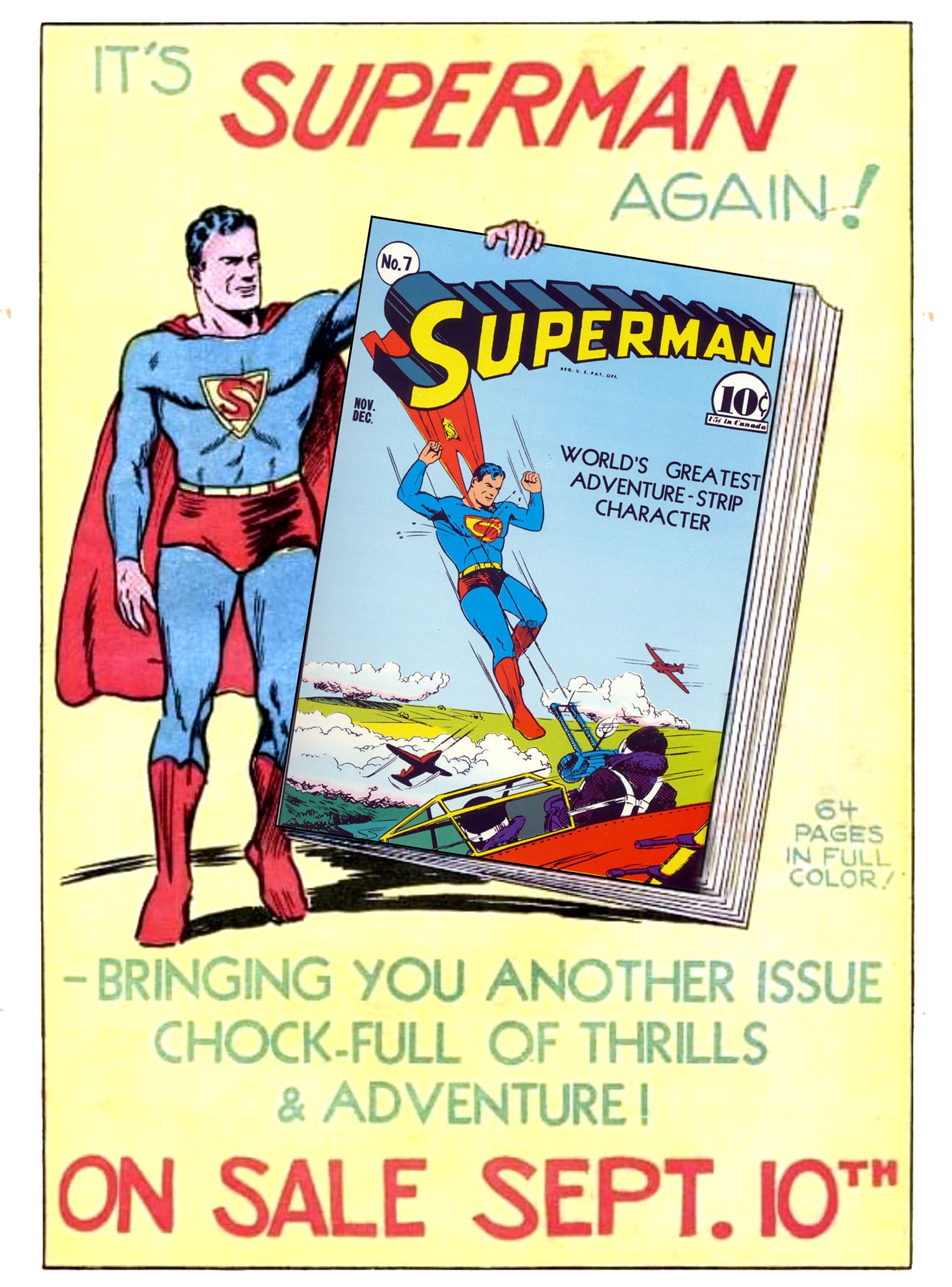
Two years after his debut, the Man of Tomorrow could still be rendered unconscious with a diabolical gas developed by the evil scientist Kotzoff (Superman 7, Nov. 1940) or the fiery “globe gun” wielded by the Middle Eastern conqueror Zolar (Action Comics 30, Nov. 1940).

Elsewhere in the Superman title that busy month, the Man of Steel corralled Nick Norton, a gangster who tried to frame a Metropolis prosecutor for murder, and protected another honest lawyer, Bert Runyon, who was attempting to clean up public corruption. Superman also ended a string of brutal night club robberies performed by the hooded thugs of the Black Gang, exposing their leader as Peter Peeker, a gossip columnist on the Morning Pictorial.

The two comic books appeared on the newsstands in September 1940. 

Meanwhile, on radio, Superman was involved in the adventure of Professor Thorpe’s Bathysphere. In his daily newspaper strip, Superman battled the Hooded Saboteur, a fascist terrorist. “By wrecking utilities, he hoped the sick and weak would die, making civilization return to a simpler, hardier way of living!”

And in the Sunday newspapers, trouble brewed when Lois Lane inherited 5,000 acres of land from her uncle. 

The land turns out to be rich in radium, but Lois elects to remain a “sob sister” and gives the millions to charity.

Her deceased uncle’s name? Bill Bixby.

That same month, in Hollywood, production began on what would have been the first Superman movie serial, The Mysterious Doctor Satan.

“(B)ut the license National Comics provided to the Fleischer Studios to make their Superman cartoon series was exclusive and therefore prevented other film companies from using the character,” Wikipedia notes. “The script was subsequently reworked with a new character standing in for Superman. The Copperhead’s love interest, Lois, had only her surname changed between these drafts, while his secret identity, down to the surname, mimicked Batman’s Bruce Wayne, National’s other major comic book character.”