June 1938: A Superman for the Underdog

On the newsstands in May 1938, browsers had their choice of Tarzan in Comics on Parade, Popeye in King Comics, daredevil aviator Captai...

Showing posts with label Joe Shuster. Show all posts

Tuesday, November 11, 1980

November 1940: When Superman Wasn’t So Tough

Even by 1940, Superman wasn’t quite so super.

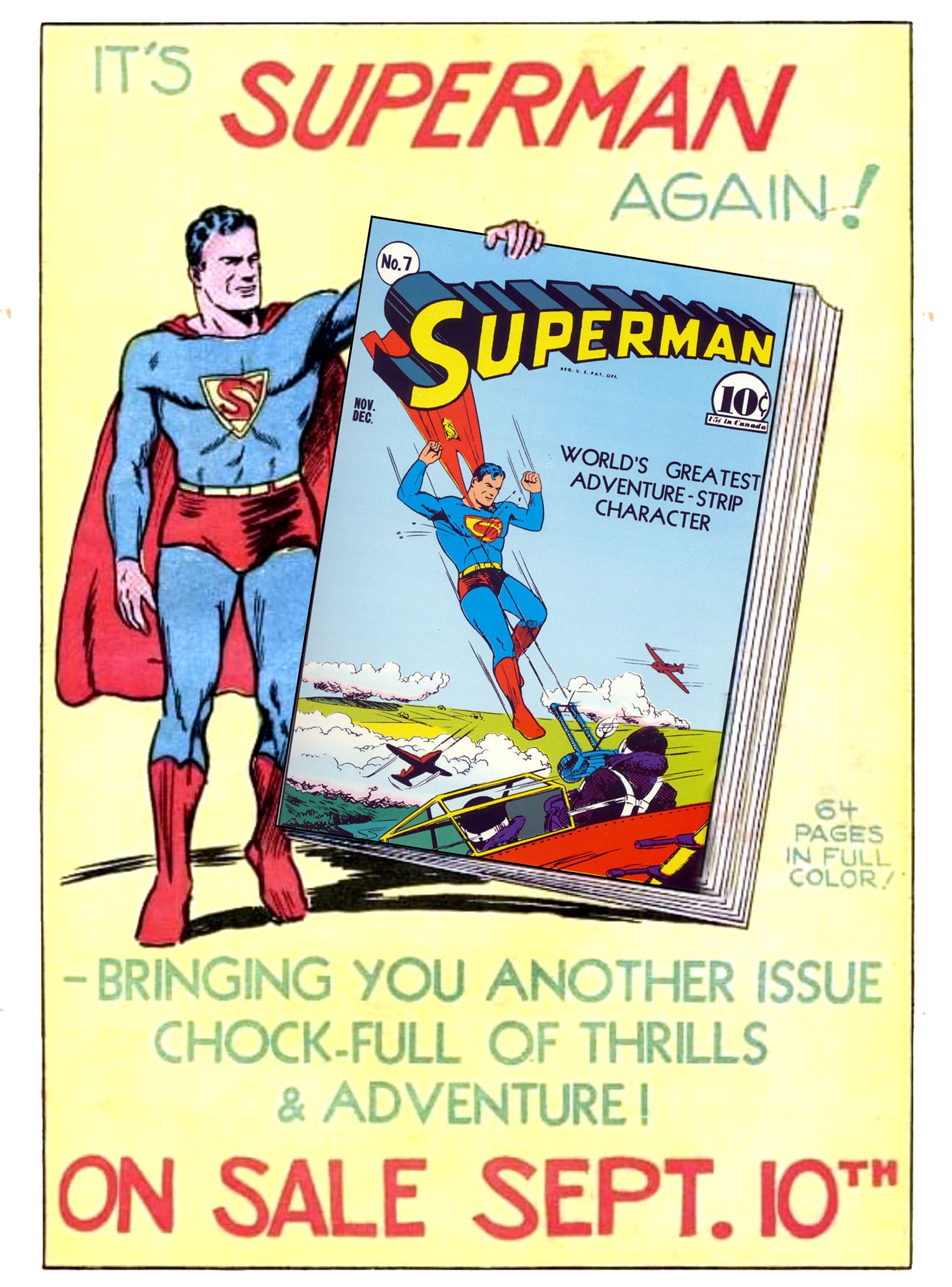
Two years after his debut, the Man of Tomorrow could still be rendered unconscious with a diabolical gas developed by the evil scientist Kotzoff (Superman 7, Nov. 1940) or the fiery “globe gun” wielded by the Middle Eastern conqueror Zolar (Action Comics 30, Nov. 1940).

Elsewhere in the Superman title that busy month, the Man of Steel corralled Nick Norton, a gangster who tried to frame a Metropolis prosecutor for murder, and protected another honest lawyer, Bert Runyon, who was attempting to clean up public corruption. Superman also ended a string of brutal night club robberies performed by the hooded thugs of the Black Gang, exposing their leader as Peter Peeker, a gossip columnist on the Morning Pictorial.

The two comic books appeared on the newsstands in September 1940. 

Meanwhile, on radio, Superman was involved in the adventure of Professor Thorpe’s Bathysphere. In his daily newspaper strip, Superman battled the Hooded Saboteur, a fascist terrorist. “By wrecking utilities, he hoped the sick and weak would die, making civilization return to a simpler, hardier way of living!”

And in the Sunday newspapers, trouble brewed when Lois Lane inherited 5,000 acres of land from her uncle. 

The land turns out to be rich in radium, but Lois elects to remain a “sob sister” and gives the millions to charity.

Her deceased uncle’s name? Bill Bixby.

That same month, in Hollywood, production began on what would have been the first Superman movie serial, The Mysterious Doctor Satan.

“(B)ut the license National Comics provided to the Fleischer Studios to make their Superman cartoon series was exclusive and therefore prevented other film companies from using the character,” Wikipedia notes. “The script was subsequently reworked with a new character standing in for Superman. The Copperhead’s love interest, Lois, had only her surname changed between these drafts, while his secret identity, down to the surname, mimicked Batman’s Bruce Wayne, National’s other major comic book character.”


Wednesday, August 8, 1979

August 1939: Fun with a Firing Squad

The most dreaded weapon of World War I, mustard gas, cast its shadow over Superman 2 (Fall 1939).

When Prof. Adolphus Runyan invents a poison gas capable of penetrating any type of gas mask, he’s murdered by the evil munitions magnate Lubane, who intends to use the chemist’s formula to prolong an ongoing civil war in Boravia (a reference director James Gunn winked at in his 2025 Superman movie).

Hitching a ride atop a plane, Superman travels to Boravia and forces the leaders to stop the civil war by threatening to bring the roof down on them literally, like Samson. Superman bombs Lubane’s munitions factory, then destroys the formula after watching it kill Lubane.

While accomplishing all this, the Man of Tomorrow amuses himself by shrugging off the bullets of a firing squad.

Firing squads are emblematic of the fascist regimes Superman opposed, which is why he ran into more than one of them in his early days.

Elsewhere in his second titular issue, Superman builds confidence in a suicidal boxer by assuming his identity, going into the ring and beating up a bunch of prize fighters. (Admittedly, Superman’s ethical reasoning was sometimes questionable).

Then, when crooked builder Nat Grayson causes a series of fatal construction “accidents” on the site of the Atlas Building, Superman grabs him by the throat and chokes him until he sees the error of his ways.

In a two-page text story written by Jerry Siegel, Superman drives Big Mike Caputo out of Metropolis.

Quoting the gangster, Siegel wrote, “I say I can take over this town, and if you two weasels are getting chicken-livered...!’

“ ‘But —' interposed the other hireling, ‘— you’re not counting on ...SUPERMAN!’

“ ‘SUPERMAN?’ questioned Caputo. ‘And who in blazes is he?’

“ ‘That's just it!’ whispered Sneer. ‘Nobody knows. He’s a will-of-the-wisp... a phantom of the night. He preys on evildoers who operate in Metropolis... and once that bozo’s on your trail, brother, you're sunk!’”

Wednesday, June 6, 1979

June 1939: The Cops Corner Superman

Superman had just destroyed the office of a corrupt patent attorney, and the police had him trapped in the elevator.
“Triumph blazed in Sergeant Blake’s eyes… ‘Careful men!’ he warned the officers grouped about him. ‘We’ve prayed for this break for months, and now that it’s come, we don’t want to muff it. He was seen going into that elevator … and he’s bound to come out of that door any minute!’
“ ‘And that’s what bothers me,’ muttered someone. ‘What do we do when he does emerge?’
“Said another: ‘Our guns are useless against him.’
“Nonsense!’ retorted Sergeant Blake. ‘All we’ve got to do is keep cool and we’ve got him!’
“But his glib comeback didn’t satisfy even the Detective Sergeant himself. There were some very wild tales being circulated about this fellow who called himself SUPERMAN. He was said to be a modern Robin Hood … a person who had dedicated his existence to assisting the weak and oppressed. It was whispered that he possessed super-strength, could lift tremendous weights, smash steel with his bare hands, jump over buildings and that nothing could penetrate his amazingly super-tough skin. But of course, pondered the sergeant, these were mere rumors, fantastic fairy tales. Probably SUPERMAN was just an ordinary person whose better-than-average strength had been immensely exaggerated. Without a doubt!”
Blake’s bluster was featured in what was probably the first prose story written about Superman, a two-page text piece in Superman 1 (Summer 1939).
That issue also gave us the first version of the Superman’s origin that mentions Krypton and his foster parents, stories reprinted from the first four issues of Action Comics in 1938 and a biography of Superman’s young creators, Siegel and Shuster, who wouldn’t always remain so popular with the publisher.
The opening of the elevator doors proved to be an anticlimax for the jumpy cops, because all that emerged was “a slim, nervous figure” whose “…meek eyes blinked fearfully behind thick-rimmed glasses.”

Tuesday, June 6, 1978

June 1938: A Superman for the Underdog

On the newsstands in May 1938, browsers had their choice of Tarzan in Comics on Parade, Popeye in King Comics, daredevil aviator Captain Desmo in New Adventure Comics or some caped guy smashing a sedan in the new Action Comics.
Readers who opened the magazine met Superman in medias res, running through the night with a bound-and-gagged woman under his arm. That’s because the story was rearranged from a long-unsold newspaper strip by Superman’s creators, Jerry Siegel and Joe Shuster.
The Man of Tomorrow was racing to deliver evidence that would secure the governor’s pardon for an innocent prisoner on death row.

In the hardscrabble Depression era, this giant of a man was looking out for the little people — the battered wives, the victims of lynch mobs, the abused orphans and prisoners, the citizens betrayed by Washington politicians.
“He stood up for the underdog, the little guy/gal, the downtrodden,” recalled comics historian Johnny Williams. “He was the ‘anti-bully.””
As writer Tom De Haven noted, “When Jerry Siegel wrote every story, Superman functioned as a freelance do-gooder with the demeanor and gumption of a laughing caballero, a rabble-rouser devoted to ameliorating social ills...”
“Whatever he does, he does philanthropically, often for just one poor soul in despair (having been swindled, wrongfully jailed or driven by the powerful to the brink of suicide) but always, too, for the common good. He accepts no reward, modestly waves off any applause.”
Clark Kent wasn’t “virtue signaling,” He was virtuous, in an era when the values of decency and honesty were repaid with poverty and anxiety.
As writer Mark Waid observed, Superman was “…as close as contemporary Western culture has yet come to envisioning a champion who is the epitome of unselfishness.”
Those rejected newspaper panels, crudely reassembled for inclusion in a 10-cent throwaway rag for kids, channeled a power to fire the imagination that ignited an industry, founded a popular cultural genre and still echoes around us in another century.