June 1938: A Superman for the Underdog

On the newsstands in May 1938, browsers had their choice of Tarzan in Comics on Parade, Popeye in King Comics, daredevil aviator Captai...

Showing posts with label War comics. Show all posts

Saturday, June 6, 2009

June 1969: Bruce Wayne, OSS Agent


 “Ein Fledermausmann! Schiessen! Schiessen!”

It’s the spring of 1969. You pick up a copy of The Brave and the Bold 84 from the spinner rack and open it at random.

What you see is a lushly illustrated, tuxedoed Bruce Wayne on a motorcycle, charging across a World War II airstrip the day before D-Day.

What th — ?

You flip through the issue and find the melodramatic action thrilling (and then realize that it’s been a long time since you’ve been thrilled by the action in a Batman comic book).

The story by writer Bob Haney featured an unlikely team-up between the Caped Crusader and Sgt. Rock, the WWII infantry noncom featured in Our Army at War.

The story featured Batman, in 1969, thinking back on an Allied mission he performed in France a quarter-century before on June 5, 1944.

Continuity problems aside, for me, this was the issue that signaled the direction Batman needed to go.

By 1969, the Masked Manhunter was stuck with a tired and played-out image as “camp,” a legacy of the Adam West TV show that had ended the year before. We long-time fans were aware that that the character needed a complete change — leaving the garish, clownish spotlight behind and returning to the shadows from which he emerged.

And here was just such a change, in both art and story. Nazis, after all, are not the Penguin or Mr. Freeze. They always make perfect villains, and have the advantage of having been real.

The art by a 27-year-old Neal Adams was breathtakingly fresh, and the inking by Sgt. Rock’s  Joe Kubert reinforced the new approach — muting the silliness of the superhero genre by enfolding it into the more “realistic” atmosphere of war comics.

Earth One, Earth Two, Earth Whatever. Who cared? This was one good story.

The idea of Bruce Wayne/Batman as an Allied secret agent had even had a precedent. That was his status in the 1943 Batman movie serial.

Saturday, May 5, 2001

May 1961: The Ghost in the Machine

Writer Robert Kanigher was particularly good at coming up with concepts for fantastic adventure stories that weren’t quite superheroes.

“With legendary artist Joe Kubert, he created Sgt. Rock and Easy Co., and would write the bulk of their adventures until his retirement,” observed comics historian Chris Sims. “His stories were marked by action and a weariness of combat that made his characters seem human, even while they were battling Nazi supermen with metal fists and shooting down airplanes with handguns. But while Rock might've had that glow of realism to it, war comics also provided the jumping off point for some of his stranger creations: The War That Time Forgot, in which soldiers battled against an island of dinosaurs (awesome) and The Creature Commandos, in which a crack team of monsters, including a vampire, a werewolf, a Medusa, and a Frankenstein named Lucky were sent to assassinate Hitler (super awesome).”

I was intrigued by Kanigher’s Haunted Tank feature, which provided the inhabitants of a World War II M3 Stuart tank with an invisible assist from the machine’s namesake, beginning in G.I. Combat 86 (May 1961).

“The Haunted Tank was actually a series of tanks commanded by Lt. Jeb Stuart,” noted the DC Comics Encyclopedia. “The spirit of Alexander the Great assigned the spirit of Confederate Gen. James Ewell Brown (J.E.B.) Stuart to become the ghostly guardian of a Stuart M3 tank in Northern Africa.”

The Haunted Tank is best remembered for the (art) work of Russ Heath and the remarkable run of Sam Glanzman, who worked on 134 consecutive episodes, from #154 until its demise,” Mike Conroy noted.

The feature’s 26-year run finally finished in 1987 when G.I. Combat ended with issue 288.

On reflection, Stuart’s bearded ghost appeared a little old to me. After all, the flamboyant Virginian died at tender age of 31, having been mortally wounded at the Battle of Yellow Tavern in 1864.


Sunday, August 8, 1999

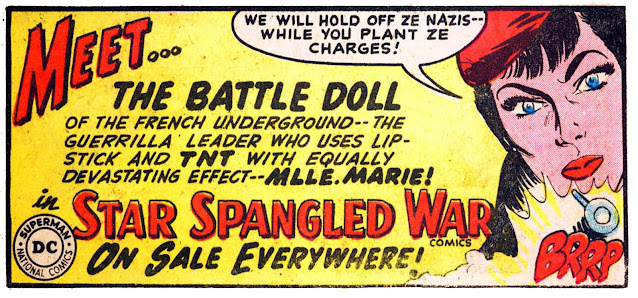
August 1959: Behold ze Battle Doll

At age 6, my only problem with Mlle. Marie was that I had no idea how to pronounce her name.

“Mlle.?” What might that mean and how do you say it? “Milly,” I guessed.

With her pencil skirt, beret, submachine gun and inability to pronounce the word “the,” Mlle. Marie was a breath of perfumed Parisian air in DC’s male-dominated war comics.

Created by writer Robert Kanigher and artist Jerry Grandenetti for Star Spangled War Stories 84 (Aug. 1959), this French Resistance “Battle Doll” veered as close to romance as any war comic dared.

“Raised on a farm in France … Marie and her father join the Resistance when Germany invades France during World War II,” noted comics historian Jeff Rovin. “After her father dies, she is acknowledged to be the most dangerous resistance fighter of them all, especially by her arch-foe Commander Von Ekt. Right before the liberation of France, Marie is shot by a Nazi spy, Roget, and falls into the St. Joan River.” 

But she apparently survived to have a daughter with Alfred Pennyworth (!).

In 1959, she seemed an odd choice for a comic genre read almost exclusively by boys. 

“However, Kanigher was also writing and editing Wonder Woman, and had created Black Canary (1947) and Wonder Girl (1958) before Mlle. Marie, so he was also well aware of the potential of female heroes,” observed popular culture historian Ensley F. Guffey.

“(W)hile Marie’s wasn’t quite the first of DC’s war series to be introduced (that would be Sgt. Rock, who had started four months earlier, followed by Gunner & Sarge a month after that), it was the first dropped,” noted comics historian Don Markstein. “Star Spangled 90 introduced The War that Time Forgot, and that was the beginning of the end. Before long, the visceral thrill of pitting World War II soldiers against dinosaurs crowded Marie completely out.”

She returned as an occasional guest star in other war features like Haunted Tank.


Saturday, October 10, 1981

October 1941: Premonitions of Pearl Harbor

This Fiction House flirtation with superheroes was breezy and brief.

I presume the publisher had noticed the instantly terrific sales of the fascist-flattening title Captain America when it hit the newsstands in December 1940. Seven months later, Fiction House debuted both Super-American (in Fight Comics 15, cover-dated Oct. 1941) and the Rangers of Freedom (in Rangers of Freedom 1, ditto).

The latter title offered three teens — Biff Barkley, Tex Russell and Percy Cabot — who were recruited by the FBI to serve as the star-spangled Rangers of Freedom. 

The story, written by R. W. Colt and drawn by Joe Doolin, bothered to offer a rationale for why the FBI would need teenagers. The villainous Super-Brain is using his mental powers to attack American democracy, and only “young minds” can resist him.  Miss America herself pronounces the teens fit to fight the wave of sabotage and lunacy that has overwhelmed the nation.

“This is an interesting peek into the American psyche on the eve of the country’s entry into World War II,” observed online fan Ratty. “Just (five) months before the attack on Pearl Harbor, the lead story has young ‘extraordinary examples of American youth’ volunteer to fight ‘Super-Brain,’ a super-villain schemer in the Fu Manchu mold, rather than Hitler directly. Indeed, issue 2 retcons the story to be set in the near future of 1948 with Hitler demoted to merely an ‘adventurer’ Super-Brain is using.”

That story shows Super-Brain ordering Hitler to invade the U.S. three years after the actual dictator’s death.

“Things quickly changed after the attack on Pearl Harbor,” Ratty noted. “By issue 5 the original titular ‘Rangers of Freedom’ team would be replaced by a less super-themed group of Army Rangers. 

“It's interesting to note that many of the other stories in issue 1 deal with fifth columnist saboteurs. If you can put yourself in the time, it gives an incredible sense of foreboding. America was just waiting for the other shoe to drop.”