Sometimes the comic books you saw in ads but didn’t read could be as fascinating as the comics that you'd paid your dime or 12 cents to buy. They might even be more compelling, because not knowing the story behind the covers forced you into the delightful practice of using your imagination and speculating — of writing, in effect, just the way Stan Lee, Gardner Fox and John Broome did. So welcome to Just Imagine: The Colorful World of Comic Book House Ads.
June 1938: A Superman for the Underdog
On the newsstands in May 1938, browsers had their choice of Tarzan in Comics on Parade, Popeye in King Comics, daredevil aviator Captai...
-
For the 10-and-under crowd, Showcase 34 contained not only the debut of a new superhero, but a thrilling surprise. A text feature gave us ...
-
In Tales of Suspense 49 (Jan. 1964), Iron Man would use his new armor to withstand a nuclear detonation and rescue a member of the X-Me...
Monday, December 12, 2005
December 1965: Things Go a Little Batty
Friday, August 8, 2003
August 1963: Reflection of a Bat
“I leaned over the sink, closer to my reflection, and stare at myself hard,” wrote Nina LaCour. “I don't know what I see. I don’t even know what I want to see.”
We tend to associate mirrors with the mysteries of human identity, and Batman’s archenemy Mirror-Man exemplified that theme.
Mirror-Man — Floyd Ventris — became pretty well convinced that he’d penetrated the secret of Batman’s identity, and came close, more than once, to proving that the Masked Manhunter was Bruce Wayne.
Apparently as omen-prone as Wayne, Ventris was able to escape from prison using the fragment of a broken mirror to dazzle a guard.
“I broke a mirror, and it brought me luck!” he thinks. “I’ll do a lot of research on mirrors — because from now on I’m going to use them for crime!” (The Mysterious Mirror-Man, Detective 213, Nov. 1954).
Using a “two-way electronic mirror” to see through Batman’s cowl, the mirror-spectacled criminal only gets ridiculed by his gang when he announces his discovery.
Batman has defeated him with preemptive PR, having written a newspaper article as Bruce Wayne about ridiculous past occasions when people claimed he was Batman.
Mirror Man’s return in Batman 157 (Aug. 1963) began with a storytelling flourish from writer Bill Finger. Four of the characters — Batman, Batwoman, Vicki Vale and Ventris — were shown considering their images in reflective surfaces.
Mirror-Man’s mirror-themed crimes include the use of reflective billboards and a U.S. Army “solar mirror” and the theft of a giant telescopic mirror intended for installation at the Mt. Malador Observatory.
Twice, Ventris trapped Batman and Robin in mirrored rooms.
Mirror-Man’s impact was undoubtedly diluted by the fact that he was “reflected” in a contemporaneous Flash super villain. The Mirror Master, who also employed esoteric mirror tricks, debuted in Flash Comics 105 (Feb.-March 1959).
The first line of Wikipedia’s entry on Mirror Man is, of course: “Not to be confused with Mirror Master.”
Monday, July 7, 2003
July 1963: They Grow Up So Fast, Don’t They?
Readers were treated to a merman Batman, a phantom Batman, a zebra Batman, a bewitched Batman, a giant Batman, Rip Van Batman and Robin the Wonder Man, a reprint from Batman 107 (April 1957).
Imaginatively, children become instant adults when they read superhero stories. But in The Grown-Up Boy Wonder, Robin didn’t find the abrupt transition so easy.
In the Batcave, Dick Grayson is overcome when he accidentally spills “…the thing Superman found floating in outer space.” He awakens to find himself physically mature.
Things Superman brings back from space should always come with an FDA warning label, by the way.
In this tale drawn by Sheldon Moldoff, writer Bill Finger cleverly exploits the immaturity theme, making the plot turn on the advantages and disadvantages of sudden physical maturity.
Robin’s inexperience with his new size and weight causes him to be captured by the red-clad Daredevil gang, which promptly unmasks him. But that does them no good, because no one can recognize the face of an adult Dick Grayson.
Robin’s new identity as Owlman may well have been a cheeky wink at one or two of Batman’s vanished competitors. Both the Owl and the Black Owl began fighting crime for different publishers beginning in 1940.
This wouldn’t be the only time that Batman recycled concepts from rival superhero titles he had outlived. The same thing happened with another imitator, Cat-Man.
Despite his experience with the adult responsibilities of crime-fighting, Robin wasn’t ready to grow up — a fact that was underlined by two stories in this issue.
The Grown-Up Robin ends with the restored Dick Grayson running after schoolmates, saying, “Gee, it’s good to be a kid again! Hey fellas, wait for me!”
And the middle story, Robin Falls in Love, ends when the Boy Wonder assures Batman, “From now on, I’m keeping my mind on criminals, not girls!”
Wednesday, January 1, 2003
January 1963: Catman and Company
![]() |
| The Golden Age Catman |
Sunday, May 5, 2002
May 1962: When Batman Needed a Nap
The Masked Manhunter’s bizarre transformations hit the wall in March 1962, the month Batman 147 appeared on the newsstands.
A giant, a mummy, an alien, a genie, a negative man, an invisible man, whatever. I didn’t mind seeing Batman temporarily transformed into any of those.
But a baby?
No.
Children don’t like seeing their own rather comical impotence reflected back at them — at least the ones who read superhero comics don’t. So Bat-Baby was an ill-conceived concept.
“In a story by Bill Finger, Sheldon Moldoff and Charles Paris, Batman and Robin are recovering jewels from a heist by Nails Finney,” noted Dave Marchand. “The Dynamic Duo bust into the deserted warehouse that the hoods are using, to find renegade scientist Garth there as well... who bathes Batman in a strange energy beam, that reduce
s his age to that of a baby!’”
The chagrined Robin says, “I’d better carry you to the Batmobile! You can’t walk while your costume is sagging all about you!”
“Robin, I never thought there’d be a time when you’d have to carry me in your arms like a baby!” replies the infantilized Batman.
Tricked up in a sort of Bat-playsuit, the ever-resourceful superhero retrains himself to use his small size as an advantage, then subdues Garth’s gang and reverses the transformation.
“De-aging superheroes was an oddly popular trend at the time,” wrote Evan Mullicane. “Superman had the well-known Superboy and the more obscure Superbaby while Wonder Woman had Wonder Girl and Wonder Tot. These characters proved popular enough that DC even turned Superboy and Wonder Girl into their own characters with Connor Kent and Donna Troy. Despite this, younger versions of Bruce Wayne never caught on. To date, Batman 147 is the only appearance of Bat-Baby in DC comics.”
The Bat-Baby costume ended up in a Batcave display case.
“Just a reminder — of a brief childhood!” Batman remarked with a smile.
Ironic. Batman’s childhood was indeed brief, but not for that reason.
Wednesday, August 8, 2001
August 1961: A Plethora of Powers
Batman and Robin could corral not only costumed crooks, but also super-powered foes – and just about as easily.
The continued popularity of Superman probably had something to do with the proliferation of super-powered criminals and beasts who plagued Gotham City in the late 1950s and early 1960s.
In Detective Comics 294 (Aug. 1961), an energy leak from a Gotham City scientist’s experimental device drove John Dolan insane while giving him the ability to change his own molecular structure by using a control belt.
Dolan appears to be writer Bill Finger’s revamping of the concept of the earlier Atomic-Man. Engineer Paul Strobe had altered the molecular structure of objects by staring at them through special googles, while Dolan altered his own molecular structure.
Three years later, those same elemental transformation powers were reborn in a superhero, Metamorpho.
But Batman got ’em first. When a device designed to trap Dolan accidently explodes, Batman gains the same powers, and employs them in a plan to defeat the Elemental Man.
This became a typical pattern for these stories. When he encountered super-powered foes, the Masked Manhunter sometimes helpfully gained the same powers himself. That also happened with Zebra-Man and the Flame-Master.
This house ad from the first Batman Annual shows that in same month, in World’s Finest 119, Superman, Batman and Robin were seemingly under the thumb of a new superhero called Tigerman. However, the character turns out to be a hoax the heroes have dreamed up to outfox the criminal Purple Legion.
Meanwhile, in Batman 141, a humiliated super-criminal called the Moth vows revenge against Bat-Girl (Betty Kane). Oddly enough, another lepidopteran-inspired villain, the Killer Moth, would become the first opponent of the next Batgirl, Barbara Gordon, in Detective Comics 359 (Jan. 1967).
Monday, January 1, 2001
January 1961: Bizarre Characters and Fantastic Weapons
Saturday, November 11, 2000
November 1960: That Thing You Doom
Tuesday, June 6, 2000
June 1960: Thrills Times Three

Friday, March 3, 2000
March 1960: Let’s Give the Kids a Big Hand
Wednesday, February 2, 2000
February 1960: At the Waves, Waving Goodbye
Superman’s first great romance seemed a little fishy.
Actually, that bad pun doesn’t do justice to an engaging storyline. In The Girl in Superman’s Past (Superman 129, May 1959) and Superman’s Mermaid Sweetheart (Superman 135, Feb. 1960), artists Wayne Boring and writers Bill Finger and Jerry Siegel introduced readers to Lori Lemaris, a mermaid from sunken Atlantis.
The first story begins with Clark Kent and Lois Lane bundled up to attend a football game at his alma mater, Metropolis University. Clark reminisces how a chance campus encounter with a girl in a wheelchair led him to fall in love with the mysterious beauty, and moon over her.
One poignant, ironic element of the story has the most physically free man in the world drawn to what appears to be a disabled girl.
But when Clark asks her to marry him and is about to reveal himself, Lori cuts him off by telling him that she’s always known he’s Superman.
The shocked Man of Steel figures out she’s a telepathic mermaid, and they team up to rescue flood victims before they part.
Finger’s stories about Superman were often memorable, and these added a recurring character to Superman’s universe, despite the built-in contradiction with Superman’s friend Aquaman (Lori’s Atlantis and Aquaman’s Atlantis were clearly not the same place).
It did seem interesting, to me, that Clark Kent’s first real romance should coincidentally involve a being as fantastic and secretive as himself.
And Clark and Lori have more in common than we might initially think. For one thing, they’re both monsters.
“Like fantasy creatures such as mermaids, Clark/Superman combines categories in ways that technically make him a ‘monster’ without inspiring the kind of fear/disgust that would make him the centerpiece of horror (except, perhaps, to villains),” observed critic Greg M. Smith.
This kind of doomed romance has the advantage of seemingly bringing major changes to a continuing character who will, at the end, be left back at square one.
February 1960: Peril from the Past
Writers must have found it tricky to keep Batman and Robin relevant in stories in which they teamed up with Superman.
After all, as screenwriter Jackson Gillis observed, the nearly omnipotent Superman could “corral any criminal” all by himself.
One writer who could handle the job of giving the Dynamic Duo equal weight in those team-up stories was Bill Finger, Batman’s co-creator.
In World’s Finest 107 (Feb. 1960), Finger came up with a two-step solution to the problem: one, confront Superman with a monster so mighty his powers cannot overcome it and two, give the Dynamic Duo an autonomous mission that’s crucial to stopping the creature.
The fact that their mission is separate gives Batman and Robin a chance to shine out from under Superman’s shadow.
When a red-eyed, blazing yellow giant emerges on a Mediterranean island, Superman, Batman and Robin rush to intercept it. But this Time Creature’s force field proves as effective as Brainiac’s in stopping Superman.
Meanwhile, a whistling signal draws the Dynamic Duo to a cave where they discover an ancient telepathic device informing them that such Time Creatures had previously laid waste to other worlds.
Anticipating the monster’s emergence on Earth, our alien benefactors buried the one weapon that can stop the creature during the beginning of the reign of Alexander the Great. Finding it missing, Batman and Robin use Professor Carter Nichols’ time travel device to go after it in 336 BC (Nichols’ friendship with Bruce Wayne stretched all the way back to Batman 24 in 1944).
Finger bounces the action of this lively story back and forth between Superman’s efforts to stall the Time Creature and Batman and Robin’s adventures in the colorful era of Alexander III of Macedonia.
Artist Dick Sprang once confessed that he enjoyed drawing the Superman-Batman stories more than the solo Batman stories for which he became famous. The science fictional possibilities inherent in the World’s Finest stories provided more visual scope for Sprang’s creativity.
Saturday, January 1, 2000
January 1960: Black and White and Batman All Over
“This meant a sad existence for Batman” noted comics historian Tony Guerrero. “He couldn't get near anyone. He couldn't eat. His secret identity would be in jeopardy if he tried walking around as Bruce Wayne.”Sunday, December 12, 1999
December 1959: The Terrific Trio’s Double Trouble
Thursday, November 11, 1999
November 1959: The Year of the Catty
DC characters tended to share certain bizarre experiences — accidentally acquiring Superman’s powers, getting trapped in the Phantom Zone, traveling in time and space, pretending to die, pretending to turn evil, turning invisible, developing futuristic brains, becoming elastic, attaining giant size, instantly becoming fat, instantly growing older or younger.
And, unlikely as it might seem, acquiring the head of a cat.
In Superman’s Girl Friend Lois Lane 13 (Nov. 1959), writer Bill Finger and artist Wayne Boring present us with a mystery for Superman to solve. Why does Lois show up at the Daily Planet for a tearful goodbye to her friends with her head encased in a lead box?
In the vanished reporter’s diary, Superman reads that Lois had confronted a vaudeville sorceress calling herself Circe, only to find that she wasn’t dealing with a fake — that her head had been transformed into a cat’s.
Passing a circus sideshow where people are laughing at freaks, Lois thought, “I can never go back to the normal world I once knew — not with my freakish face. (Sob!) And I could never be Superman’s girl friend again! I knew that though Superman would try not to show it, he’d be repelled by my face!”
Superman discovers that Lois doesn’t have the face of a cat, but only thinks she does — thanks to a drugged lemonade and some hypnosis practiced by the fake Circe.
Despite Lois’s traumatic experience, Superman’s sympathy only extends so far. At dinner that night at a restaurant, he orders Lois a saucer of milk to mock her cat-like curiosity.
The story is a reversal of what happened to Superman 15 months earlier in Action 243’s The Lady and the Lion!, when the real Circe gave the Man of Tomorrow a lion’s head.
It might have seemed to readers that Superman’s writers and editors were spinning in Circe circles.
Sunday, October 10, 1999
October 1959: Batman Gets Hammered
Outsized and colorful, myth has always provided fertile storytelling material for comic-book superhero adventures.
In The Hammer of Thor (Batman 127, Oct. 1959), the Dynamic Duo battles a super-powered criminal thunder god who turns out to be museum curator Henry Meek. Meek transforms into Thor when he touches the hammer, just as meek Dr. Don Blake would three years later.
In this story written by Bill Finger and drawn by Sheldon Moldoff, the hammer is a replica empowered by a mysterious meteor. Meek’s obsession with mythology does the rest, triggering a hypnotic state in which Meek confuses the sound of thunder with the voice of Odin.
This is one of the rare Batman adventures that ends happily for the criminal. Unaware of his transformations, Meek is blameless, and the resulting publicity makes a success of his faltering museum.
DC heroes ran into a number of faux Thors over the years.
In May 1948, Superman thwarted one of them, shrugging off lightning blasts by remarking nonchalantly that they only felt like electric sparks (Superman in Valhalla, Superman 52).
Then in October 1956, under the influence of a gamma-ray-powered “reincarnation helmet,” a ginger-haired cub reporter recalls past lives as the pal of Samson, Hercules and Thor (Superman’s Pal Jimmy Olsen 16). But it turns out to be a hypnotic swindle to steal radium. Clark Kent figures it all out when the same machine causes him to dream about a past life on Earth — something that, being from Krypton, he knows to be impossible.
In The Magic Hammer (Tales of the Unexpected 16, August 1957), artist Jack Kirby gave us another Thor, one in pursuit of his hammer Mjolnir which had been stolen by Loki. Kirby and writer Stan Lee would revisit the theme in Journey Into Mystery 83 (Aug. 1962), creating the longest-running and most famous version of the thunder god.
So Batman met Thor, and then Robin met Ant-Man. But that, as they say, is another story…
Sunday, August 8, 1999
August 1959: Lois of the Leopards
On her way back from interviewing Dr. Albert Schweitzer in Africa, Lois Lane’s small plane develops engine trouble.
Bailing out, she strikes her head on a rock upon landing and develops amnesia. And that’s how the Daily Planet’s star reporter became The Leopard Girl of the Jungle (Lois Lane 11, Aug. 1959).
So maybe a subplot involving a jungle girl novel written by Lana Lang made little sense. And maybe writer Bill Finger had to perform logical backflips to “explain” why Superman didn’t simply rescue Lois, but let her knock about for weeks with wildlife while secretly helping her.
But all that really didn’t matter. We wanted to see Lois as a jungle girl, with all that gorgeous Kurt Schaffenberger art. And that’s what we got.
“The end result is an homage strategically placed in the jungle girl history,” observed G.W. Thomas. “Most of the jungle comics and movies were done by the early ’50s. The only significant one was in 1959 with Audrey Hepburn playing Rima the Jungle Girl in Green Mansions. That premiered around the same time this issue of Superman's Girlfriend Lois Lane appeared. Coincidence? Probably not.
“DC had no jungle comics in 1959. Bill Finger’s tale is a swan song to an era of liana-swinging gals in leopard bikinis. The 1960s would be the decade that gave us Ron Ely on TV, Jack Benny and Gilligan parodies, George of the Jungle and Ray Stevens singing ‘Guitarzan.’ We had become too sophisticated for Nyoka serials or Irish McCalla as Sheena.”
As usual, Jimmy Olsen had macheted a trail through the jungle before Lois, in this case three years before (Jungle Jimmy Olsen!, Superman’s Pal Jimmy Olsen 10, Feb. 1956).
Because Lois’s title began four years later than Jimmy’s, the kinds of things that had happened to him tended also to happen to her later. So he became Elastic Lad and she Elastic Lass. Both moonlighted as werewolves. And both tried the Tarzan life.
Wednesday, March 3, 1999
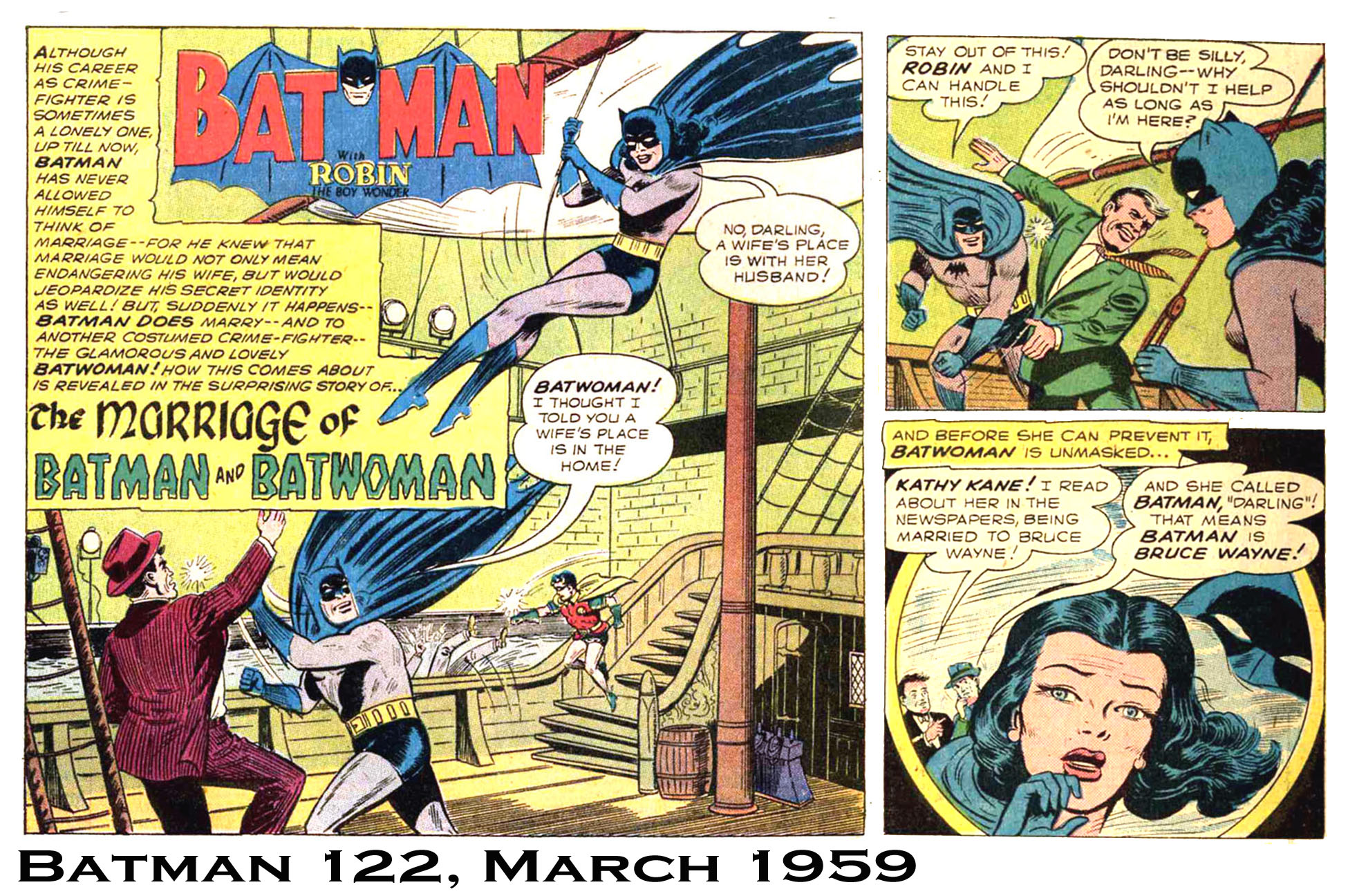
March 1959: The Marriage Menace
![]() |
Saturday, January 1, 1994
January 1954: A Surprising Number of Giant Turtle Men
Friday, June 6, 1980
June 1940: The Many Faces of Clayface
One wonders how Boris Karloff felt about becoming a Batman villain.
Was he amused, or irritated, or did he never hear about it at all?
In fact, Karloff was probably too busy to read comic books in 1940, the year Detective Comics 40 introduced the villain “Basil Karlo,” i.e. Clayface. Since his major success as the monster in 1931’s Frankenstein, Karloff had appeared in 37 movies, most of them horror films, and was thus well established as Hollywood’s King of Horror.
When Detective Comics 40 hit America’s newsstands in May 1940, Karloff was starring around the corner in the Columbia Pictures horror/science fiction film The Man with Nine Lives.
The fictional Karlo, once a star of equal stature, had been undermined by his own bad publicity. Outraged that a movie company was remaking his old picture Dread Castle, the deranged Karlo adopted his Clayface disguise so he could kill the actors just as they were to die in the movie.
The Dynamic Duo thwarted him, but then an accident allowed Karlo to escape from a prison ambulance and try to get revenge against Batman, Robin and actress Julie Madison, Bruce Wayne’s girlfriend (Clayface Walks Again, Detective Comics 49, March 1941).
Clayface would be reshaped again and again. Finding a mysterious pool, treasure hunter Matt Hagen became a shapeshifter Clayface in Detective Comics 298 (Dec. 1961). And using Hagen’s blood, Preston Payne became a monstrous Clayface who could melt others with a touch in Detective Comics 478 (July-Aug. 1978).
In fact, you can trace Batman’s evolution through the iterations of Clayface. Basil Karlo epitomized the Dark Knight’s pulpish weird menace era in the late 1930s. Matt Hagen was an example of the science fictional silly fun of the 1950s. And Preston Payne represented a return to the weird menace era in the 1970s, but with neo-noir-ish science fictional elements mixed in.
Many other Clayfaces have been added since, enough for a whole Legion of Clayfaces, in fact.