June 1938: A Superman for the Underdog

On the newsstands in May 1938, browsers had their choice of Tarzan in Comics on Parade, Popeye in King Comics, daredevil aviator Captai...

Showing posts with label Joe Samachson. Show all posts

Saturday, January 1, 2000

January 1960: Trading Capes for Coonskin Caps

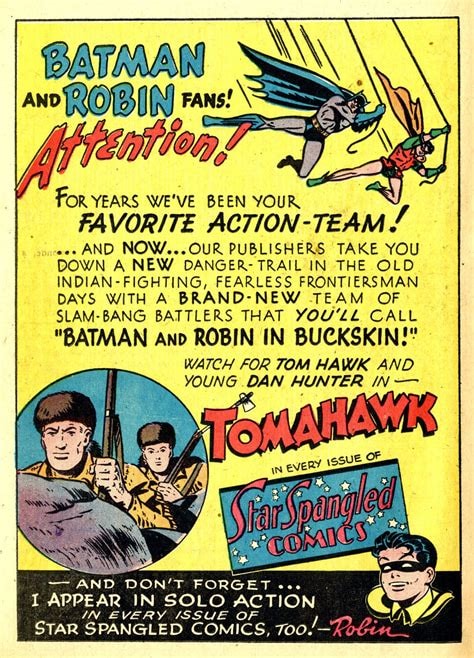
Tomahawk was a Revolutionary War-era pioneer woodsman created in 1947, just as superheroes were fading.
The character anticipated and undoubtedly got a boost from the Davy Crockett craze of 1954-55, kicked off by Disney’s version of Crockett’s life. The Ballad of Davy Crockett was probably the most-sung song of 1955, recorded by Bill Hayes, Fess Parker, Tennessee Ernie Ford, Steve Allen, Burl Ives and Fred Waring.
Graduating from a back-up feature to his own title in 1950, DC’s Tomahawk was a cross between Davy Crockett and Batman.
With his boy sidekick, Dan Hunter, he fought British troops, tyrannosauruses rex, a frontier Frankenstein monster, aliens, Indians  and alien Indians (don’t ask). Like Batman, he occasionally gained super powers and encountered a female masked champion of justice — Miss Liberty.
“Toward the latter part of the ‘50s, practically all DC comics ran aliens, monsters and other goofy sci-fi stuff on the covers, no matter how badly it clashed with the title's subject matter — even war comics often sported dinosaurs in that position,” observed comics historian Don Markstein. “And so, all through the late 1950s and early to mid ‘60s, Tomahawk fought gigantic tree men, miraculously surviving dinosaurs, mutated salamanders and other menaces that seem somehow to have escaped the history books. There was even a giant gorilla among them, and putting a gorilla on the cover was also a contemporary trend at DC.”
“The character was created by writer Joe Samachson (who also scripted the first J’onn J’onzz, Manhunter from Mars story) and artist Edmond Good (whose work also appeared at Quality and Fox) — but the man most closely associated with his development was Fred Ray, a cartoonist who was also a Revolutionary War buff,” Markstein noted.
“Tomahawk got his name from the fact that he was raised by Indians, thus absorbing their lore — a definite asset in the forest-based guerilla warfare he carried on against the British — combined with the fact that his name actually was Tom Hawk.”

Wednesday, May 5, 1999

May 1959: When Indians Were Invisible

Tomahawk started out fighting redcoats, and ended up battling frontier dinosaurs, frontier supermen, giant gorillas, Indians who flew giant eagles, Liliputian Indians, volcano Indians, alien Indians — and invisible Indians.

In that, Tomahawk and his young friend Dan were really no different than Batman and Robin, Jimmy Olsen and Lois Lane, the Sea Devils, the Challengers of the Unknown, or any of the other DC features that featured bizarre and absurd menaces month after month. 

As a kid, I liked them all. Plausibility need not apply. A world of silly, colorful melodrama suited me just fine.

“The character was created by writer Joe Samachson (who also scripted the first J’onn J’onzz, Manhunter from Mars story) and artist Edmond Good (whose work also appeared at Quality and Fox) — but the man most closely associated with his development was Fred Ray, a cartoonist who was also a Revolutionary War buff,” noted comics historian Don Markstein. 

 “Tomahawk got his name from the fact that he was raised by Indians, thus absorbing their lore — a definite asset in the forest-based guerilla warfare he carried on against the British — combined with the fact that his name actually was Tom Hawk.”

Tomahawk was therefore a direct descendent of one of the first American fictional heroes, James Fenimore Cooper’s Nathaniel “Natty” Bumppo, introduced in Cooper’s 1841 novel The Deerslayer

A cross-cultural figure, this highly skilled and courageous “Hawkeye” was a son of white parents who grew up among Delaware Indians and was educated by Moravian Christians.

But unlike Hawkeye or even Batman, Tomahawk was born in 1947, into the age of the atom bomb. So perhaps it shouldn’t be a surprise that science-fictional elements began to flavor the series.

For example, Tomahawk 62 (May-June 1959) offered Raids of the Invisible Braves with art by Bob Brown. The braves have access to an invisibility fluid created by a now-dead “paleface medicine man,” and Tomahawk and Dan take a bath to turn the tables on them.