June 1938: A Superman for the Underdog

On the newsstands in May 1938, browsers had their choice of Tarzan in Comics on Parade, Popeye in King Comics, daredevil aviator Captai...

Showing posts with label Julius Schwartz. Show all posts

Tuesday, January 1, 2008

January 1968: Vanity and Advantage

Sometimes, being underestimated may be made to work to one’s advantage.

The cover of Detective Comics 371 (Jan. 1968) is frequently mocked for trivializing women. Batgirl is shown fretting about a run in her tights while Batman and Robin need her help in a fight.

But then you know the old adage about judging a book by its cover. The point of Gardner Fox’s story inside is exactly the opposite.

DC’s Julius Schwartz-edited titles consistently portrayed women as smart, capable and professional, particularly when compared to titles edited by others. So it was no surprise to me, even back then, that Batgirl’s apparent silly vanity was a sham. I’d only have been surprised had it been otherwise.

In Batgirl’s Costume Cut-Ups, Barbara Gordon is troubled when, by reflexively adjusting her mask when it was knocked askew in a fight, she leaves herself vulnerable to a kick from a crook.

Worrying that her vanity — her “instinctive female reaction” — had betrayed her, Batgirl is determined to improve her performance, despite reassurance from Batman that she’s doing fine as a crimefighter.

Ultimately, during a fight with the nine members of the Sports Spoiler gang, the Dominoed Daredoll pauses to ostentatiously repair a tear in her tights.

“What a pair of gams!” exclaims one of the crooks. The Terrific Trio wades into the distracted gang, with Gil Kane’s artwork making the finish brisk, dynamic and even, at times, winsome.

After Batman and Robin somewhat condescendingly reassure her that her “vanity” came in handy this time, Batgirl spares their vanity by refraining from revealing that the “accidental” rip in her tights was her plan all along — strategic jiu jitsu.

Back at the library, Barbara thinks “I didn’t have the heart to tell Batman and Robin that I tore my tights deliberately — to give me an excuse for showing off my leg and distracting those crooks!”

Finally, Batgirl is just as “ditsy” as Lt. Columbo is “befuddled,” and for the same reason.

Sunday, September 9, 2007

September 1967: From Tiny to Titanic


Early on, I realized that on subatomic worlds, the Atom could as easily become a giant as a tiny hero. So I was pleased to see writer Gardner Fox and artist Gil Kane explore that possibility in The Up and Down Dooms of the Atom (The Atom 32, Sept. 1967).

Paralyzed in a scientific accident, Ray Palmer recovers his power of movement by shrinking to a subatomic world where he finds a cure for his malady even as he stops the subjugation of the Palond tribe by the savage Honds.

“A giant Gulliver Atom in the land of Lilliput!” wrote Texas reader Don Akers. “Quite a contrast to the normal Lilliputian properties Atom himself assumes! It’s different! I like it!”

Such one-note superheroes require versatility. The Atom used size in the way the Flash used speed, developing all sorts of uncanny applications for his power. 

“Great use of size and spatial relations,” noted comics historian Matthew Grossman.  “Another aspect of the character which I think makes him unique is that his abilities simultaneously make him powerful and vulnerable — he can ride through telephone wires but water-filled sinks are a potentially deadly menace! The nature of Atom’s abilities requires intellectual planning by the hero to overcome challenges, which I’d say more than most firmly puts him in the Silver Age ‘scientific adventurer’ mold.”

The Atom could have spent a lot of time exploring such subatomic worlds, but he didn’t, as comics historian Michael E. Grost observed.

“(Editor Julius) Schwartz had two science fiction magazines for which Fox frequently wrote,” Grost noted. “Mystery in Space tended to deal with stories set in outer space, while Strange Adventures tended to be based on Earth, and have tales grounded in daily life. There is something of a similar dichotomy between Fox’s two science fiction series for Schwartz, Adam Strange and The Atom. Adam Strange was set on another planet, while the Atom was set on the daily life of Earth.”


Wednesday, August 8, 2007

August 1967: No More the Boy Wonder

In the 1960s, readers loved the Justice League’s annual “Crisis” team-ups with the Justice Society, but wondered where the 1940s Superman and Batman were.

The parallel Earth was created as a way to revive the distinctly different versions of superheroes that had ceased publication more than a decade before — the Flash, Green Lantern, Hawkman, the Atom — as well as those older crimefighting champions who had no analog in the newer continuity — Hourman, the Sandman, Mr. Terrific, the Spectre, Dr. Fate, Black Canary and so forth.

But Superman, Batman and Wonder Woman had been published continuously, and were in some sense the “same character” all along. That seemed to make them problematic to DC, though in Wonder Woman’s case the problem was simply ignored.

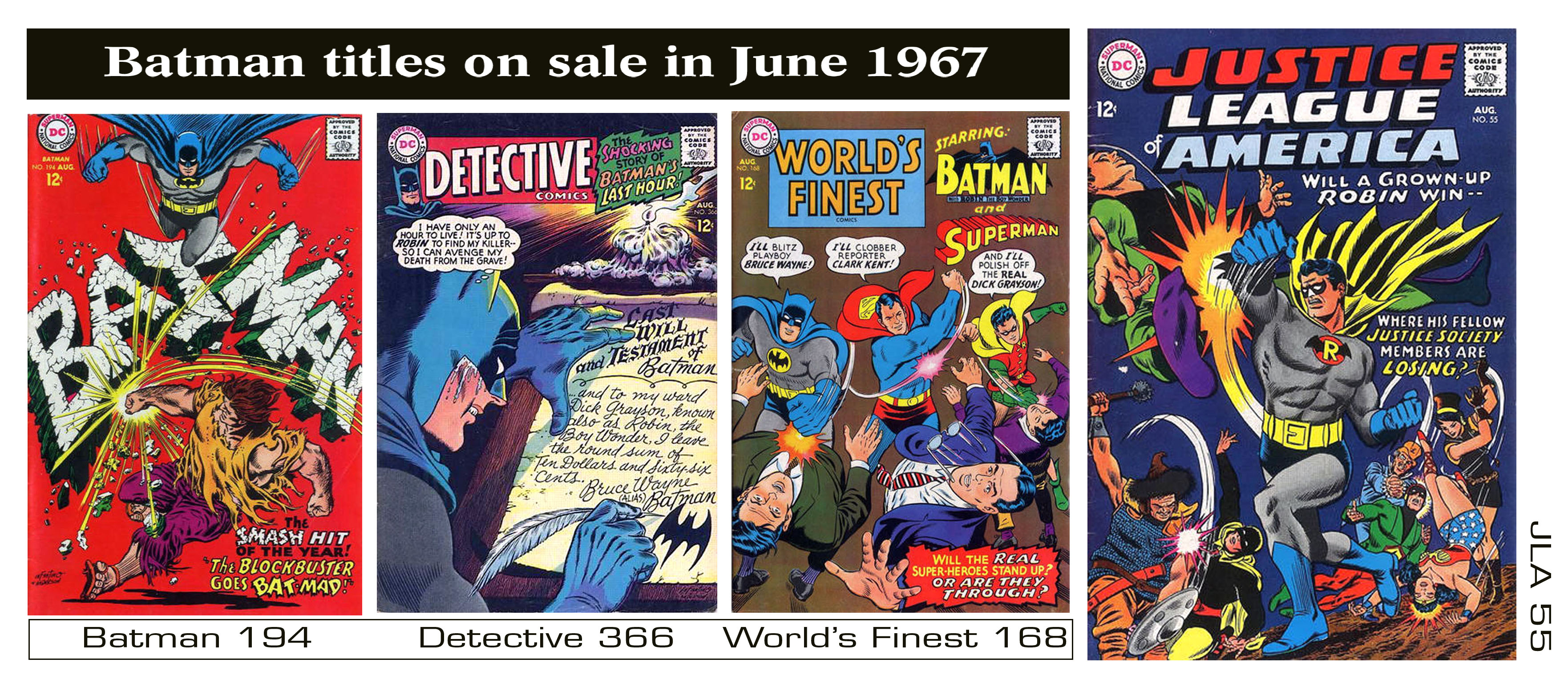
In 1967’s Justice League of America 55-56, though, the adult Earth-Two Robin appeared as the newest JSA member, with Batman “semi-retired.” Robin’s costume was an eye-catching amalgam of his Boy Wonder duds and Batman’s outfit.

“Why the Batman look in the ’60s?” asked Tim O’Keefe. “Easy. All connected to sales. The Batman TV series was at its height of popularity and DC was cashing in. Batman trading cards, Batman plastic models, Batman clothing. It was everywhere. If you notice, most Justice League of America covers of the era overemphasized Batman. It was pure marketing. That said, JLA 55 was the first comic I had as a kid and it hooked me on the JSA. After that, I felt that the Earth-2 Robin was the most underutilized hero of the group.”

The Man Wonder joined JSA and JLA members in thwarting the menace of black alien “energy spheres” that conferred super powers while causing moral derangement.

“(P)erhaps either (writer Gardner Fox) or (editor Julius) Schwartz (or both) just thought a grown-up Robin was a cool idea,” suggested comics historian Alan Stewart. “Which, actually, it was; although the costume could have used more work (and would, thankfully, be overhauled for the Earth-Two Robin’s later appearances.)”

From JLA 91


Monday, December 12, 2005

December 1965: Things Go a Little Batty


Something must have seemed oddly familiar to Bruce Wayne, that day in 1965.
Only a couple of years before, he’d been accustomed to being changed into bizarre forms — a King Kong-like giant, or a baby, or an old man, or a genie, or a mummy, things like that. Then suddenly, in May 1964, all that stuff stopped.
Oh sure, since then some pallid telekinetic weirdo calling himself the Outsider had been attacking him with witches and animated Batmobiles and stuff, and his young friend Mark Desmond had been Jekyll-and-Hyding into a super-strong monster called the Blockbuster.
But other than that, things had been relatively normal.
Then, in Batman 177 (Dec. 1965), the old weirdness returned with Two Batman Too Many!, a story penned by veteran scribe Bill Finger.
As usual, the cover’s beautiful art by Carmine Infantino promised more than what would be delivered by the interior, which featured the increasingly indifferent art of Sheldon Moldoff.
The story spotlighted a giant Batman and a tiny Batman, explained away as clay homunculi brought to life by a shaman’s magic (an explanation that would have sufficed by itself in the pre-1964 era).
In fact, it was a scheme concocted by Batman to trap numbers racketeer and jewel thief Ed Garvey. The large and small Batmen were revealed to be the Atom and a well-padded Elongated Man — two other characters from the stable of Julius Schwartz, the editor who’d been tasked with revitalizing the Batman titles in 1964 by using fresher art and slightly more “realistic” plots.

Thursday, March 3, 2005

March 1965: Reflections of a Golden Age


 They might have gone in another direction.

DC’s popular revivals of its 1940s superheroes had previously been revamps, stylistically refitting World War II characters like the Flash, Green Lantern, the Atom and Hawkman for the jet age. The trend had been so successful it had kicked off a whole new superhero craze in comics publishing.

But in Showcase 55 (March-April 1965), editor Julius Schwartz, writer Gardner Fox and artist Murphy Anderson decided not to create new “Earth One” iterations of Hourman and Dr. Fate, but instead simply revive the original “Earth Two” superheroes.

After all, Flash 123 had introduced the parallel worlds concept. And in Flash 137, Earth Two’s Justice Society of America — having been rescued from Vandal Savage’s stasis cubes by the Flashes — decided to come out of retirement.

So in Showcase 55, the older but presumably wiser Dr. Fate and Hourman teamed up to corral the original Green Lantern’s formidable archenemy Solomon Grundy.

And in Showcase 56, the Tick-Tock Thunderbolt and the Wonder Wizard battled a new Psycho Pirate who’d learned his skills as a cellmate of the original JSA super villain (something similar happened with Spider-Man’s foe the Vulture).

I loved Hourman and Dr. Fate’s pair of adventures, as well as the subsequent two-issue team-up of Starman and the Black Canary in Brave and the Bold and the revival of the Spectre in Showcase (all of them graced by Anderson’s sumptuous art).

But only the Ghostly Guardian won his own title, and even that was fairly short-lived.

Marvel Comics, which had been born in response to the earlier DC revivals, was by then setting the pace.

One wonders, though. What if Schwartz and company had decided to revamp and update Hourman, Dr. Fate, Black Canary and the Spectre? What might they have come up with?

Sunday, June 6, 2004

June 1964: A New Look for an Old Bat


After a quarter-century of ceaseless crime-fighting, Batman was clearly slowing down.

“Editor Julius Schwartz had helped engineer the superhero resurgence, and (DC publisher Irwin) Donenfeld was fond of his handling of The Flash, a bold, colorful title that had debuted in 1959,” explained Glen Weldon in The Caped Crusade: Batman and the Rise of Nerd Culture. 

“Donenfeld looked at the team behind that comic — John Broome on scripts, Carmine Infantino on pencils and Joe Giella on inks — and decided to issue an ultimatum. He called Schwartz and Infantino into his office and told them they were taking over the Batman books. If the two men couldn’t turn them around in six months, both Batman and Detective Comics would be cancelled.”

“(Schwartz) suspected that Donenfeld’s threat to cancel Batman was an empty one, given the Caped Crusader’s historical number two status in the publisher’s firmament of intellectual property.”

Nevertheless, however reluctantly, the team took on the assignment. Out went all those alien-ridden science fictional plots, and that cozy extended “Bat Family.” In came a sleeker, more grounded Batman whose chest emblem now included a discreet, colorful oval surrounding the bat silhouette.

“(B)y encapsulating the emblem within a yellow field, Infantino transformed it into an eminently reproducible and trademarkable symbol,” Weldon observed.

The New Look shift showed up in a few more updates within the narrative. Batman lost his butler (briefly) but gained a sportier 1960s Batmobile, and Commissioner Gordon acquired a substitute for the Bat Signal — his Hot Line to the Batcave (called the Bat Phone later on TV). 

That was an up-to-the minute reference to the presidential “hotline” that had recently been installed to connect the Pentagon with the Kremlin. Made a priority because the 1962 Cuban Missile Crisis had brought the world to the brink of nuclear destruction, the hotline was a Teletype system that became operative in 1963. The system was intended for text only because of the fear that speech might be misinterpreted.

Monday, May 5, 2003

May 1963: You’ll Never Lay a Glove on Him

“Like all comics readers, I was allergic to sports, but I LIKED Strange Sports Stories!” recalled Robert Rivard. 

“I first saw them in the 25-cent DC Special that reprinted some B&B stories, and then bought the series when it came out a few years later. I thought it was a great change of pace with some interesting sci-fi twists!"

Editor Julius Schwartz clearly enjoyed the concept, and promoted the series’ five Brave and the Bold tryout issues heavily in ads. But the series never landed its own title, and this handful of stories by DC’s top talents remain a pleasant curiosity.

In The Phantom Prizefighter (Brave and the Bold 47, April-May 1963), artist Carmine Infantino and writer Gardner Fox introduce us to Paul “Socko” Chase, a farmer who longs to be the heavyweight boxing champion.

Walking home along a lonely country lane, dejected because of his loss in a carnival boxing match, Chase encounters an invisible alien stranded on Earth by a damaged space ship. 

Significantly, the alien turns out to be tall, arrogant and red-skinned — a devil of a fellow who wants not Chase’s soul but his body, which he needs to pass safely pass through a radiation belt. In exchange, he’ll first make Chase an invincible prizefighter.

Weirdly, Chase agrees, but he’s angry when he learns that his invulnerability consists of being made intangible in the ring. 

He is able to defeat the alien with a semantic trick and a fistfight.

The cover image, of a prizefighter’s fist slipping through his opponent’s ghostly body, might well have looked familiar to older readers. Captain Comet had found himself in exactly the same position nine years before (Strange Adventures 43, April 1954) when he suddenly became intangible while fighting the world’s heavyweight champ. 

The superhero discovered that the anomaly was the result of an assassination attempt because a one-eyed, slug-like alien, disguised as an electrical technician, had tried to disperse his atomic structure. 


Friday, April 4, 2003

April 1963: In Brightest Day, In Swiftest Flight…

The Justice League teemed with teams within the team — Superman and Batman, Hawkman and the Atom, Green Arrow and the Martian Manhunter and a particular favorite, the Flash and Green Lantern.

“The third team-up between the two heroes was in 1963’s Green Lantern 20, titled Parasite Planet Peril,” noted John Peterson.  “When a phenomenon dubbed the vanishing plague causes people on earth to vanish over time, the Green Lantern and Flash team-up to try and prevent more people from vanishing. When the Green Lantern gets afflicted by the disease, he hands over his power ring to the Flash, hoping that the power of the ring could prevent (him) from vanishing.”


In between missions to protect Earth from alien invaders, Barry Allen and Hal Jordan had time to relax together with their girlfriends Iris West and Carol Ferris, providing a cozy, cheerful view of young adulthood in the Camelot era.

To a child, this seemed like an ideal way to grow up.

Nor did it seem strange to me that all four were young professionals — a police scientist, a test pilot, a magazine photojournalist and the owner/manager of an aircraft manufacturing company. 

Of course women would want to have lucrative, challenging and creative careers, just like men. Why wouldn’t they?

Call it the Schwartz Effect. The comics Julius Schwartz edited took the emancipation of women for granted, consistently sending the young readers a message that didn’t seem to be a message at all.

Another fact about these stories that jumps out at me now is that while Hal calls his Eskimo pal “Pieface,” Carol addresses him respectfully as “Thomas.”

Good for you, Carol.


April 1963: A Small Dose of History


A reliable method of time travel can prove to be particularly handy, and many superheroes had one.

The Flash had his century-shifting Cosmic Treadmill, for example, and the Atom had the Time Pool.

Ivy University Prof. Ray Palmer’s former teacher, Prof. Alpheus V. Hyatt, had developed a device that combined several rays of light to form a small circle capable of piercing time. 

Hyatt used it like an ice fishing hole, probing for historical curiosities — not knowing his friend Ray could become small enough to travel through the time portal himself.

In the first of the Time Pool stories, Ray posed as a genie for Sinbad’s grandson, inadvertently inspiring an Arabian Nights tale (The Secret of ‘Al Atom’s’ Lamp! The Atom 3, Oct.-Nov. 1962).

In the second such story, writer Gardner Fox and artists Gil Kane and Murphy Anderson send the Atom to 1739, where he crosses paths with the infamous English bandit Dick Turpin (The Highwayman and the Mighty Mite! The Atom 6, April-May 1963).

Turpin, a real-life burglar, horse thief and killer, became known for a fictional 200-mile overnight ride from London to York on his horse Black Bess. 

“Fox makes Turpin be a relative of Ray Palmer, claiming his name is really Tom Palmer, and Kane draws him to look an awful lot like the Atom himself,” noted comics historian Michael E. Grost.

And that, I think, was a wink from Fox. The romanticized criminal — a domino-masked adventurer with a secret identity — is in fact a distant ancestor of the superhero, at least in terms of popular culture.

Fiction turned the brutal robber into the Robin Hood of Epping Forest. He appeared as a hero in penny dreadfuls — the 19th century equivalent of comic books — and in a 1925 silent film in which he was portrayed by cowboy star Tom Mix. 

In that movie, Turpin saves two women from rape at the hands of highwaymen, saying, “Dogs! You’re a disgrace to the profession!”


Sunday, February 2, 2003

February 1963: The Alien Invasion on the 18th Hole


Having always had somewhat less than no interest in spectator sports, I shouldn’t have been expected to embrace a 1963 comic book called Strange Sports Stories.
That I had any interest in it at all was entirely due to the talents of writers Gardner Fox and John Broome, artist Carmine Infantino and editor Julius Schwartz, who had refined the optimistic, sunlit, linear-landscaped science fiction stories they created for Strange Adventures and Mystery in Space into a distinctly odd sub-genre.
Where else might you find intangible prizefighters, invisible baseball teams or rocket-sledding golfers who had to overcome alien spaceships instead of water hazards?
But the concept never progressed beyond five tryout issues in The Brave and the Bold, so general interest in it was apparently as tepid as my own.
Presumably kids who wanted to play baseball were out doing it, while those who wanted to read comics were sprawled on the living room carpet doing that.
Strange Sports Stories explicitly tried to bridge that gap by providing more than one story (Goliath of the Gridiron, The Hot-Shot Hoopsters) about young intellectuals who become literally fantastic athletes. In Hoopsters  (The Brave and the Bold 46, February-March 1963), undersized kids aged 12 to 14 — certainly part of the target audience for this title — use their scientific knowledge to outperform top college basketball players.
But after all, why be a mere star athlete when, with the same mental leap, you might be a superhero? That left Strange Sports Stories falling short, an idea whose time never came.

Thursday, October 10, 2002

October 1962: The Tiny Titan’s Time Trials

Super-villains didn’t ordinarily rate a big build-up in DC Comics house ads, but Chronos the Time Thief got one for his debut in The Atom 3 (Oct-Nov. 1962).
With one or two notable exceptions, the Atom’s antagonists had up to then been fairly ordinary crooks. So editor Julius Schwartz’s spotlight on the caped and colorful — well, garish actually — Chronos may have been an attempt to begin to build for the Atom the kind of rogue’s gallery that had helped make the Flash popular.
Created by writer Gardner Fox and artist Gil Kane, Chronos was precisely the kind of concept-obsessed arch-criminal who was constantly turning up in the Scarlet Speedster’s Central City.
“The tale has a neat cover by Kane, showing the Atom in the watch, but the minor tale written around it is by the numbers,” observed comics historian Michael E. Grost. “Chronos is the sort of theme-oriented villain found more often in John Broome’s Flash stories: everything he does is related to time. Just as in Broome’s tales, we see the villain starting out as an ordinary convict, learning and obsessing over time, developing his persona, working as a watch repairman and horologist, etc. Broome does all this with a lot more pizzazz.
“Fox was always a lot more interested in his heroes than in his villains, which is not necessarily a bad thing! One can compare a far more successful tale written by Fox with a horologist hero: The Invisible Dinosaur (Strange Adventures 133, October 1961).
The issue also introduced an intriguing, popular running series about Prof. Alpheus V. Hyatt’s  “Time Pool” — a time warp so small only the Atom could travel through it — in The Secret of Al Atom’s Lamp. The Ivy Town university setting of the Atom’s stories made it easy to drop technological innovations into the plot. This tale marked the second time in a handful of issues when a tiny super-scientific figure had been identified with an Arabian nights genie.


Sunday, September 9, 2001

September 1961: Those Thrilling, Time-Lost Titans

For the 10-and-under crowd, Showcase 34 contained not only the debut of a new superhero, but a thrilling surprise.

A text feature gave us our first glimpse of something we’d never heard of or suspected: a 1940s superhero team like the Justice League of America called the Justice Society of America.

The Spectre? Dr. Fate? Hourman? Sandman? Weirdly costumed alternate versions of the Flash, Green Lantern, the Atom and Hawkman? Just who were these tantalizing titans, anyway? Time would tell us…

The JSA’s founding members ranged from a crime-crushing ghost who was virtually omnipotent and a man who wielded a wish-fulfilling Aladdin’s ring to a stout, tough-talking matron whose mask was a pot with eye holes.

Also on the lower end of that power scale was a undersized college kid whose power was lifting weights — Al Pratt, the original Atom.

“Anyone who knows the Atom in his 1961 incarnation knows the two characters have nothing in common,” observed Pappy’s Golden Age Comics Blogzine. “I have said that DC used the old name, but appropriated the powers of Doll Man. Doll Man had been moribund since 1953, and then the publisher, Quality Comics, was sold to DC in ‘56.”

The Atom’s Silver Age makeover was a more radical revamp than the Flash, Green Lantern or Hawkman’s had been. The 1940s’ origins of the latter characters had been soft-peddled in their titles, but with the Atom editor Julius Schwartz clearly decided that a fuller explanation was in order.

The three-page text feature included background on the original Atom and the JSA, as well as mini-autobiographies on writer Gardner Fox and artists Gil Kane and Murphy Anderson.

“When my long-time editor Julie Schwartz presented me with the task of creating an ‘Atom,’  I began dipping into a memory that stores the faces of almost every movie star and bit player since the 1920s, and I decided on Robert Taylor as a basis for Ray (The Atom) Palmer,” Kane explained.

September 1961: Shrinking, But Not from a Fight

He was a superhero smaller even than the children who read his adventures, but nevertheless trickier and stronger than the irritating adults who told them what to do.
The formula had worked before, during the 14-year run of Doll Man in Feature Comics and his own title. So editor Julius Schwartz, writer Gardner Fox and artist Gil Kane redeployed it in the redesign and re-launch of their 1940s super-scrapper the Atom.
No longer an undersized college student with super strength, in Showcase 34 (Sept.-Oct. 1961), the new Atom was Ray Palmer, another of Schwartz’s and Fox’s space-age scientist-heroes dedicated to reason and education.
The first story in the issue told us, in leisurely detail, how an Ivy College physics professor acquired the power to shrink from dwarf star matter and used it to rescue trapped spelunkers.
The second story put him in costume and pitted him against one of those mirror-image foes so favored by superheroes — in this case a diminutive extraterrestrial teleporter named Kulan Dar who, when mentally enslaved by a criminal, resembles a genie from a bottle.
Palmer’s girlfriend Jean Loring doesn’t want to marry him until she’s established herself as a successful attorney, so the help the Atom frequently provides her on her legal cases isn’t entirely altruistic — he’s working to hasten the day when they can wed.
The first and most successful of Schwartz’s Golden Age superhero revivals, the Flash, worked up any number of crime-fighting tricks with his super speed, so the Atom played similar crowd-pleasing variations on the theme of shrinking.
While retaining his full-size strength, he could ride the winds by reducing his weight. The effective invisibility provided by his small stature proved useful to the CIA. The Atom could shrink into subatomic worlds, and even paradoxically appear as a giant there. His neatest trick was the ability to ride along on a telephone call, meaning that he could virtually teleport himself instantly to almost any spot on Earth.


Saturday, July 7, 2001

July 1961: Ghosts and Shadows

The Gentleman Ghost,
a character created by Robert Kanigher who first appeared in Flash Comics 88 (Oct. 1947), was an elusive mysterioso foe of Hawkman throughout the late 1940s.
But the postwar world was a new one, facing fears of atom bombs and flying saucers, not things going bump in the night. Eventually, even in children’s entertainment, the supernatural was de-emphasized in favor of the super-scientific.
So Hawkman received a jet-age reboot from editor Julius Schwartz not as an occult reincarnation but as an alien police officer from the planet Thanagar (Brave and the Bold 34, Feb.-March 1961).
I suspect writer Gardner Fox, wanting to recapture some of that 1940s magic, created an arch-criminal similar to the Ghost whose powers would be pseudo-scientific rather than supernatural. He debuted in Brave and the Bold 36 (June-July 1961). In both cases, Joe Kubert did the art, and the covers are among his best.
So Carl Sands, after saving alien explorer Thar Dan of the Xarapion dimension, was rewarded with a Dimensiometer, a device that transformed him into the intangible, incorrigible Shadow Thief.
Of course, it could be that the parallels between the Gentlemen Ghost and the Shadow Thief are accidental. Superhero comics frequently play variations on a theme, and concepts get reincarnated as least as often as Hawkman and Hawkgirl.
Hawkman’s mission to capture Sands was more urgent than he realized, because only the comic book’s readers were told that overuse of the Dimensiometer would wreck human civilization by causing global climate change.
Hard for even a spook to compete with a scare like that.


    Saturday, January 1, 2000

    January 1960: Big Purple Beasts and the Borg

    I wonder if the purple simian-ish creature in I Was a Bodyguard to a Beast (My Greatest Adventure 39) counted toward DC’s monthly maximum quota on gorilla covers?

    I’m guessing not.

    Meanwhile, in the Space Ranger story in Tales of the Unexpected 45, artist Jim Mooney shows us a criminal’s “army of specially trained interplanetary beasts” that might have made appropriate foes for the Legion of Super-Pets a couple of years later.

    Come to think of it, Space Ranger’s Cryll and Chameleon Boy’s Proty were a lot alike. Cryll and the Martian Manhunter’s Zook might have fit right in with the Legion of Super Pets.

    Such are the kinds of thoughts that jolt me awake at night.

    Strange Adventures 112 includes a Gardner Fox/Mike Sekowsky cover story and a Space Museum story, Revolt of the Spaceships!

    “The Space Museum tales center on a 25th Century museum filled with objects commemorating heroic deeds leading to the conquest of space,” noted comics historian Michael E. Grost. “Each tale would involve a visit by Howard Parker and his young son Tommy Parker. Howard would tell Tommy the story behind one of the objects in the museum.

    “The Space Museum tales sometimes contained science fiction mysteries; near the end of each tale, Howard would pause, and urge Tommy to find a clue that would solve the mystery. The effect is similar to Ellery Queen’s Challenge to the Reader.”

    The issue also includes a John Broome/Sid Greene story intended to underline editor’s Julius Schwartz’s running theme about celebrating the intellect. 

    In Tomorrow’s Hero, mutant Ral Grayson has the ability to understand things instantly by just seeing a portion of the process, a power he employs to stop an alien invasion.

    The invaders’ name? The Borg.

    Sunday, October 10, 1993

    October 1953: DC Goes to the Dogs

    If you ever need a dog to fight a dinosaur, Rex is game.
    This white German Shepherd — or “Alsatian,” as they say in Europe — was plucky enough to tackle not only a Tyrannosaurus rex but also various lions, wolves, bears and octopuses during his healthy seven-year run in his own comic book.
    “Rex debuted in his own regularly published title, with a first issue cover date of Jan-Feb, 1952,” noted comics historian Don Markstein. “The opening story was written by Robert Kanigher (editor of Wonder Woman and DC's war comics) and drawn by Alex Toth (former Green Lantern artist who went on to create Space Ghost). The same team had earlier created Johnny Thunder. The editor was Julius Schwartz, who at the time also edited DC’s western and science fiction comics, but is best known for his work a few years later on The Flash, Green Lantern and other 1960s superheroes. Starting in the fourth issue, Rex had a back-up feature, Detective Chimp.”
    Trained by the U.S. Army's K-9 Corps, Rex lived with the Dennis family and eventually helped scientist John Rayburn, who took Rex on subatomic adventures that anticipated the Atom’s.
    Other DC Comics wonder dogs — all products of the 1950s — would include Krypto, Ace the Bat-Hound and Pooch, another German Shepherd who helped Gunner and Sarge on a Pacific island during World War II. An earlier DC wonder dog, Streak, eventually replaced the original Green Lantern as the star of his own magazine.