June 1938: A Superman for the Underdog

On the newsstands in May 1938, browsers had their choice of Tarzan in Comics on Parade, Popeye in King Comics, daredevil aviator Captai...

Showing posts with label Dramatic radio. Show all posts

Thursday, March 3, 1988

March 1948: The Biggest of All Game

By the time Harvey Comics’ Green Hornet Fights Crime 38 appeared on the newsstands in February 1948, the title was a bit redundant. 

After all, the Green Hornet was then a more famous crimefighter than even Batman.

By then, the masked publisher had already been fighting crime for a dozen years on radio, the heir to the mission of his even-more-famous great-uncle, the Lone Ranger.

Fran Striker and George W. Trendel’s Detroit-based Green Hornet radio adventures originally aired for 16 years, and listening to them made me realize that the character’s crime-fighting strategy is much better worked out than most. 

It’s really almost plausible in comparison to, say, Batman’s or Spider-Man’s. 

Posing as a mysterious master criminal, Britt Reid is able to infiltrate and intimidate criminal operations that are often marginally within the law. When he exposes and destroys them, it’s dismissed as the action of a rival gangster, and no one figures out what he’s really up to. He also has the resources of a major newspaper to back up his operations and provide him with intelligence. 

The approach was pretty well thought out, and retained those flashy superhero elements that made the Lone Ranger so successful — the mask and costume, the symbolic weapon, the daring and faithful friend, the spectacular and speedy transportation.

Trendle said he sought to “…show that a political system could be riddled with corruption and that one man could successfully combat this white-collar lawlessness.” 

Britt Reid initially hunted “…the biggest of all game! Public enemies that even the G-Men cannot reach!” But that perennial national busybody J. Edgar Hoover didn’t like the implication, so the announcer’s line was changed to “…public enemies who try to destroy our America!”

The Green Hornet’s licensed comic book adventures began in 1940 with Holyoke, but in 1942 switched to the more durable Harvey Comics for a lengthy run under various titles, including Green Hornet Comics, Green Hornet Fights Crime and Green Hornet, Racket Buster.


Wednesday, December 12, 1984

December 1944: Truth, Justice & the Tibetan Way


One of those powers the Green Lama acquired in Tibet must have been adaptability.
Though little-known now, the Green Lama was a fairly important American superhero in his day, a crossover character in three media — pulp magazines, comic books and dramatic radio.
In the pulps where the Buddhist superhero first appeared, he was like the Shadow. In comic books in the 1940s, he was like Superman. And on radio, he was like the Saint.
The Green Lama, who was really millionaire Jethro Dumont, was created in 1940 by pulp writer Kendell Foster Crossen as an assignment from Munsey Publications. His mission was to duplicate the success of the pulp and radio Shadow.
“I was trying to pick a name somewhat like in sound to Lamont Cranston,” Crossen recalled.  “You know what I mean, Lamont-Dumont. It was as close as I dared get to Lamont Cranston. A book had just been published about an American who had gone to Tibet and studied and had become a lama, the only white person who ever had at that time. The result was the Green Lama, which the company liked.”
Sales of Double Detective Magazine jumped for the issue when the Green Lama appeared. Unlike other superhero creators, Crossen wisely retained the rights to his character.
When the Lama’s pulp magazine ran its course in 1943, Crossen spring-boarded the character as a rival for Captain Marvel and Superman. The Green Lama’s comic book adventures for Spark Publications benefited from art by the much-admired Mac Raboy.
In comics, the now-caped Green Lama could fly and smash Japanese Zeroes. But even in pulps, he had some modest super powers. He could, by ingesting “radioactive salts,” stun criminals with a gentle touch. Seems more fitting for a Buddhist hero than a teeth-rattling haymaker, somehow.
In 1949, as the comics’ superheroes were fading, Crossen sold the character to CBS as a radio series, and the Green Lama almost made it into onto early television.
Golden Lad gives a pitch for the Green Lama Club


Monday, December 12, 1983

December 1943: When Green Lantern Met the Shadow (Sort Of)

Comic book readers must have had an odd sense of déjà vu when they tuned to The Shadow on the Sunday afternoon of Dec. 10, 1944.

In the episode The Immortal Murderer, they heard invisible avenger Lamont Cranston confront a Neanderthal museum exhibit come to life, a 100,000-year-old super-villain who called himself Adam Cain. 

Explaining that he had effectively been made immortal by radioactive gases, Cain reveals that he knows the Shadow’s secret identity and offers him a partnership in plundering the world.

But wait a minute.

That was virtually the same plot as DC’s Green Lantern 10, the Winter 1943 issue that had appeared on newsstands a year before. 

Like Cain, the million-year-old Vandal Savage became immortal by inhaling weird gases. Like Cain, Savage offered the superhero a villainous partnership and, like Cain, his long experience had given him the smarts to figure out the superhero’s secret identity.

“You know!” exclaimed the nonplussed Green Lantern.

“But of course!” replied Savage. “I have been watching your movements for some time. The mere application of symbolic logic to the 6th degree led me to that inevitable conclusion.”

The inevitable conclusion that the listeners might have reached is that both stories had been dreamed up by the same person, and they’d have been right. The writer was Alfred Bester, later a celebrated science fiction author, who had recycled his Green Lantern story for The Shadow.

Bester appreciated the springboard comics gave him. “The comic book days were over, but the splendid training I received in visualization, attack, dialogue and economy stayed with me forever,” he recalled.

Cranston locked himself into an airless bank vault with Cain in an attempt to destroy them both, but luckily Margot Lane turned up to accidentally shoot the Neanderthal through the heart. Green Lantern’s ring drilled a bottomless pit beneath Savage’s feet, but unlike Cain, the million-year-old monster returned many times to menace humanity.

Vandal Savage returned in the early 1960s.

Tuesday, July 7, 1981

July 1941: Fliers and Funnies

In the 1990s Britcom Keeping Up Appearances, Hyacinth Bucket’s dotty old dad sometimes dashes about performing imaginary feats of derring-do as “Captain Midnight.”

Even then, that was a name probably only vaguely familiar to many in the audience. But the character — an aviator cum superhero created for radio — was famous in the 1940s.

“By the end of the 1930s there were radios in 28,700,000 homes offering a daily smorgasbord of news, information and entertainment,” observed Kurt F. Mitchell in the American Comic Book Chronicles. “Like film, radio was a national medium. The Lone Ranger, Amos 'n' Andy, The Green Hornet, Baby Snooks, Fibber Magee and Molly, Ma Perkins, Captain Midnight, Henry Aldrich and other characters born on radio became cultural touchstones, their catchphrases and theme music recognized from coast to coast.”

On radio from 1938 to 1949, Captain Midnight branched out into a movie serial, a newspaper strip, a TV show, Big Little Books and more than one comic book series.

Dell’s Funnies featured the ace aviator in issues 57-64, 1941-1942.

“The comic book series, drawn primarily by Dan Gormley, followed the program's continuity faithfully: World War I flying ace Jim Albright was chosen to head the Secret Squadron, a paramilitary air force answerable only to a high-ranking government official code-named ‘Mr. Jones,’” Mitchell noted. “Alongside his teenage ward Chuck Ramsey, Midnight and the Squadron opposed the machinations of criminal mastermind Ivan Shark and his beautiful but wicked daughter Fury.”

Fawcett Comics gave the good captain a more superheroic vibe, starring him in a title that ran for 67 issues, 1942-48. There, the intrepid inventor-aviator fought crime with the aid of a gliderchute that allowed him to sail through the air, blackout bombs, a doom-beam torch and a belt transmitter that linked him to his Secret Squadron.

Then, in 2013, Dark Horse used a freak storm to propel Captain Midnight into the 21st century for the space of 24 issues. 

Captain America could commiserate with him.

Tuesday, November 11, 1980

November 1940: When Superman Wasn’t So Tough

Even by 1940, Superman wasn’t quite so super.

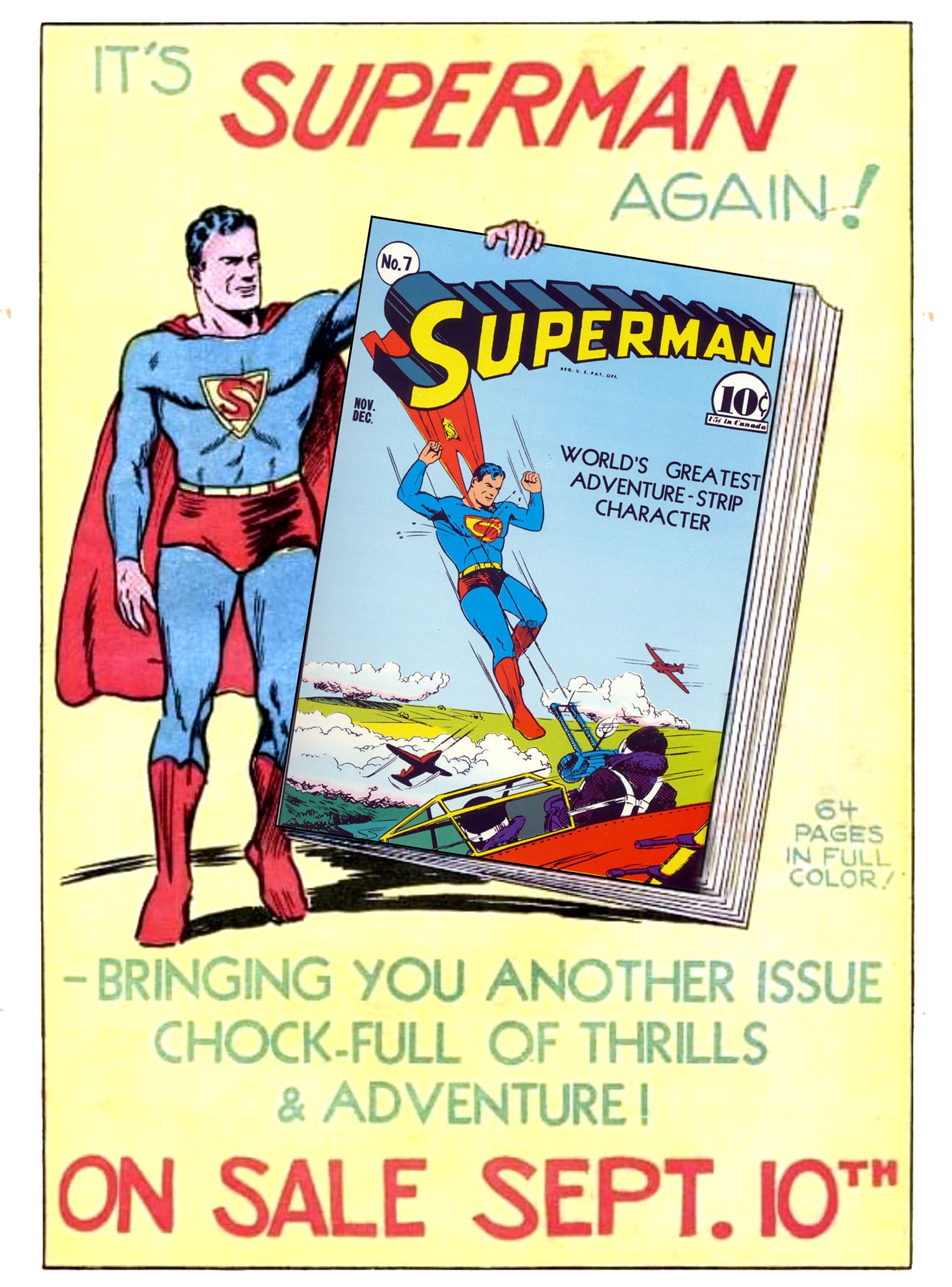
Two years after his debut, the Man of Tomorrow could still be rendered unconscious with a diabolical gas developed by the evil scientist Kotzoff (Superman 7, Nov. 1940) or the fiery “globe gun” wielded by the Middle Eastern conqueror Zolar (Action Comics 30, Nov. 1940).

Elsewhere in the Superman title that busy month, the Man of Steel corralled Nick Norton, a gangster who tried to frame a Metropolis prosecutor for murder, and protected another honest lawyer, Bert Runyon, who was attempting to clean up public corruption. Superman also ended a string of brutal night club robberies performed by the hooded thugs of the Black Gang, exposing their leader as Peter Peeker, a gossip columnist on the Morning Pictorial.

The two comic books appeared on the newsstands in September 1940. 

Meanwhile, on radio, Superman was involved in the adventure of Professor Thorpe’s Bathysphere. In his daily newspaper strip, Superman battled the Hooded Saboteur, a fascist terrorist. “By wrecking utilities, he hoped the sick and weak would die, making civilization return to a simpler, hardier way of living!”

And in the Sunday newspapers, trouble brewed when Lois Lane inherited 5,000 acres of land from her uncle. 

The land turns out to be rich in radium, but Lois elects to remain a “sob sister” and gives the millions to charity.

Her deceased uncle’s name? Bill Bixby.

That same month, in Hollywood, production began on what would have been the first Superman movie serial, The Mysterious Doctor Satan.

“(B)ut the license National Comics provided to the Fleischer Studios to make their Superman cartoon series was exclusive and therefore prevented other film companies from using the character,” Wikipedia notes. “The script was subsequently reworked with a new character standing in for Superman. The Copperhead’s love interest, Lois, had only her surname changed between these drafts, while his secret identity, down to the surname, mimicked Batman’s Bruce Wayne, National’s other major comic book character.”


Monday, May 5, 1980

May 1940: The Sinister Sound of a Beetle

“This mysterious, all-powerful character is a problem for the police, but a crusader of the law!” intoned the announcer. “In reality, Dan Garret, a rookie patrolman loved by everyone, but suspected by none of being the Blue Beetle! As the Blue Beetle, he hides behind a strange mask and impenetrable chain armor, flexible as silk, but stronger than steel!”
Created in 1939 by Charles Nicholas Wojtkoski, the character’s name, obviously, was meant to evoke the popular radio character the Green Hornet.
“The Beetle was an obvious swipe of George W. Trendle’s radio hero the Green Hornet, not just in look and name, but also in modus operandi: both were vigilantes posing as criminal masterminds,” noted Christopher Irving in TwoMorrows’ Blue Beetle Companion.
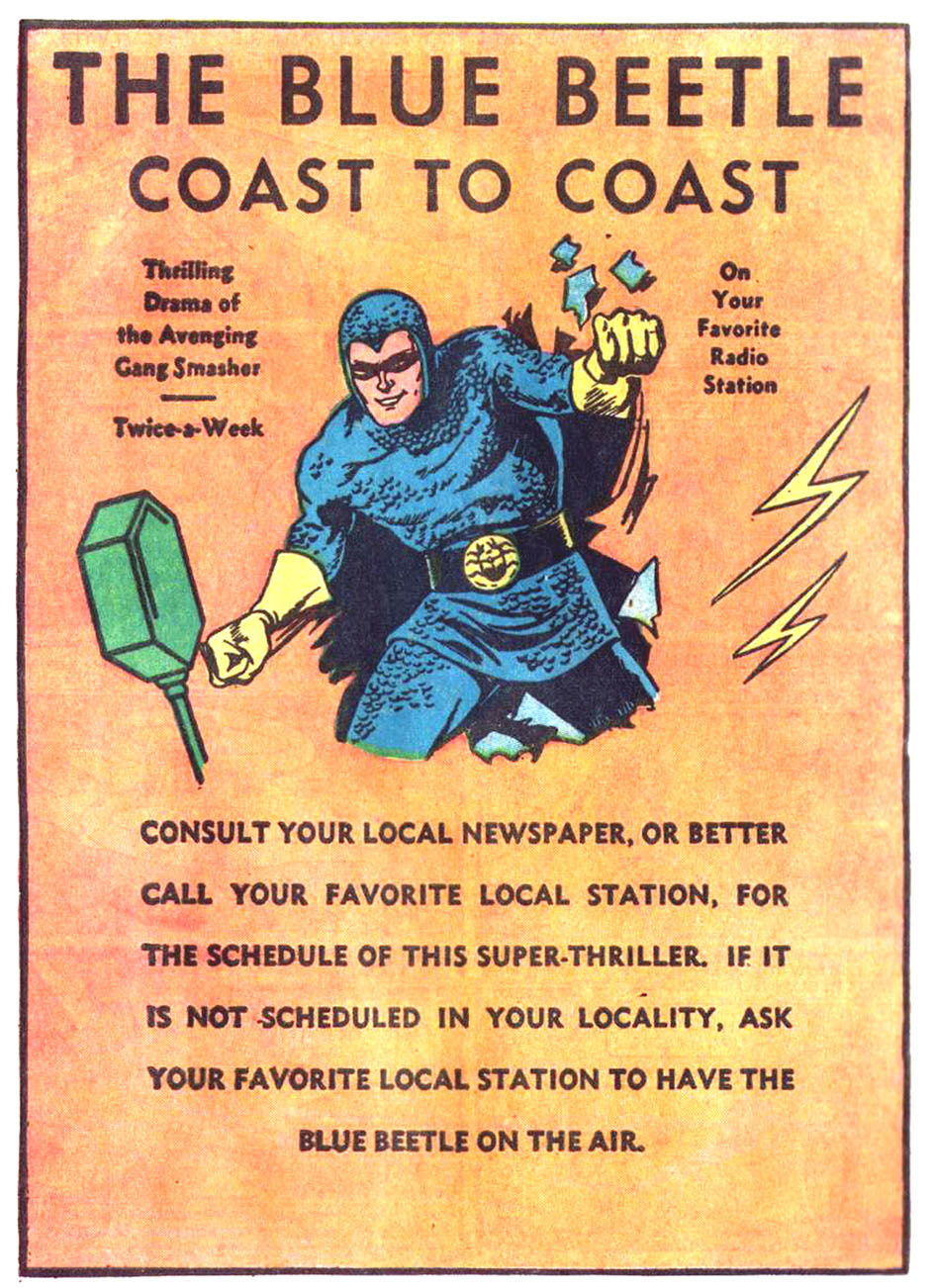
The superhero sprang from the fly-by-night publishing operation of the agile, oily Victor Fox. Fox even managed to promote a short-lived radio series for the character.
“Frank Lovejoy, who would eventually become a prolific radio and movie actor … voiced the Blue Beetle,” noted Irving. “Lovejoy brought a rather maniacal, almost sadistic cackle to the character… His tough-guy banter; his voice going grim when dealing with criminals, or buoyant when around the leading lady of the episode, his cackle when he blows thugs away … all paint the picture of a crimefighter scarier than Superman or the Green Hornet.”
Like his comic book counterpart, the radio Beetle gained superhuman strength and stamina from Formula 2X. But he also picked up and dropped various other super gimmicks during the show’s 48 episodes, including an electric ray, an X-ray camera, a formula to melt steel and paint that rendered him invisible, like radio’s Shadow.
Why did Lovejoy leave the role after only a handful of the 48 episodes? Radio historian Jim Harmon guessed that it may have been because he wasn’t paid — a move pretty typical of Fox.
Although few recall it now, MLJ’s Black Hood and Spark’s Green Lama also made brief forays into radio.

Tuesday, October 10, 1978

October 1938: A Man Called Midnight


A mystery-man combat pilot who originally flew out of Chicago’s WGN radio in 1938, Captain Midnight’s serial adventures went national in 1940 on Mutual Broadcasting as Ovaltine’s replacement for Little Orphan Annie. 

“By the time Captain Midnight came to Mutual, the adventure serial was firmly established as an early-evening must for millions of Midwestern kids,” wrote John Dunning in Tune in Yesterday. “The show developed the themes they liked best: action, mystery, a master villain and plenty of peer identification. Like the ever-popular Jack Armstrong, Captain Midnight even had a girl along for the ride.”

Developed by Robert Burtt and Wilfred Moore, the show was purportedly inspired by Burtt’s exploits as a World War I combat pilot in the Lafayette Escadrille.

“Burtt conceived Midnight as a man of mystery whose job in the war was so important that not even his superiors knew his identity,” Dunning noted.

Returning from a dangerous solo mission at the witching hour, a young airman earned himself the nom de guerre “Captain Midnight.” 

“For 20 years, strange stories were whispered about ‘a shadowy plane and a mysterious pilot who, whenever trouble started in any part of the world, was certain to come diving furiously from the night sky.’” Dunning wrote.

Immensely popular, the good captain expanded to comic books in Dell’s The Funnies and Popular Comics, but really came into his own when Fawcett gave him his own title in 1942.

In the Fawcett version, Captain Midnight was a scientific genius who wore a red glider suit emblazoned with his clock insignia, and wielded such crime-stopping inventions as a “drill tank,” a flying aircraft carrier, a “swing spring” grappling hook and his “doom beam torch,” used to mark enemies and penetrate walls.

In both the Fawcett comic and a 1942 Columbia movie serial, Captain Midnight was a full-fledged superhero whose secret identity was Jim Albright.

A newspaper comic strip based on the radio program ran from 1942 until the late 1940s.

A 1944 sequence from the Captain Midnight newspaper strip

October 1938: Avengers of Many Colors

The Green Hornet was clearly popular in 1938 — so much so that DC Comics offered two comic book pastiches of the radio superhero.

An urbanized, updated version of the Lone Ranger, the Green Hornet had debuted on WXYZ radio in Detroit in 1936. By the spring of 1938, the show was being heard nationally on the Mutual network.

And in Detective Comics 20 (Oct. 1938), the Crimson Avenger took a bow.

“Whereas in reality the Hornet was Britt Reid, daring young publisher of the Daily Sentinel, the Crimson Avenger was Lee Travis, daring young publisher of the Globe Leader,” noted comics historian Ron Goulart. “The only person who knew the Hornet’s true identity was his faithful valet, Kato, and the Crimson Avenger’s secret was shared only by his Chinese servant, Wing. Like the Green Hornet, the Crimson Avenger never used a deadly weapon and preferred to put his adversaries to sleep with a blast from his gas gun. He wore a dark blue slouch hat, a domino mask and an Inverness-style cape of crimson hue.”

Elsewhere in Detective Comics 20, you could find a house ad for the More Fun Comics feature the Masked Ranger — DC’s version of the Green Hornet’s great-uncle, the Lone Ranger.

A little later, in Adventure Comics 40 (July 1939), DC provided readers with another masked, gas-gun-wielding man about town in a business suit. The Sandman added a cape to the ensemble.

“It’s anybody’s guess whether the Sandman was inspired by Superman or (like the Crimson Avenger) the Green Hornet,” observed comics historian Don Markstein.

Hornet or no Hornet, both the Crimson Avenger and the Sandman were examples of an evolution in melodrama already underway in comic books.

“Masks, hoods and villains with colorful names were becoming the norm in the stories even though many of them were still the evil Orientals at this stage,” noted comics historian Steve Thompson.

And Lee Falk’s Phantom had been haunting the funny pages since 1936.