June 1938: A Superman for the Underdog

On the newsstands in May 1938, browsers had their choice of Tarzan in Comics on Parade, Popeye in King Comics, daredevil aviator Captai...

Showing posts with label Superman. Show all posts

Friday, September 10, 2010

October 1970: When Kirby Met Kent

In August 1970, at age 16, I was no longer reading many comics. But I knew I had to have a copy of Superman’s Pal Jimmy Olsen 133.

Jack Kirby, the Marvel visionary, coming to DC? I must say, the mind reeled.

So, like a lot of other readers, I picked up Jimmy Olsen 133, the first issue of that title I’d purchased in several years. It did seem odd that Kirby’s first new DC efforts were published in the moribund Jimmy Olsen title,

“Pete Costanza (Nemesis, Captain Tootsie) was the artist handling Jimmy's comic when Jack Kirby (Devil Dinosaur, Sky Masters) moved from Marvel to DC in 1970,” explained comics historian Don Markstein. “Since Costanza was planning to retire, Kirby could replace him without worrying about anybody getting thrown out of work. Thus, Jimmy was catapulted into Kirby’s Fourth World multi-title storyline, which also included The New Gods, The Forever People and Mister Miracle.

I remember being particularly interested in examining Kirby’s take on Superman. I wanted to see Kirby’s dynamism injected into my favorite character.

I also remember suspecting that Kirby’s Superman faces had been redrawn. No matter. This Superman hurtled along in reckless Kirby abandon, and that’s what I wanted to see. 

Even Superman’s heat vision looked more formidable when Kirby drew it. Kirby knew that superheroes were about power, and he took care to put that on the page.

I also noticed that Kirby’s characterization of Superman didn’t quite tally with DC’s established one. Superman did not generally moan about being lonely the way he did in the first issue of Forever People. Nor would DC’s established Man of Steel have considered leaving Earth to live with some tribe of super strangers. He was too dedicated to his mission for that.

But again, no matter. Here, Kirby was merely anticipating events. Superman’s sense of himself as an isolated outsider on Earth was a theme writers would return to repeatedly in later decades.

Sunday, June 6, 2010

June 1970: An Assembly of Archenemies


In 1970, Murphy Anderson provided us with a group portrait of the main enemies who had bedeviled the Man of Tomorrow over the three previous decades.

I never had much patience with those 1940s goofballs the Prankster, the Puzzler and the Toyman, three lame tricksters who shouldn’t have been a challenge to Batman, let alone Superman (in fact, Batman battled his own Puzzler).

But that other trickster, Mr. Mxyzptlk, was another matter. 

A being from a higher dimension than our own, the imp’s omnipotence overshadowed even Superman’s vast powers. Luckily, this ancestor of Star Trek’s Q really only wanted to play games.

Both Robert Mayer’s Superfolks and Alan Moore’s Whatever Happened to the Man of Tomorrow? deal with the chilling consequences of what would happen if Mxyzptlk decided to stop being mischievous and start being evil.

Naturally I’ve been impressed by Lex Luthor, who evolved from criminal scientist to criminal capitalist. The persistent arch-foes Luthor and Brainiac represent the yin and yang of Superman’s enemies, the human and the alien.

The power-draining Parasite is the newcomer here, having been created by writer Jim Shooter in 1966 (when he was 15).

Finally we have a sinister quartet from the spooky Phantom Zone: General Zod, Jax-Ur, Kru-El and Professor Vakox. This twilight dimensional prison was introduced in the comics in Adventure Comics 283 (April 1961), but had been prefigured in the 1950 movie serial Atom Man vs. Superman.
Jor-El’s discovery of the Phantom Zone has proven to be as enduring as the criminals who inhabit it.

The zone was a neat solution to the problem of how an advanced alien civilization might be able to sidestep capital punishment — even though banishment to an eternal incorporeal existence seems a fate almost worse than death, when you think about it.

The Phantom Zone even served to save the life of Superman’s “brother,” Mon-El, by removing him from exposure to lead, a substance fatal to him that’s prevalent on our planet. 

Sunday, September 9, 2007

September 1967: That’s Nice, That’s Terrific

Superman editor Mort Weisinger often took his story cues from the popular culture fads of the day, shopping for ideas by scanning movie posters and other such signposts of the zeitgeist.

But in 1967, that could be a little like looking into a mirror. Batman was on TV and a Superman musical had just finished on Broadway. DC superhero cartoons abounded.

And then came the live-action superhero sitcoms Captain Nice and Mr. Terrific, both premiering on the evening of Jan. 9, 1967.

Whatever appeal the superhero comedy concept might have had in 1967, the shows stumbled right out of the starting gate because of their back-to-back network scheduling.

Mr. Terrific starred Stephen Strimpell as Stanley Beamish, a filling station operator whose singular biochemistry permitted him to pop a power pill and become a flying, super-strong superspy for a maximum of 100 minutes.

Captain Nice was police chemist Carter Nash (William Daniels), a mother-dominated fusspot who nevertheless appeared to be the only person with any sense of civic responsibility in Big Town, USA. When goggled and caped, Carter seemed self-conscious but game, smashing through walls, catching bullets, shrugging off artillery shells and zipping around the globe in under 60 minutes.

Both Mr. Terrific and Captain Nice were obviously Superman parodies. In Action Comics 354 (Sept. 1967), Weisinger did a tribute to both shows, splitting the difference by creating a character called Captain Incredible.

Captain Incredible turned out to be a super-robot created by a 27th century scientist to assist Superman. However, the strain of time travel proved too much for the mechanical man, and he became a menace.

Actually, the shows were virtually off the air then, having been cancelled. They were just finishing their summer reruns by the time Action 354 appeared on the stands in July 1967.

“How ironic,” as the comic books used to say.

Looking back, Daniels put his show’s quick demise down to the audience’s disinclination to cheer for an “insecure Superman.”


The super-sitcom rivals: Captain Nice and Mr. Terrific


Wednesday, August 8, 2007

August 1967: A Giant Jimmy in a Jimmy Giant

After the great superhero extinction event of the early-to-mid 1950s, any number of perfectly serviceable character concepts were going begging, and ended up recycled into non-superhero titles.

So it was that Jimmy Olsen ended up with Flash-like speed in September 1956, Hawkman-like wings in February 1958 and finally the flexible form of Plastic Man (Superman’s Pal Jimmy Olsen 31, Sept. 1958).

Plastic Man had only been out of business four years when exposure to an alien chemical gave Jimmy his stretchy powers. Later, Prof. Phineas Potter’s stretching formula would enable Jimmy to become Elastic Lad for short periods.

Elastic Lad’s adventures became almost a backup feature for Jimmy, appearing repeatedly and even earning him an honorary membership in the Legion of Super Heroes.

Even Lois Lane got in on the act as Elastic Lass (Superman’s Girl Friend Lois Lane 23, Feb. 1961). The unstoppable Composite Superman used Jimmy’s Elastic Lad powers to defeat both Superman and Batman.

The quirky, oddball nature of the Elastic Lad powers made them perfect for Jimmy’s adventures. They enabled him to maintain an occasional superhero persona while never threatening to steal the spotlight from the real hero, Superman.

The 80-Page Giant Jimmy Olsen 104 (Aug. 1967) also featured Wolfman Jimmies, Giant Turtle Jimmies and a Jimmy tied up by tiny Superman.

The tiny city of Kandor would become the urban bottlescape for Superman and Jimmy’s Batman-and-Robin adventures as Nightwing and Flamebird. And, in Superman’s Pal Jimmy Olsen 48 (Oct.-Nov. 1960), it would give us the Superman Emergency Squad, a silly team I loved.

In this Otto Binder story with art by Curt Swan, we met Superman’s tiny flying army from Kandor. After shoving their way out of the corked bottled, they swarmed to the rescue dressed in Superman costumes (which would in fact make them uniforms, I suppose). Initially someone insisted that they should all look like Superman too, which seems a bit too fetishistic even for Silver Age comic books.


Wednesday, June 6, 2007

June 1967: Captain Marvel By Any Other Name

Readers had been arguing whether Superman could beat Captain Marvel at least since 1940, when the good captain first appeared.

Legally, that question was answered in 1953, when Superman finally sued his most popular imitator out of existence. 


But references to the Big Red Cheese kept popping up in popular culture. Even DC couldn’t resist teasing a Superman-Captain Marvel battle.

In a three-part story beginning in Action Comics 351 (June 1967), Superman faced a bearded bruiser called — in an obvious play on Captain Marvel’s magic word — “Zha-Vam!”

This epic adventure was drawn by the classic Superman artist Wayne Boring and written, ironically, by Otto Binder, who’d penned 986 of Fawcett’s original Captain Marvel-related stories.

Working with the United Crime Syndicate, the mysterious Zha-Vam engages Superman in an earthshaking fight. 

Like Captain Marvel, Zha-Vam’s powers involve an acronym that cites various gods. In addition, he wears a belt bearing lettered buttons that activate various “reserve powers” — the ability to grow to titanic size, for example.

Hard-pressed to handle this bombastic baddie, Superman is temporarily turned to stone by Zha-Vam’s G-for-Gorgon power.

By blacking out the planet with his P-for-Pluto power, Zha-Vam blackmails Superman into super-shouting: “Zha-Vam is the greatest of all superheroes! I, Superman, am nothing compared to him!”

The former Captain Marvel scribe must have been amused to finally put those words into Superman’s mouth.

After Zha-Vam exiles Superman from Earth using Orion’s impenetrable shield, the Man of Tomorrow realizes he can visit yesterday to solve his dilemma.

Time-traveling to ancient Greece, Superman learns that the Oracle at Delphi has revealed his own future existence to the jealous Zeus, who forms Zha-Vam out of clay specifically to outdo the Man of Steel. 

Obtaining his own divine reserve power belt from Neptune, Superman is able to overcome Zha-Vam and dump him back on ancient Mount Olympus, where he is returned to lifeless clay.

Outshone by Superman, the forgotten gods finally fade into limbo. Superman sheds no tears.


June 1967: The Everyman in Superman


That mild-mannered reporter Clark Kent seldom gets any applause. Superman 197, a 1967 80-Page Giant, was the rare exception. So we tend to forget how much of Superman’s power — his fantasy power, not his fictional power — comes from his secret identity.

Superman feigns timidity, cowardice and uncertainty as Kent in a emotional disguise that’s doubly necessary because his physical disguise is so slight. So Kent is, in a way, the repository for Superman’s human failings.

There’s a deeper psychological resonance in Kent as well. He’s the Everyman in Superman. He’s us.

Superman is often criticized for silliness on the grounds that his friends would certainly see through his secret identity. But that really misses the point, which is psychological, not practical.

The fact that nobody knew who Clark Kent really was — particularly those closest to him — added greatly to the fantasy kick of the character.

Adults often feel that they are underrated and unappreciated by those around them, and children — still uncertain about their own identity — experience that feeling even more intensely. Clark Kent was our revenge and our redemption. If they only knew…

Of course, the fantasy of being the Special One has its downside — it’s inherently narcissistic, after all. But it can also provide an emotional compensation in a harsh and/or indifferent world. Somewhere beneath every superhero story we’ll find an underlying premise — the reassuring idea that one person can make a difference.

“The truth may be that Kent existed not for the purposes of the story but for the reader,” wrote cartoonist Jules Feiffer in The Great Comic Book Heroes, his seminal hardcover retrospective on superheroes published in 1965.

“His fake identity was our real one. That’s why we loved him so. For if that wasn’t really us, if there were no Clark Kents, only lots of glasses and cheap suits which, when removed, revealed all of us in our true identities — what a hell of an improved world it would have been!”


Saturday, May 5, 2007

May 1967: The Thing that Kept Coming Back

I loved this particular story, and I wasn’t alone.

The tale’s popularity was demonstrated by the number of times it was reprinted — in Superman Annual 2 (Winter 1960), in Superman 196 (May 1967) and in The Best of DC 42 (Nov. 1983), among other places.

In The Thing from 40,000 A.D.!, first published in Superman 87 (Feb. 1954), a shape-shifting blob monster from Earth’s bleak far future invades Metropolis, generally wreaking havoc and finally duplicating even Superman, complete with super powers. 

Writer Bill Woolfolk and artist Wayne Boring gave us a super-battle that remained a thunderous standoff until the Man of Tomorrow maneuvered the Thing to a nuclear test site. In 1938, Superman could be knocked for a loop by a “bursting shell,” but by the 1950s he could shrug off H-bomb blasts. 

The Thing, however, could not.

Science fiction menaces had begun challenging Superman with more frequency during that era — among them The Three Supermen from Krypton in Superman 65 (July-Aug. 1950), It from Action Comics 162 (Nov. 1951), The Machines of Crime from Action Comics 167 (April 1952), the dragon-like Beast from Krypton in Superman 78 (Sept-Oct. 1952), the Return of Planet Krypton in Action Comics 182 (July 1953), the asteroid Menace from the Stars in World’s Finest 65 (Jan.-Feb. 1954, a story also featured on TV as Panic in the Sky).

I suspect it was Hollywood that put the science fiction back into Superman’s stories. Once relegated to movie serials for kids, the genre had reemerged in popular, critically acclaimed films like The Day the Earth Stood Still (1951) and The War of the Worlds (1953). 

Superman’s Thing, specifically, owed a lot to the 1951 Howard Hawks film The Thing from Another World. The menace there was an extraterrestrial vegetable monster played by James Arness, but in the 1938 story on which the film was based, John W. Campbell’s Who Goes There?, the Thing is an alien shape-shifter from 20 million years ago.

Thursday, February 2, 2006

February 1966: Long Day's Journey to Nightman

A comic book company with a long history can afford to have a long memory.

DC Comics, for example, could publish a story in Action Comics in 1958, and then a sequel in World’s Finest at the end of the next decade.

The World’s Finest team of Superman, Batman and Robin spent a lot of time conning each other. Usually it was some hoax or ruse to protect one of the other members of the team from danger without their knowledge, but sometimes, as in World’s Finest 155 (Feb. 1966), it was just for fun.

On the anniversary of Superman and Batman’s 1,000th case together, a new crimefighter appears who eclipses Batman in every way. Batman unravels the mystery with the logical (if immodest) deduction that the only masked crimefighter who could be as good as Batman would be Batman himself.

And yes, Superman had arranged the whole thing as a treat for Batman, using super-hypnosis to persuade Batman to adopt another identity that would be kept secret even from himself.

Superman is surprised to see Batman and “Nightman” appear together — a trick arranged by the Masked Manhunter using his old Batman robot.

“Once, for a birthday present, Batman dreamed up a puzzle that took all my powers to solve!” Superman explains. “To celebrate our 1000th case together, I decided to return the favor … in spades!”

Superman was making a casual reference to The Super-Key to Fort Superman in Action Comics 241 (June 1958), a tale in which Batman hid out in the Fortress of Solitude in order to provide a birthday puzzle for the Man of Steel.

Interesting that writer Edmond Hamilton would be familiar with an old story by another writer, Jerry Coleman. The Super-Key to Fort Superman had been reprinted in the first Superman annual in 1960, however.

World’s Finest 155 went on sale in December 1965, just one month before Batman would be catapulted to the pinnacle of pop culture stardom.


Sunday, June 6, 2004

June 1964: The Legion in Triplicate

Readers got a triple dose of the Legion of Superheroes in comics on newsstands in April 1964.

In their cover feature in Adventure Comics 321, the Legion proper wended their way through the usual suspicions and accusations of betrayal to thwart the scheme of the Time Trapper.

In Superman’s Pal Jimmy Olsen 77, the ginger-haired cub reporter used an enlarging potion to become a 20th century stand-in for Colossal Boy, costume and all, so that he could contain the threat of Titano the Super Ape. Titano’s kryptonite vision had rendered the Man of Tomorrow hors de combat.

And in World’s Finest 142, Superman, Batman and Robin faced a foe who possessed all the powers of 20 members of the Legion. They shouldn’t have been able to beat him — and they couldn’t!

“Readers learn that the Composite Superman is actually Joe Meach, a former high diver who, down his luck, attempted a publicity stunt dive which would have killed him were it not for a timely rescue by Superman,” Matthew Grossman noted. “Given a job as janitor at the Superman Museum, Meach is struck by a freak lightning bolt that blasted statues of Superman and the Legion of Superheroes before hitting him, giving him all of those heroes’ combined powers.

“Vowing to prove himself Superman and Batman’s equal, he torments the duo again and again. Finally deciding to kill the captured and helpless pair, the Composite Superman suddenly finds his powers fading as the lightning charge in his body dissipates… The Composite Superman’s two Silver Age appearances have a distinct charm and a somewhat unique theme.”

Teenage superhero teams were in the air that month. Kid Flash, Robin and Aqualad also joined forces in The Brave and the Bold 54 for a story that would lead to the formation of the Teen Titans. And over at Marvel, the teenage mutant X-Men were between their fifth and sixth adventures.

Wednesday, January 1, 2003

January 1963: Seven Times Superman

In the Kennedy era, having been popularized on TV, radio, movie serials and cartoons and a newspaper comic strip, Superman was featured in seven comic book titles — or eight if you count The Justice League of America, where he was initially downplayed (he tended to upset the balance of power there).

But the Man of Tomorrow was central to the titles Action Comics, Superman, Adventure Comics, Superboy, Lois Lane, Jimmy Olsen and World’s Finest. 

Important additions to the Superman mythos might appear in any one of them — the tiny Supermen in Jimmy Olsen, the Phantom Zone in Adventure, Bizarro in Superboy and Luthor’s sister Lena Thorul in Lois Lane.

The Mort Weisinger-edited Silver Age Superman mythos probably reached its zenith when the Superman Emergency Squad was introduced in 1960.

We’d already seen the arrival of Brainiac, whose shrinking ray gave us the Kryptonian bottled city of Kandor, to be stored in another recent innovation, Superman’s arctic Fortress of Solitude (shamelessly lifted from Doc Savage).

Krypto the Superdog had arrived even earlier, and Supergirl more recently. Her own expanding mythos would give us Streaky the Supercat and Comet the Superhorse. Lori Lemaris, Superman’s lost collegiate love, was available if we happened to need telepathic assistance from a mermaid.

Kandor would be the source of further mythic evolution for the Man of Tomorrow. The tiny city would become the urban bottlescape for Superman and Jimmy’s Batman-and-Robin adventures as Nightwing and Flamebird. 

And, in Jimmy Olsen 48 (Oct.-Nov. 1960), it would give us the Superman Emergency Squad, a silly team I loved.

In this Otto Binder story with art by Curt Swan, we met Superman’s tiny flying army from the Kandor.

After shoving their way out of the corked bottled, they swarmed to the rescue dressed in Superman costumes (which would actually make them uniforms, I suppose). 

Initially someone insisted that they should all look like Superman too, which seems a bit fetishistic even for Silver Age comic books.

Thursday, October 10, 2002

October 1962: Superman Faces His Finish

Perhaps because he’s such a powerful character, some of Superman’s best stories concern not his life, but his death.
It’s a case of the irresistible force of Superman meeting the immovable object of mortality, a dramatic conflict that works well in both Jerry Siegel’s 1961 “imaginary” Death of Superman story and Edmond Hamilton’s 1962 “real” The Last Days of Superman tale (Superman 156).
Here, apparently stricken with the Kryptonian Virus X, Superman must decide how to face his end.
“Metropolis … The city I have loved so well!” thinks Superman as he soars. “But I want to get away from it now … to be by myself … to think…”
Brooding on a mountaintop while lightning flashes, Superman thinks, as always, of others: “Nothing can save me, but I’ve got 30 days left! It’s my last chance to help the world, before my end!”
“The tale has utopian qualities, with Superman looking forward to performing great deeds,” noted comics historian Michael E. Grost. “Such an approach anticipates Leo Dorfman’s The Amazing Story of Superman-Red and Superman-Blue (1963). Most of the super-deeds here involve transformations of Earth on an astronomical scale. These recall the cosmic stories which Edmond Hamilton and Otto Binder wrote for Mystery in Space.
“Hamilton wrote several tales in which people rejected by society, instead of becoming bitter, idealistically use their talents for good. Superman … is not a social reject — rather, he is dying. But like Hamilton’s rejects, he too is a person with problems who devotes himself to accomplishments and helping others instead of bitterness. The Last Days of Superman is impressively idealistic.
“This is another Hamilton tale with a community as hero: in this case the community of Superman's friends.”
A cooperative effort in investigation and reasoning by Supergirl, Superman, Saturn Girl and Mon-El finally saves the superhero.
And as for Clark Kent’s coincidental “disappearance,” for once Superman’s friends simply decide to ignore its implications — proving themselves true friends after all.

Thursday, June 6, 2002

June 1962: Tarzan Meets Superman

By 1962, innumerable reflections of Tarzan and Superman had been cast in the funhouse mirror of popular culture. So why not just combine the two concepts?
That’s just what writer Dave Wood and artist Dick Dillin did in The Super Jungle Man, a nine-page cover story in Blackhawk 173 (June 1962).
Several iterations of Edgar Rice Burroughs’ ape man preceded even the creation of comic books. Pulp magazine readers had their choice of Bomba, Bantan, Jan, Jongor, Tam, Tharn, Kaspa, Ki-Gor, Kioga and Ka-Zar (who’d be reinvented as Marvel’s in-house Tarzan).
And versions of Tarzan were always popping up in comic books, once Superman got the industry off the ground in 1938. Batman and Robin, for example, not only fought Tarzan knockoffs, they — along with such unlikely others as Jimmy Olsen and Lois Lane — temporarily became ersatz Tarzans themselves.
“After Tarzan showed up and hit it big in books, comics and movies, there was a wave of Tarzan clones,” noted the ERBzine blog. “They were raised by wolves, by apes, by ape-men, strange beasts of varying sorts, crazy old jungle coots, lost tribes, you name it. Probably the most ridiculous serious one was the Black Condor, a 1940s comic superhero who was raised by, you guessed it, condors, and went on to fly and fight crime in one of the most homoerotic superhero costumes ever created.”
Blackhawk’s super-strong, super-fast Jungle Man — seen outracing a gazelle and beating out a fire with a tree trunk — is Kim Craig, the lost son of a big game hunter. A verbally limited defender of animals, he gained superhuman powers after finding “a great cave with a glowing rock.” When criminals use the same rock to empower themselves, the Blackhawk team overcomes them with subterfuge.
This fun, silly story wouldn’t mark the low point for Tarzan iterations in superhero comics. That would come five years later, in a Showcase feature called B’wana Beast.
But that, as they say, is another story.


June 1962: King Kong vs. Batman

Batman has a history of tackling challenges outside his weight class that long predates the Batman vs. Superman movie.
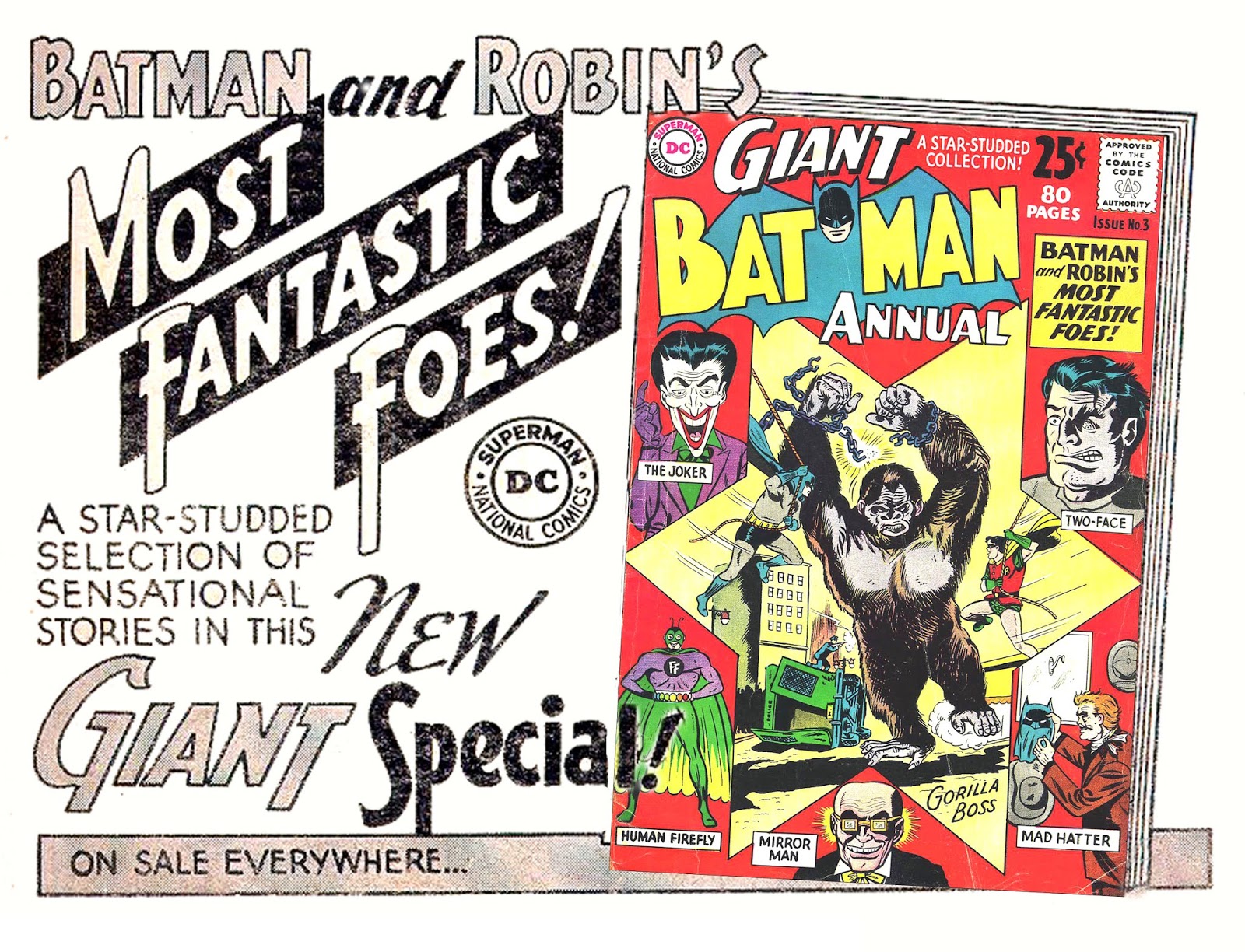
For example, how about King Kong vs. Batman? What kid could resist that? Few, as it turns out, either in 1953’s Batman Comics 75 (The Gorilla Boss of Gotham City) or in 1962’s third Batman Annual, where the story was reprinted (and slightly censored to accommodate the Silver Age Comics Code).
Why was the Masked Manhunter fated to fight a giant ape in 1953? I’m going to suggest it was because in 1952, RKO had re-released their 1933 hit film King Kong. Advertised on TV, the movie became a tremendous smash again, generating more box office receipts than the original 1933 release had. Cinema owners named it Picture of the Year.
Okay, but exactly how do you pit an acrobatic detective against a titanic simian, story-wise? By putting a human criminal’s brain into the ape.
Executed for murder, George Dyke has his brain transplanted into a giant ape’s body, then goes on a rampage of larceny with his super strength, intending to lure Batman out and steal his body in turn.
Seems a villain more suitable to Superman, but it would be years before the Man of Tomorrow tackled his own giant ape foe, Titano, in 1959’s Superman Comics 127.
By that time, Batman would be up to his cowled neck in giant monsters and bizarre aliens.
Of course, that’s only in the comic books. In 1942, Superman captured a giant gorilla in the Paramount movie cartoon Terror on the Midway, the ninth in the Fleischer Studios series.


Tuesday, January 1, 2002

January 1962: Brainiac By Any Other Name

An alien invader who shrinks and collects your civilization? That would be Brainiac, right?

Well, no, it’s Grq, at least in the Archie Adventure universe of 1962.

When the Fly and Fly Girl ran into the planet-shrinker in The Test Tube Flies! (Adventures of the Fly 17, Jan. 1962), they were, ironically, reduced to the size of insects. But nevertheless, eventually they taught Grq just how formidable insects can be.

Robert Bernstein, a writer who worked for both DC and Archie, was well familiar with Superman’s exploits, and clearly used Otto Binder’s The Super-Duel in Space! (Action Comics 242, July 1958) as his inspiration. 

But then, DC Comics was perfectly capable of copying their own stories, as in The Alien Who Doomed Robin! (World’s Finest 110, June 1960). In that tale, written by Jerry Coleman, Superman, Batman and Robin fought to stop a green, tentacled alien from shrinking and stealing buildings to use as exhibits on an asteroid amusement park.

“The Fly stories largely consisted of our hero doing battle with various menaces: giant robots, alien invaders, prehistoric monsters and gangs of crooks were favorite opponents,” recalled comics historian Michael E. Grost. “In this way, his stories resembled those of the Green Lantern, who also spent much of his time fighting monstrous menaces from outer space and other dimensions.”

“The Fly was a superhero who had the powers of insects,” Grost noted. “He could fly, glow like a firefly, employ the immense strength of an ant, weave silk cocoons and bind his enemies, etc. He could also command hordes of insects to do his bidding.”

“John Rosenberger, most of whose comics work was in the romance genre, became the regular illustrator,” noted comics historian Don Markstein. “He delivered dependable, routine work until 1964, when the title ended. Along the way, only one more notable thing happened — in the 14th issue, the Fly picked up a female counterpart, Fly Girl, who was in reality actress Kim Brand.”

Wednesday, August 8, 2001

August 1961: Deus Ex Time Machina


Writer Jerry Siegel enjoyed a good deus ex machina.

The “god of the machine” from ancient Greek drama has come to mean a plot device that’s introduced suddenly and unexpectedly in order to supply a contrived, far-fetched solution to an apparently impossible-to-solve problem.

Is your character in a tough spot? Just ring in some super being from the far future to rescue him at the last minute. 

Siegel used that trick first to bail out Superboy (Superboy 86, Jan. 1961) and then both Lex Luthor and Superman in the same story (Superman 147, Aug. 1961).

Recalling how he’d been defeated by the Legion of Super-Heroes’ Lightning Lad in that Superboy tale, the imprisoned criminal scientist reasons — not terribly logically — that a Legion of Super-Villains must also necessarily exist in the future, and rejiggers spare radio parts to summon them.

When the evil Lightning Lord, Cosmic King and Saturn Queen capture and cage Superman, his now-adult teammates Lightning Man, Cosmic Man and Saturn Woman appear to rescue him. 

By using radiation from her home planet’s rings, the Man of Tomorrow is able to turn Saturn Queen against the super-villains — thereby turning the tables.

“There is often a certain good/evil duality to Siegel’s mystery tales,” observed comics historian Michael E. Grost. “Characters who seemed to be evil throughout the tales are revealed to be good at the end, or vice versa.”

“Siegel has a consistent interest in showing grown-up Legionnaires,” Grost noted. “He seems to be the only one of the Superman family to have done so. His first Supergirl Legion story The Three Super-Heroes (1960) shows the kids of the original Legionnaires, an idea that was dropped from the mythos — probably it was considered as a mistake. His Superman’s Super-Courtship (1962) shows grown-up Legionnaires celebrating Christmas.”

Siegel used similarly fantastical, out-of-nowhere plot stunts in his camp stories about Archie Comics’ “Mighty Heroes” a few years later, but they didn’t work so well in those largely unsalvageable tales.