June 1938: A Superman for the Underdog

On the newsstands in May 1938, browsers had their choice of Tarzan in Comics on Parade, Popeye in King Comics, daredevil aviator Captai...

Showing posts with label Female characters. Show all posts

Monday, July 8, 2013

October 1983: A Champion by Chance

A kind of latter-day Fly Girl, AC Comics’ heroine Nancy Arazello was appealing and unassuming, feeling her way toward independence both as a woman and as a superhero. 

She only became a superhero, in fact, because she’d accidentally interrupted her boyfriend when he was beseeching the dark insect god Zzara for power. 

“During the 1940s, student of the occult John Howard Gallagher performed a mystic ritual which gave him super powers,” noted Jeff Rovin in his Encyclopedia of Superheroes. “Engineer Kenneth Francis Burton Jr. spends years learning all he can about Gallagher, who had died in 1957 — and eventually learns the secret of the incantation. But while he was performing the ceremony at his factory, his fiancée Nancy walks in and receives the full force of the unleashed supernatural powers. Thereafter, simply by willing it, she becomes the Dragonfly, able to fly and possessing great strength and invulnerability.”

In fact, she could reach speeds of Mach 4 and move objects with telekinesis. She came with a built-in enemy, a boyfriend who seethed with envy over the powers he thought were rightfully his.

As T.M. Maple observed, “(Writer/artist) Rik Levins did seem to have a good time with the story, interjecting some of the more mundane, nevertheless interesting and amusing, problems that a superhero might run into.”

The character could be seen as a more mature homage to Fly Girl, with the 1950s’ male superhero who preceded her analogous to the Fly, and perhaps Charlton’s mystically powered Blue Beetle.

Nancy also had something in common with the Greatest American Hero as a goodhearted, accidentally super-powered person who was somewhat out of her depth.

Introduced in Americomics 4 (Oct. 1983), Dragonfly went on to star in eight issues of her own title.

I’ve always thought Dragonfly was among those well-done “might-have-beens,” a character who had some of the freshness Spider-Man originally possessed, and who deserved better than she got.


Thursday, December 13, 2012

October 1976: “The Following Information Is Classified…”

Martin Caidin’s 1972 novel Cyborg inspired the 1973-78 TV series The Six Million Dollar Man, which in turn spawned the TV show The Bionic Woman.

Airing from 1976 to 1978 and starring the bright and talented Lindsay Wagner, the science fiction superhero series was popular enough to produce a Kenner doll (with its own Bionic Beauty Salon playset) a record, a metal lunchbox, two paperback novels, a Parker board game and a five-issue comic book series from Charlton (1976-77).

Unlike its abortive 2007 remake, the original series managed to be optimistic and humanistic (without being saccharine).

Watching the last episode, I was surprised to find that, unlike most American TV programs, the show did not simply break off, or run out of gas and splutter to a stop. It effectively concluded, and concluded well.

The dispirited Jaime Sommers, tired and somewhat sickened after three years of being a superspy “robot lady,” quits the secret Office of Scientific Intelligence, only to find that she can’t quit — she’s government property. They intend to jail her.

The Bionic Woman meets The Prisoner.

This cynical, realistic take on what the U.S. government would do is a little surprising in a 1970s adventure show. She has an ally in her dash for freedom from American law enforcement — her ex-boss Oscar Goldman (Richard Anderson, who takes a break from exposition to enjoy a strong acting turn).

Jamie tells him, “I thought I was more than a pawn to you, or one of your little tools…”

“You’re hurting my arm,” Goldman replies.

Ever the compassionate heroine, Jamie takes time to help the alienated son of a blind man, and finds the solution to her own personal dilemma.

Wagner had specifically asked for a concluding episode, and the writer, Steven E. De Souza, worked all Wagner’s frustrations with doing a network series into Jamie’s emotions about her spy job.

The script, and Wagner’s Emmy-winning charm and acting ability, let the series finish with class.


Tuesday, January 1, 2008

January 1968: Vanity and Advantage

Sometimes, being underestimated may be made to work to one’s advantage.

The cover of Detective Comics 371 (Jan. 1968) is frequently mocked for trivializing women. Batgirl is shown fretting about a run in her tights while Batman and Robin need her help in a fight.

But then you know the old adage about judging a book by its cover. The point of Gardner Fox’s story inside is exactly the opposite.

DC’s Julius Schwartz-edited titles consistently portrayed women as smart, capable and professional, particularly when compared to titles edited by others. So it was no surprise to me, even back then, that Batgirl’s apparent silly vanity was a sham. I’d only have been surprised had it been otherwise.

In Batgirl’s Costume Cut-Ups, Barbara Gordon is troubled when, by reflexively adjusting her mask when it was knocked askew in a fight, she leaves herself vulnerable to a kick from a crook.

Worrying that her vanity — her “instinctive female reaction” — had betrayed her, Batgirl is determined to improve her performance, despite reassurance from Batman that she’s doing fine as a crimefighter.

Ultimately, during a fight with the nine members of the Sports Spoiler gang, the Dominoed Daredoll pauses to ostentatiously repair a tear in her tights.

“What a pair of gams!” exclaims one of the crooks. The Terrific Trio wades into the distracted gang, with Gil Kane’s artwork making the finish brisk, dynamic and even, at times, winsome.

After Batman and Robin somewhat condescendingly reassure her that her “vanity” came in handy this time, Batgirl spares their vanity by refraining from revealing that the “accidental” rip in her tights was her plan all along — strategic jiu jitsu.

Back at the library, Barbara thinks “I didn’t have the heart to tell Batman and Robin that I tore my tights deliberately — to give me an excuse for showing off my leg and distracting those crooks!”

Finally, Batgirl is just as “ditsy” as Lt. Columbo is “befuddled,” and for the same reason.

Saturday, July 7, 2001

July 1961: When Women Take Wing

Comic books, like television, are a generally conservative mass medium, reflecting social change only after it’s taken hold in the culture at large. And that makes it interesting to track the course of women’s rights in comics.
Mary Marvel, Bulletgirl, Miss America, Namora, Golden Girl, Doll Girl, Batwoman, Batgirl, Supergirl, Superwoman, Aquagirl, Miss Arrowette, Fly Girl, Hawkgirl, Power Girl, Ms. Marvel, Spider-Woman, even She-Hulk … the female knock-off of the dominant male superhero was a venerable tradition from the 1940s on, one that paradoxically paralleled American society’s growing recognition of female power even as it kind of condescended to the idea.
Take Fly Girl, for example.
Introduced in Adventures of the Fly 13 (July 1961) as a traditional damsel in distress, actress Kim Brand didn’t play that role for long. In Adventures of the Fly 14 (September 1961), she was granted a magic ring by extra-dimensional emissary Turan that enabled her to duplicate the powers of attorney Thomas Troy, the Fly. She co-starred with him thereafter while appearing in solo stories in the Archie comics Laugh and Pep.
The trend even continued outside comics, with Six Million Dollar Men spawning Bionic Women.
Those female copies sometimes served as guinea pigs, trial balloons for plot developments that would later be visited on the more established male hero. Supergirl was “killed” before Superman, and Batgirl was physically disabled before Batman.
The 1979 movie Alien featured a female lead besting a space predator after her male crewmates had failed. And Joss Whedon’s innovative 1997 TV series Buffy the Vampire Slayer marked a shift in the culture, featuring a no-nonsense superheroine in the lead who had copied no one, and whose adventures balanced the traditionally male mission of monster hunting with traditional female concerns about high school relationships.
And the permanent cultural shift that has taken place is even more apparent now. Thor’s original love interest, Jane Foster, gained the powers, the hammer and the name of the thunder god.

Sunday, August 8, 1999

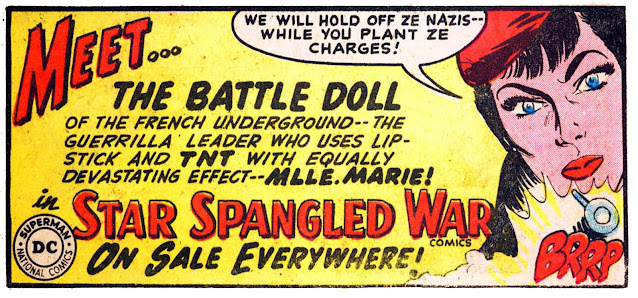
August 1959: Behold ze Battle Doll

At age 6, my only problem with Mlle. Marie was that I had no idea how to pronounce her name.

“Mlle.?” What might that mean and how do you say it? “Milly,” I guessed.

With her pencil skirt, beret, submachine gun and inability to pronounce the word “the,” Mlle. Marie was a breath of perfumed Parisian air in DC’s male-dominated war comics.

Created by writer Robert Kanigher and artist Jerry Grandenetti for Star Spangled War Stories 84 (Aug. 1959), this French Resistance “Battle Doll” veered as close to romance as any war comic dared.

“Raised on a farm in France … Marie and her father join the Resistance when Germany invades France during World War II,” noted comics historian Jeff Rovin. “After her father dies, she is acknowledged to be the most dangerous resistance fighter of them all, especially by her arch-foe Commander Von Ekt. Right before the liberation of France, Marie is shot by a Nazi spy, Roget, and falls into the St. Joan River.” 

But she apparently survived to have a daughter with Alfred Pennyworth (!).

In 1959, she seemed an odd choice for a comic genre read almost exclusively by boys. 

“However, Kanigher was also writing and editing Wonder Woman, and had created Black Canary (1947) and Wonder Girl (1958) before Mlle. Marie, so he was also well aware of the potential of female heroes,” observed popular culture historian Ensley F. Guffey.

“(W)hile Marie’s wasn’t quite the first of DC’s war series to be introduced (that would be Sgt. Rock, who had started four months earlier, followed by Gunner & Sarge a month after that), it was the first dropped,” noted comics historian Don Markstein. “Star Spangled 90 introduced The War that Time Forgot, and that was the beginning of the end. Before long, the visceral thrill of pitting World War II soldiers against dinosaurs crowded Marie completely out.”

She returned as an occasional guest star in other war features like Haunted Tank.


Monday, August 8, 1988

August 1948: One Brief Shining Heroine

A wave of superwomen arrived toward the end of the 1940s, just as the tide turned against superheroics.

Among them was Sun Girl, a jiu-jitsu expert who came armed with her signature wrist-mounted light projector (making her the Phantom Lady’s opposite number, in a way).

“Sun Girl didn’t seem to have a secret identity, or in fact, any name other than the one in her logo,” recalled comics historian Don Markstein. “As Sun Girl, she was apparently a popular personality throughout the world. No explanation was given as to why she wore a costume to fight crime… She was adept at various forms of martial arts, but again, no explanation was given. It was implied she’d been superheroing for a long time.”

She was capable enough. During her brief tenure, she handled an army of crystalline monsters, a 30-foot-high Brazilian ape, an alpine giant, a huge heat ray, ghostly aliens, a crook who leaped great distances, weaponized humor, lethal lollipops, a two-dimensional villain, a sphere-creature, Cube Men working for a monstrous brain and invaders from Jupiter (armed with one of those several “hate rays” Marvel superheroes would eventually encounter).

“The year is 1948,” recalled Capeworld Comics. “The Golden Age is about to shut down for the ’50s and enter an era where Superman, Batman and Captain Marvel are virtually the only active superheroes amid a rising tide of genre comics – horror, science fiction and romance. 

“Timely sees females as an untapped market, and so — similarly to (what) Marvel would later try … during the Bronze Age with Night Nurse, Tigra and She-Hulk — Timely focuses on female characters: Namora, Venus, Blonde Phantom, Golden Girl and Sun Girl. Most of these were sidekicks to established male heroes.”

Although the heat-themed Sun Girl was a natural partner for the Human Torch, she didn’t debut in that role. She was introduced in her own title.

The Mysterious Beauty also appeared in Human Torch and the company flagship Marvel Mystery Comics.

Saturday, December 12, 1987

December 1947: All Flash to No Flash


All-Flash 32 (Dec. 1947-Jan. 1948) became No-Flash with the next issue, which never appeared.
Even as postwar interest in superheroes was waning, the art and storytelling in superhero comics was continuing to improve. The stories began to anticipate the 1960s superhero revival, with its emphasis on colorful costumed super villains.
In this issue, the Flash is opposed by the Thinker, an enemy introduced in All-Flash 12 (Fall 1943) who uses his “thinking cap,” a metal hat that projects mental force.
And the superhero is introduced to the Fiddler — a thief who learned the mystic art of music while imprisoned in India — as well as Star Sapphire, an evil alien queen.
Described by writer Robert Kanigher as “an amazingly exotic creature,” the purple-clad Star Sapphire was an example of comic books’ new emphasis on female audiences and characters  in the late 1940s. Black Canary was another.
Even as superheroes in general were on the way out, female superheroes were on the way in. Marvel/Timely alone had five such characters — Miss America, Golden Girl, Sun Girl, Namora and Venus.
The Thinker and the Fiddler returned in the 1960s to battle both the 1940s Flash and his 1950s namesake.
Star Sapphire was revamped as a Green Lantern villain. She was secretly his girlfriend, Carol Ferris — a secret kept, at least initially, even from Carol herself.


Monday, September 7, 1987

Fall 1947: The Other Wonder Woman

She had super strength and the ability to repel bullets, a mother who was a queen, a plane she controlled by thought, a secret identity that was a pun that winked at her real identity, a heroic but ineffectual and overconfident boyfriend and a tendency to exclaim appeals for strength to arcane sources.

And she wasn’t Wonder Woman.

If imitation is the sincerest form of flattery, then Superman and Batman must have been blushing from the first. And with a postwar wave of women populating comics, EC Comics’ Moon Girl paid DC Comics’ Wonder Woman that compliment.

“The story opened in the remote kingdom of Samarkand, where the princess, identified only as ‘Princess of the Moon’ or ‘The Moon Girl,’ learned of her legacy — a magic moonstone that made her invincible in battle (which she was already pretty close to being even without it), and an ancestral history of not being made happy by being able to defeat any suitor,” comics historian Don Markstein noted.

“This was complicated by the fact that, like the later Marvel Comics version of Red Sonja, she’d already made it clear she could never marry a man who wasn’t better on the battlefield than herself. 

“Sure enough, when Prince Mengu, from a nearby kingdom, came a-courting, she beat him up and sent him on his way, but was sorry about it afterward. She traveled the world looking for him, and finally tracked him down in America, where he was coaching student athletes under the name Lionel Manning. She adopted a pseudonym of her own, Clare Lune, and got a teaching job at the same school.”

As World War II ended, American women became less visible in the factories and more visible on comic book covers, while superheroes faded. Moon Girl tracked the changing postwar fashions in comics exactly. The title that began as Moon Girl in winter 1947 had, by September 1949, morphed into A Moon … A Girl … Romance.


Wednesday, July 7, 1982

Summer 1942: The Power of a Positive Princess


He originally wanted to call her “Suprema, the Wonder Woman,” a name only one letter removed from “Superman.”
Reacting against the “bloodcurdling masculinity” of Superman and friends in 1941, psychologist William Moulton Marston — who sat on DC Comics’ editorial board — decided to create a philosophical counterweight under his pen name of Charles Moulton.
A direct challenge to DC’s flagship hero, his Wonder Woman espoused the virtues of love, not war, and argued for the equality — and frequently, even the superiority — of women.
Debuting in All-Star Comics in December 1941, Wonder Woman had the lead feature in Sensation Comics and her own title the next year.
Wonder Woman’s bullet-repelling bracelets are the remnants of shackles worn by the Amazons after their conquest by Hercules, designated by the Greek goddesses as both a check on Amazon power and a necessary condition of it.
If the bracelets are chained together by a man, an Amazon loses her superhuman strength. But if they’re broken or removed, she becomes drunk with power, losing her feminine capacity for the just, compassionate use of force.
Domination and submission are therefore symbolically represented as inescapable elements of human nature.

Friday, June 6, 1980

June 1940: The Super Woman Who Wasn’t There

You may well have missed America’s first super woman. She was, after all, invisible.

Creator Russell Stamm, who was previously an assistant on the Dick Tracy strip, introduced Invisible Scarlet O’Neil to the readers of the Chicago Daily Times on June 3, 1940.

She might be regarded as a female counterpart to the popular radio superhero the Shadow, who’d been turning invisible to fight crime since 1938. Her newspaper strip combined underwear modelish “good-girl art” with super powers — contrasting visibility with invisibility, you might say.

This attractive, red-headed daughter of a scientist gained the power of invisibility through accidental exposure to a “weird-looking ray” invented by daddy, and learned to control her ability by touching a nerve in her wrist.

Scarlet’s first escapades expressed a certain maternal quality as she rescued orphans and handicapped children, but she moved on to battle the spies and saboteurs that were meat and potatoes to wartime superheroes. 

Whimsical adventures took her to prehistoric times, confronted her with an invisibility epidemic and, cleverly and tellingly, left her doubting her own reality during a bout with amnesia. 


The character’s healthy run branched out to comic books and Big Little Books.

Unfortunately, she was truly invisible by the time the strip ended in 1956, having been supplanted by a male hero, Stainless Steel, for whom the strip was renamed. 

Like her Rosie the Riveter sisters, Scarlet found that the reward of wartime public service was an invitation to step back into the background when the men came marching home.

Invisible Scarlet O’Neil and Marvel Comics’ Invisible Girl could literally vanish, while Marvel’s the Wasp, DC’s Shrinking Violet and Quality Comics’ Doll Girl boasted the ability to shrink from sight.

In attempting to create supermen, male comics writers offered us garish figures who streak across the sky, battering down all obstacles with irresistible force. But, when asked to create superwomen, the writers tended to endow them with extraordinary levels of metaphoric insubstantiality and insignificance.