June 1938: A Superman for the Underdog

On the newsstands in May 1938, browsers had their choice of Tarzan in Comics on Parade, Popeye in King Comics, daredevil aviator Captai...

Showing posts with label Alan Stewart. Show all posts

Wednesday, August 8, 2007

August 1967: No More the Boy Wonder

In the 1960s, readers loved the Justice League’s annual “Crisis” team-ups with the Justice Society, but wondered where the 1940s Superman and Batman were.

The parallel Earth was created as a way to revive the distinctly different versions of superheroes that had ceased publication more than a decade before — the Flash, Green Lantern, Hawkman, the Atom — as well as those older crimefighting champions who had no analog in the newer continuity — Hourman, the Sandman, Mr. Terrific, the Spectre, Dr. Fate, Black Canary and so forth.

But Superman, Batman and Wonder Woman had been published continuously, and were in some sense the “same character” all along. That seemed to make them problematic to DC, though in Wonder Woman’s case the problem was simply ignored.

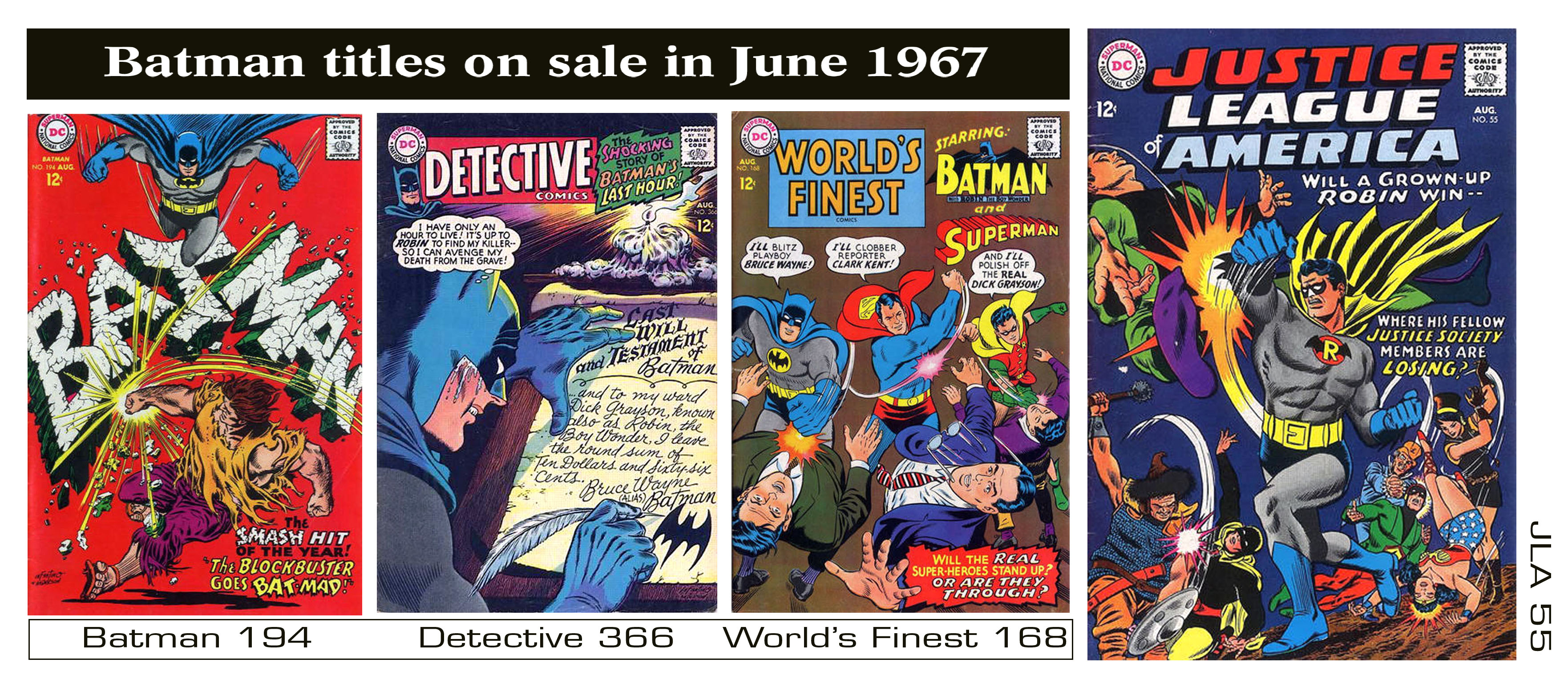
In 1967’s Justice League of America 55-56, though, the adult Earth-Two Robin appeared as the newest JSA member, with Batman “semi-retired.” Robin’s costume was an eye-catching amalgam of his Boy Wonder duds and Batman’s outfit.

“Why the Batman look in the ’60s?” asked Tim O’Keefe. “Easy. All connected to sales. The Batman TV series was at its height of popularity and DC was cashing in. Batman trading cards, Batman plastic models, Batman clothing. It was everywhere. If you notice, most Justice League of America covers of the era overemphasized Batman. It was pure marketing. That said, JLA 55 was the first comic I had as a kid and it hooked me on the JSA. After that, I felt that the Earth-2 Robin was the most underutilized hero of the group.”

The Man Wonder joined JSA and JLA members in thwarting the menace of black alien “energy spheres” that conferred super powers while causing moral derangement.

“(P)erhaps either (writer Gardner Fox) or (editor Julius) Schwartz (or both) just thought a grown-up Robin was a cool idea,” suggested comics historian Alan Stewart. “Which, actually, it was; although the costume could have used more work (and would, thankfully, be overhauled for the Earth-Two Robin’s later appearances.)”

From JLA 91


August 1967: The Hulk Who Hated Batman

Blockbuster — DC’s answer to the Hulk — struck again in Batman 194 (Aug. 1967). Introduced in Detective Comics 345 (Nov. 1965) by writer Gardner Fox and artist Carmine Infantino, Blockbuster had previously returned in Detective Comics 349 (March 1966) and then in Justice League of America 46 and 47 (Aug.-Sept. 1966).

He was chemist Mark Desmond, whose acquisition of superhuman strength cost him his sanity and made him vulnerable to manipulation by his criminal brother Roland. The twist was that Blockbuster hated Batman, but loved Bruce Wayne, the man who’d saved his life as a child.

I appreciated the irony of the setup — Blockbuster being the one enemy whom Batman defeated not by donning his mask, but by taking it off.

By Batman 194, however, that gimmick had played itself out, and Blockbuster finally figured out that Bruce Wayne and the hated Batman were the same guy.

In the story penned by Fox, Blockbuster batters the Dynamic Duo senseless, but Batman is finally able to defeat the brute by disguising himself to resemble Solomon Grundy, Blockbuster’s fellow monster and friend.

“It was the cover that grabbed me in those ads, of course.  That amazing Carmine Infantino-Murphy Anderson cover, with its impeccably rendered figures of Batman and Blockbuster, its dynamic action, and, most of all, its imaginative (and, for the time, daring) incorporation of the book’s title within the illustration,” recalled comics historian Alan Stewart,  “My nine-year-old self had never seen anything like it. Unfortunately, the interior artwork — credited to Bob Kane,’ as were all Batman stories of that era that weren’t drawn by Infantino — wasn’t up to the standards set by the cover.  At all.”

Actually, the disappointing interior art was by Chic Stone and Sheldon Moldoff. Many readers shared Stewart’s chagrin at finding Infantino covers wrapped around non-Infantino interiors.

“I can’t think of another comic book that I considered as huge of a letdown once I finally got hold of it and read it,” Stewart wrote.