June 1938: A Superman for the Underdog

On the newsstands in May 1938, browsers had their choice of Tarzan in Comics on Parade, Popeye in King Comics, daredevil aviator Captai...

Showing posts with label House of Mystery. Show all posts

Monday, January 1, 2007

January 1967: Dial D for Dizzying

The mid-1960s got a little superhero-dizzy.

With so many new characters debuting from a half-dozen comics companies, readers might have gotten the sense of a “throw everything at the wall and see what sticks” desperation. 

How else could we explain B’wana Beast or Fatman?

One feature that had “thrown at the wall” baked right into the concept was Dial H for Hero, starring teenager Robby Reed. Robby’s mysterious alien dial enabled him to randomly transform himself into superheroes, generally three per adventure. 

Artist Jim Mooney and writer Dave Wood kicked off the series. Like Alfred Hitchcock’s 1954 film Dial M for Murder, the feature’s title was inspired by the rotary telephone, a device gradually phased out beginning in the 1970s.

Debuting in House of Mystery 156 (Jan. 1966), Robby bore a passing resemblance to an extremely short-lived Harvey Comics character named Tiger Boy (Unearthly Spectaculars 1, Oct. 1965). This surly alien shape-shifter could also become an unlimited number of super-powered beings. Both Robby and Tiger Boy became similar-looking robot-men, in fact.

In several of Robby’s transformations, one could see the ghosts of great Golden Age characters or other abandoned or underused character concepts. 

Zip Tide, for example, shared the power of liquid transformation with Bill Everett’s Hydroman. The Human Bullet echoed Fawcett’s Bulletman. Chief Mighty Arrow recalled DC’s own Super Chief. Robby the Super-Robot was like DC’s Robotman. Hornet-Man recalled Archie Comics’ the Fly. Giant Boy resembled the Legion of Super-Heroes’ Colossal Boy. Shadow-Man might have been mistaken for the pulp superhero the Shadow (particularly in his signature dim lighting). 

In House of Mystery 160 (July 1966), Robby dropped his fig leaf of pastiche and became the “actual” Plastic Man, a famous superhero unseen for a decade. DC would revive the character in a new series in November of that year.

While entertaining for its initial 15-issue run, Dial H predictably lacked focus. Being all over the map was kind of the feature’s point, after all.

Saturday, November 11, 2000

November 1960: The Riddle of the Rival Spacemen

Even when I was 6 years old, in 1960, I was clear on the fact that Space Ranger was only the second-best spaceman in the DC universe.
Over in Mystery in Space, Adam Strange had the advantage of stories by Gardner Fox and art by Carmine Infantino (who could not only make you believe the unbelievable, but make you believe the unbelievable to be sleek, tempered and elegant).
Space Ranger, the lead feature in Tales of the Unexpected, was delivered with the workmanlike art of Bob Brown and goofy-fun stories by Arnold Drake and Bob Haney.
DC’s two spaceman superheroes — one operating in the present, the other in the future — were actually created to be rival concepts and placed with rival editorial teams.
This house ad spotlights Tales of the Unexpected 55. In The Ghost Creatures of Phobos, Allied Solar Enterprises exec Rick Starr dons his Space Ranger disguise and, with his cute shape-shifting little pal Cryll, investigates reports of ghostly menaces on the Martian moon Phobos. The phantoms of monsters and Wellsian war machines turn out to be images reflected from the moon’s past for criminal purposes.
In Mystery in Space 63’s The Weapon That Swallowed Men, the green, cube-headed alien Vantor invade Rann with a weapon that turns people into gas.
“Carmine Infantino’s art is beautiful in this tale,” observed comics historian Michael E. Grost. “An early scene shows ruins of Sumuru, the first city on Rann. The walls of the ruins are made up of numerous irregularly sized rectangular blocks... They form an imaginative and unusual variation on Infantino's Art Deco architecture.”
And in House of Mystery 104’s The Seeing-Eye Man, a scientist’s “retriever ray” pulls an alien spaceship to a crash landing on Earth. He’s pressed into service leading the temporarily blinded, telepathic alien Zod, and cleverly thwarts the alien’s plan to conquer Earth.


Tuesday, April 4, 2000

April 1960: Moon Monsters and Jewel Men


To me, the appeal of DC’s science fiction titles ran a close second to my true love, the superheroes.
Here we have titles that were on the newsstands during January and February 1960 — Strange Adventures 114, House of Mystery 97 and Tales of the Unexpected 47, starring its own superhero, Space Ranger (many readers generally seemed to prefer Adam Strange, over in Mystery in Space).

Tuesday, February 2, 1993

February 1953: Of Fat and Phantoms

Hurt feelings, loss and embarrassment loomed large in editor Mort Weisinger’s Superman titles, and a certain amount of fat-shaming went along with that.

It may well have all started here, in Superboy 24 (Feb.-March 1953). In The Super-Fat Boy of Steel, drawn by John Sikela, all Smallville’s teenagers mysteriously become obese while Clark Kent is off on vacation.

The major characters in Weisinger’s Superman titles — Jimmy Olsen, Lois Lane, Lana Lang, Supergirl and Superman himself — all got plumped up at one time or another. 

In the Julius Schwartz-edited title The Flash, the same thing once happened to the Scarlet Speedster. But it wasn’t presented as an embarrassment to Barry Allen, merely a predicament for him to think his way out of.

As superheroes faded in the early 1950s, horror comics flourished.

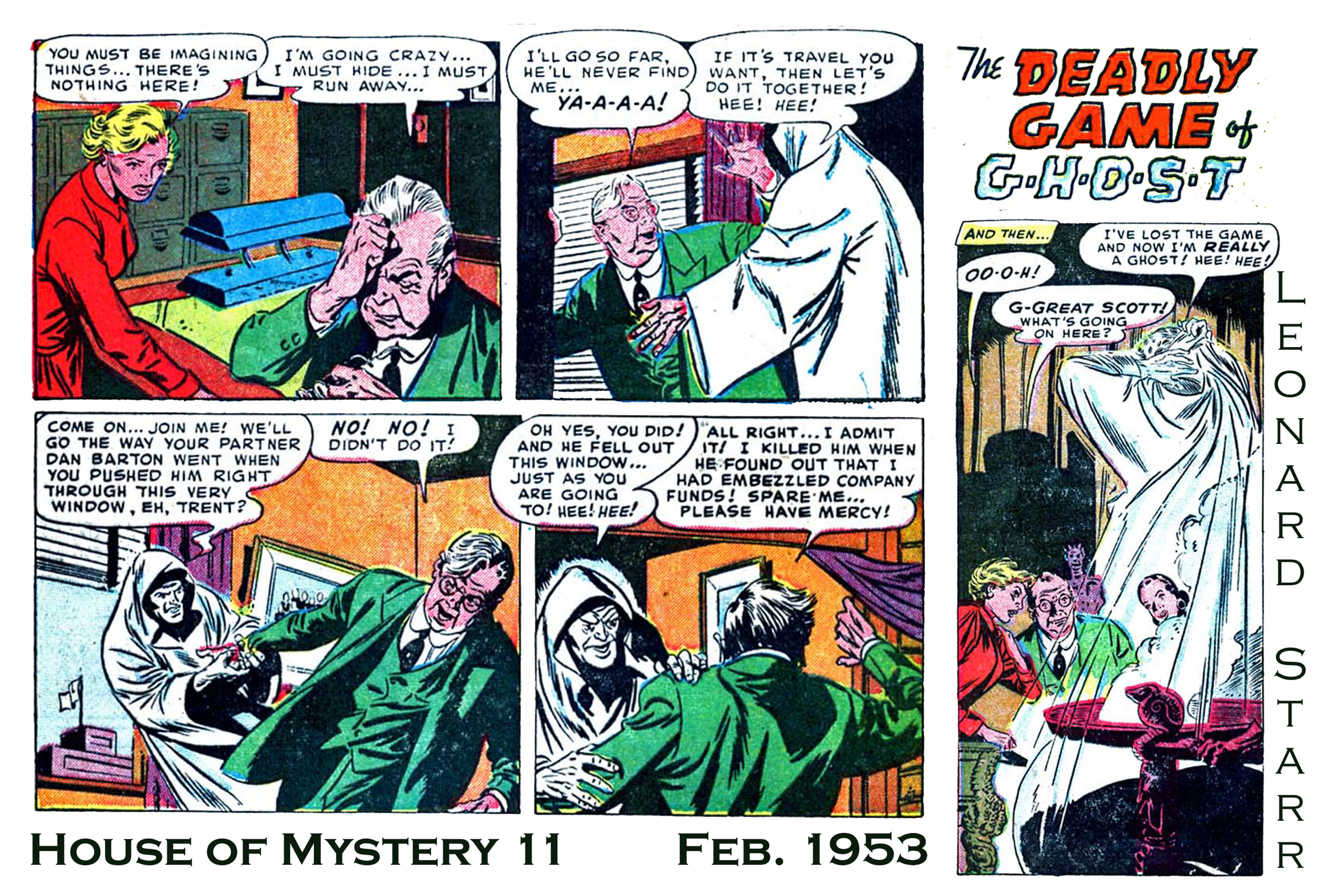
“What about National horror?” wondered Bill Schelly in American Comic Book Chronicles. “There was actually none. Editor Jack Schiff’s House of Mystery 1 (Dec.-Jan. 1951) was National’s first such title in the ‘mystery’ genre, the closest the firm came to a horror comic book. The company that published Superman didn’t want to taint its cash cow by associating with anything approaching Grand Guignol, and National wasn’t temperamentally suited to produce that kind of material, anyway. 

“In House of Mystery, everything supernatural is a hoax or has a scientific explanation.”

And so it was here in the Leonard Starr story The Deadly Game of G-H-O-S-T (House of Mystery 11, Feb. 1953). The “ghost” turns out of be part of an extremely elaborate, highly unlikely but nevertheless ultimately successful scheme to expose a murderer. 

Scooby-Doo would have seen through that hoax at once.


Saturday, June 6, 1992

June 1952: This Old House of Mystery

Curses and cavemen graced the covers of DC Comics on the newsstand in April 1952.

In Caveman Clark Kent! (Action Comics 169, June 1952), Clark and Lois Lane crash-land into an isolated prehistoric society complete with dinosaurs. 

Superman’s cast of characters found themselves in Stone Age circumstances more than once. In The Challenge of Stoneman! (Action Comics 201, Feb. 1955), an inventor’s time machine took the Daily Planet reporters and a mobster to the prehistoric past. 

On April 23, 1955, essentially the same story aired on The Adventures of Superman TV show as Through the Time Barrier.

In House of Mystery 4, the ever-reliable artist Ruben Moreira gave us The Man with the Evil Eye! The blinded mobster Jim Keene apparently acquires an “evil eye” in a cornea transplant, but it’s all an elaborate police hoax.

Belief in the evil eye was global and venerable. It goes back at least as far as Ugarit, a city destroyed circa 1,250 BC whose ruins can be found in modern-day Syria, according to historian Dennis Pardee. The evil eye is referenced by Plato, Hesiod, Theocritus, Plutarch and Pliny the Elder, among others. 

“Though the theory that some possess a more potent glare capable of inflicting harm is quite common in the lore of the evil eye, not all correlate the power with an inherent ill will. Some cultures view the ability to bestow the curse as an unfortunate burden, a curse in itself,” noted Quinn Hargitai, writing for the BBC.

The new title House of Mystery was DC’s subdued answer to the horror comics craze that got rolling in the late 1940s and early 1950s. When the 1954 Comics Code pretty much put horror comics out of existence, DC shifted the tone of House of Mystery and its sister title House of Secrets toward mystery, suspense, science fiction and finally superheroes. The Martian Manhunter and Dial H for Hero both found a home in the once-spooky House of Mystery.