June 1938: A Superman for the Underdog

On the newsstands in May 1938, browsers had their choice of Tarzan in Comics on Parade, Popeye in King Comics, daredevil aviator Captai...

Showing posts with label Flash. Show all posts

Monday, June 6, 2005

June 1965: Gleaming Giants, Redoubtable Rogues

In The Flash 153 and Hawkman 8, the heroes played to their strengths. While the Scarlet Speedster tangled with two members of his colorful rogue’s gallery, the Winged Wonders solved an archeological science fiction mystery.

In The Mightiest Punch of All Time (The Flash 153, June 1965), “The Flash and villainous Reverse-Flash continue their battle for Al Desmond, the former Mr. Element, trying to steer him away or towards a life of crime,” noted comics historian Michael E. Grost. 

“This is a sequel to Our Enemy, the Flash (#147, September 1964), and it is much better than the original. It is rich in plot inventions of all types.

“In the previous tale, Reverse-Flash had used physical force to coerce Al Desmond, who was virtually his hostage. This second tale is much more science fictional: it involves 25th Century mental control rays designed to influence people towards or away from a life of crime. This is typical of Broome’s approach, in that he takes ideas from an earlier tale, and science-fictionalizes them to construct subsequent story premises.

“Broome shows skepticism about the infallibility of advanced scientific machines. He had written many tales in the sf magazines criticizing computers, and these stories are in those traditions.”

Meanwhile, Hawkman traces a mind-controlling mask purportedly forged by the god Vulcan to Mount Olympus in Greece, where he and Hawkgirl battle a hostile metal giant.

Artist Joe Kubert had introduced the revamped Hawkman to the world, but by the time the Winged Wonder landed his own title, Murphy Anderson had taken over the feature.

“Anderson is not as flashy a stylist as Kubert, but, admiring both Hal Foster’s Prince Valiant and everything Lou Fine had done, he is a master draftsman,” observed comics historian R.C. Harvey. “He can portray the human figure in every position from any angle, capturing, in every pose, a classical elegance. If Kubert was Rembrandt, Anderson was Michelangelo. The body English in his pictures amplifies dramatic moments.”


Sunday, June 6, 2004

June 1964: A New Look for an Old Bat


After a quarter-century of ceaseless crime-fighting, Batman was clearly slowing down.

“Editor Julius Schwartz had helped engineer the superhero resurgence, and (DC publisher Irwin) Donenfeld was fond of his handling of The Flash, a bold, colorful title that had debuted in 1959,” explained Glen Weldon in The Caped Crusade: Batman and the Rise of Nerd Culture. 

“Donenfeld looked at the team behind that comic — John Broome on scripts, Carmine Infantino on pencils and Joe Giella on inks — and decided to issue an ultimatum. He called Schwartz and Infantino into his office and told them they were taking over the Batman books. If the two men couldn’t turn them around in six months, both Batman and Detective Comics would be cancelled.”

“(Schwartz) suspected that Donenfeld’s threat to cancel Batman was an empty one, given the Caped Crusader’s historical number two status in the publisher’s firmament of intellectual property.”

Nevertheless, however reluctantly, the team took on the assignment. Out went all those alien-ridden science fictional plots, and that cozy extended “Bat Family.” In came a sleeker, more grounded Batman whose chest emblem now included a discreet, colorful oval surrounding the bat silhouette.

“(B)y encapsulating the emblem within a yellow field, Infantino transformed it into an eminently reproducible and trademarkable symbol,” Weldon observed.

The New Look shift showed up in a few more updates within the narrative. Batman lost his butler (briefly) but gained a sportier 1960s Batmobile, and Commissioner Gordon acquired a substitute for the Bat Signal — his Hot Line to the Batcave (called the Bat Phone later on TV). 

That was an up-to-the minute reference to the presidential “hotline” that had recently been installed to connect the Pentagon with the Kremlin. Made a priority because the 1962 Cuban Missile Crisis had brought the world to the brink of nuclear destruction, the hotline was a Teletype system that became operative in 1963. The system was intended for text only because of the fear that speech might be misinterpreted.

Friday, June 6, 2003

Summer 1963: The Fastest Men Alive

As wish fulfillment, speed rated high with kids.
Speed, fueled by their boundless energy, was after all the one area where children could outdistance the somewhat worn-out adults who talked down to them, punished them and generally looked after them.
But just imagine what you might do with some real speed…
Created by writer Gardner Fox and artist Harry Lampert, the Flash was among the first of the shtick superheroes.
In just two years, Superman, Captain Marvel and their various copycats had already covered the ground of the all-purpose superhero who wielded an array of powers. By 1940, to get ahead, a super being had to have a gimmick. So the Human Torch burned and the Submariner swam, Hawkman could fly, Doll Man could shrink, Wonder Woman could be female and the Flash could run really, really fast.
College student Jay Garrick was one of only three characters I can name who became a superhero by smoking, by the way.
In a chemistry lab, while breaking football training with a cigarette, Jay accidentally knocked over some beakers and further polluted his lungs by breathing in fumes that turned him into the Flash.
The Flash could run up the sides of buildings and across water. He could catch bullets, create multiple images of himself, become invisible and — eventually — even vibrate through walls. His one power turned out to make him nearly as omnipotent as Superman’s many.
For me, the early adventures of this seminal superhero are difficult because of the underdeveloped, cartoony art.
But by All-Flash 31 (Oct.-Nov. 1947), an artist named Carmine Infantino had arrived to make the Scarlet Speedster’s adventures a pure pleasure. Infantino would carry the character, in his second and even more successful incarnation of Barry Allen, through the 1950s and 1960s.
By 1963, the new Flash was popular enough to have earned his own giant annual, which included an adventure of the original Flash and this feature page spotlighting famous Flash covers.

Friday, April 4, 2003

April 1963: In Brightest Day, In Swiftest Flight…

The Justice League teemed with teams within the team — Superman and Batman, Hawkman and the Atom, Green Arrow and the Martian Manhunter and a particular favorite, the Flash and Green Lantern.

“The third team-up between the two heroes was in 1963’s Green Lantern 20, titled Parasite Planet Peril,” noted John Peterson.  “When a phenomenon dubbed the vanishing plague causes people on earth to vanish over time, the Green Lantern and Flash team-up to try and prevent more people from vanishing. When the Green Lantern gets afflicted by the disease, he hands over his power ring to the Flash, hoping that the power of the ring could prevent (him) from vanishing.”


In between missions to protect Earth from alien invaders, Barry Allen and Hal Jordan had time to relax together with their girlfriends Iris West and Carol Ferris, providing a cozy, cheerful view of young adulthood in the Camelot era.

To a child, this seemed like an ideal way to grow up.

Nor did it seem strange to me that all four were young professionals — a police scientist, a test pilot, a magazine photojournalist and the owner/manager of an aircraft manufacturing company. 

Of course women would want to have lucrative, challenging and creative careers, just like men. Why wouldn’t they?

Call it the Schwartz Effect. The comics Julius Schwartz edited took the emancipation of women for granted, consistently sending the young readers a message that didn’t seem to be a message at all.

Another fact about these stories that jumps out at me now is that while Hal calls his Eskimo pal “Pieface,” Carol addresses him respectfully as “Thomas.”

Good for you, Carol.


Sunday, February 2, 2003

February 1963: Crowded by Cloud Creatures


Children tend to anthropomorphize their world, projecting human characteristics onto animals, cars, trains and even natural phenomena.

“As Piaget has shown, the child’s thinking remains animistic until the onset of puberty,” wrote Bruno Bettelheim in The Uses of Enchantment: The Meaning and Importance of Fairy Tales

“His parents and teachers tell him that things cannot feel and act; and as much as he may pretend to believe this to please these adults, or not to be ridiculed, deep down the child knows better… The sun, the stone and the water are believed to be inhabited by spirits very much like people.”

“Subjected to the rational teachings of others, the child only buries his ‘true knowledge’ deeper in his soul and it remains untouched by rationality; but it can be formed and informed by what fairy tales have to say.”

And by what comic books have to say.

The Julius Schwartz-edited titles at DC Comics made good use of that childhood trait by investing various inanimate phenomena with sentience. 

Over at what would become Marvel, they were busy creating rock monsters, water monsters, fire monsters and so forth. And DC had a taste for cloud monsters.

In Mystery In Space 81 (Feb. 1963), writer Gardner Fox and artists Carmine Infantino and Murphy Anderson gave us The Cloud-Creature That Menaced Two Worlds!

In a convoluted plot, Adam Strange thwarts a thousand-year-old Rann despot Alva Xar while encountering a conjured duplicate of his fiancé Alanna, a mind-over-matter device called a cyberay and a cloud monster over Tasmania.

Because he’s holding the device, Adam discovers he can simply will the attacking cloud creature to vanish — another metaphor designed to wink at the fairy tale power of childhood imagination.

Even earlier, in The Flash 111 (Feb.-March 1960), writer John Broome and Infantino and Anderson gave us The Invasion of the Cloud Creatures! 

Adam Strange also had another anthropomorphized weather phenomenon for a recurring archenemy — the sentient whirlwinds called the Dust Devils.

Sunday, May 5, 2002

May 1962: The Ham of Tomorrow


Thanks to writer John Broome, the Flash’s archenemies often had singular, quirky and engaging motivations.

Captain Boomerang was originally just a talented Australian hired by the Wiggins Game Company to promote a toy craze. Captain Cold was a romantic, forever falling haplessly in love with various women. And the 64th century magician Abra Kadabra also just wanted to be loved — but by an audience.

Abra Kadabra fervently desired to be a performing stage magician in a society so advanced it had completely outgrown them. 

“Any sufficiently advanced technology is indistinguishable from magic,” science fiction author Arthur C. Clarke wrote — a fact that renders Abra Kadabra’s career dreams hopeless in his own era, obviously.

Remarking on the super-villain’s origin (The Case of the Real-Gone Flash, The Flash 128, May 1962), comics historian Michael E. Grost observed that it’s “…more pathetic than sinister. His various thefts are done not for gain, but to try to publicize his stage act. His need for applause and public celebrity strikes a familiar Broome theme, the corrupting side of the search for fame.”

“Trickster characters like Abra Kadabra often cause difficulties for authority figures, in fiction books and comics. And they are often shown enjoying doing this. However, that is not shown as a motive for Abra Kadabra ... He is instead interested exclusively in fame and applause.”

And if applause isn’t forthcoming, the ovation-obsessed outlaw can compel it with futuristic mind-control technology.

Abra Kadabra travels back to the 20th century to wow audiences, and repeatedly runs afoul of the Flash, returning in The Plight of the Puppet-Flash (1962) and The See-Nothing Spells of Abra Kadabra (1967).

“Kadabra never deigned to work with the rest of the Flash’s Rogue’s Gallery,” observed Kelson Vibber in The Flash Companion. “He rarely worked with allies of any kind — willing ones, anyway — and Central City’s other criminals were beneath his consideration. They would only hog the limelight.”

Sunday, March 3, 2002

March 1962: Let’s Give the Villains a Hand

Early in their runs, the jet age Flash and Green Lantern had already developed surprisingly elaborate mythologies.
Barry Allen’s centered on his highly colorful, idiosyncratic “rogue’s gallery,” which ranged from would-be ladykillers (Captain Cold) to unscrupulous advertising gimmicks (Captain Boomerang).
And foremost among them was Grodd, who added an entire secret city of super gorillas to the mix. By Flash 127, the sinister simian was already making his fifth appearance in the title.
“Grodd sought to overthrow (the super-gorilla chief) Solovar through his impressive psionic powers, which included telekinesis, mind control, telepathy and mental projection,” observed Keith Dallas in his Flash Companion. “He was also a brilliant inventor, constructing various imaginative weapons and gadgets, like the one that caused the Flash to absorb so much moisture from the surrounding air that he turned into a 1,000-pound fat man (The Flash 115, Sept. 1960).”
In this John Broome/Carmine Infantino story, Grodd chooses the unusual weapon of love, using “neo-magnetic radiation” to make anyone who sees him adore him. Cheekily, he even running for governor.
In the next issue, the 64th century stage magician Abra Kadabra would also compel applause, but only because he was a hopeless ham.
The Emerald Gladiator’s mythological superstructure was well displayed on the cover of Green Lantern 11, which featured not just Hal Jordan but an array of masked aliens in vivid and verdant costumes, including a bird humanoid, a fish humanoid, a tree humanoid, a robot and a tiny grasshopper Green Lantern.
Here, Hal’s most formidable foe and opposite number, Sinestro, engineers his exile from the Green Lantern Corps to the evil antimatter universe of Qward. But he succeeds in proving only that the resourceful Hal Jordan can use anything — even the water vapor from his own breath — as the means of escaping a trap.
And of course, as close friends and frequent partners, Flash and Green Lantern were also a part of each other’s mythologies, adding to the fun for fans.

Wednesday, June 6, 2001

June 1961: Infantino’s Heroes

This DC house ad from June 1961 showcases two features that relied on the considerable talents of artist Carmine Infantino.
The Flash 121 gave us a return engagement with the merrily villainous Trickster, who’d been introduced a year before in Flash 113 (Danger in the Air!, June-July 1960).
Believe it or not, he was walking on air — and usually mocking the earthbound speedster. The blond, harlequin-costumed super-criminal drew my brightness-fascinated young eye and therefore my dime. The Trickster was caped, yellow-clad, flying — three things I loved.
Mystery in Space 68 was the first issue of that title I bought. I was fascinated by the Infantino-Murphy Anderson cover scene, which showed a horned alien tiger springing even as a colorful rocket-belted hero with a ray gun was teleported away, leaving behind a damsel in distress.
Much too much to resist.
And inside, even more! The issue introduced Strange’s recurring foes the Dust Devils — sentient, sinister, semi-anthropomorphic whirlwinds perfectly designed to inhabit the dreamlike mental landscape of a child.
Adam Strange was the thinking man’s superhero of the late 1950s, rendered with a sleek, space-age elegance by Infantino and written with a reassuring respect for intelligence by Gardner Fox.
But we were, in fact, approaching the end of an era, and Adam Strange’s loss would be Batman’s gain. In early 1964, Infantino would move on to revamp the flagging Batman titles, leaving Strange behind. By 1967, when Infantino also left the Flash feature, the best years of both characters were clearly behind them.
In June 1961, of course, we readers didn’t know it was the end of an era. But then, one rarely does.


Sunday, June 3, 2001

June 1961: The Comic That Made Me Cry

I never wanted a comic book more than the 25-cent DC giant Secret Origins, which was on newsstands in June 1961, the month I turned 7.
Unfortunately, I wasn’t alone. The comic sold out instantly at my newsstand in Effingham, IL. I was so disappointed I burst into tears on the spot. Then I was ashamed at having cried.
But we almost never got to read characters’ origins in those halcyon days, and to acquire a bunch of those in one comic would’ve been a thrill.
I wouldn’t learn until years later than DC’s apparent discomfort with reprinting 1940s material would lead them to cheat a bit on the Secret Origins title, meaning that the real origins of the Superman-Batman team, Wonder Woman and Green Arrow would remain secret.
In fact, the only “Golden Age material” to be found in all 80 pages was an old copy of Flash being chuckled over by police scientist Barry Allen while he ate lunch in one panel.
Instead of Wonder Woman’s real 1941 origin, we got a retconned version by Robert Kanigher, Ross Andru and Mike Esposito reprinted from Wonder Woman 105 (April 1959).
Green Arrow and Speedy got even shorter shrift, merely a text page that summarized their origins.
So that dark, sunny June day I had to content myself with the origin of a new superhero in Archie Comics’ Adventures of the Jaguar 1the second issue of Charlton’s Gorgo, the battle between Batman and the super-powered Villain of 1,000 Elements in Detective Comics 294, learning The Secret of Tigerman in World’s Finest 119, seeing the debut of The Legion of Super-Villains in Superman 147 and the exciting third Superman Annual, featuring The Strange Lives of Superman.
That one was almost as good as Secret Origins.
Almost.
Despite its deficiencies, Secret Origins remained The One That Got Away. I hadn’t learned, at 7, that desire often makes the unattainable seem more wonderful than reality can ever be.
The witty Bruce Kanin weighs in...


Wednesday, April 4, 2001

April 1961: Far Planets and Lost Worlds

    In the Silver Age, The Flash almost served as a team-up book, with Kid Flash, the 1940s’ Flash, Elongated Man and Green Lantern frequently dropping in to share the Scarlet Speedster’s adventures. 
Land of the Golden Giants (The Flash 120, April 1961) offered a book-length adventure with Kid Flash, a character who’d been created 10 issues before.
“Wally West, Iris’ favorite nephew and president of the Blue Valley Chapter of the Flash Fan Club, was an instantly likeable fellow, due to a slightly tongue-in-cheek origin story including an exact duplication of the chemical accident that gave Barry his speed powers, as well as a heapin’ helpin’ of juvie jive and hipster slang that all us kookie cats in Comicsville could really dig!” wrote comics historian Michael Decker in The Flash Companion. “Clothed in an identical (but smaller) version of the Flash famous fighting fashions, Kid Flash graduated to his own back-up feature with the very next issue.”
In Golden Giants, the superheroes “… help a scientist prove his theories about Continental Drift,” noted comics historian Michael E. Grost. “This science fiction tale is full of unexpected twists and turns. In many ways, it starts out as another tale in the tradition of Conan Doyle's prose sf novel The Lost World (1912), with a scientific expedition going to the Guyana Highlands, just as in Doyle's novel. But Broome develops his plot in innovative ways.”
Meanwhile, in Challenge of the Giant Fireflies (Mystery In Space 67), Adam Strange’s fans got treated to two menaces for their dime — giant fireflies and sentient sun-beings.
“No movies from that pre-computer effects stone age could hope to match the designs, vistas and details of (artist Carmine) Infantino’s imaginative alien cityscapes and landscapes,” observed Robert Klein and Michael Uslan in The Adam Strange Archives. “Deadpan serious, even in the silliest situations, (writer Gardner) Fox and Infantino kept our disbelief firmly suspended while we visited Rann. Personal and character-driven, Adam’s adventures somehow felt believable.”

Monday, January 1, 2001

January 1961: Fast and Familiar

Older readers would have recognized the two superheroes in this January 1961 DC house ad as former roomies who’d shared a title.
The Flash and Hawkman had co-starred on covers of Flash Comics from 1940 to 1949.
Now in the jet age, a streamlined Flash was the star of his own title (which had picked up on the older comic’s numbering after a 10-year gap) and a revamped Hawkman was trying his wings in The Brave and the Bold.
In The Flash 118 (Feb. 1961), the Scarlet Speedster’s cover gimmick — racing to catch a bullet being shot at a scarecrow from a helicopter — turned out to be just that. That incident is revealed to be nothing but a scene from a Flash movie, so writer John Broome didn’t have to twist his plot around to accommodate the unlikely occurrence.
“Broome used a similar approach in The Skyscraper that Came to Life (Strange Adventures 72, Sept. 1956), where he also treated Gil Kane's cover simply as a scene in an SF movie being shot by characters in the tale,” noted comics historian Michael E. Grost.
The Flash visits sun-washed California.
“Carmine Infantino, the artist of both the cover and the story, also got into the spirit of the switch as well. Infantino’s scarecrow cover is Gothic and sinister. But his story is a sun-soaked, glamorous picture of Hollywood. While the cover shows dark Gothic fantasies from the inner world of dreams, the art in the story seems unusually real. One feels one can reach out and touch the furniture and buildings in the story.”
Meanwhile, The Brave and the Bold 34 (Feb.-March 1961) introduces the new space-age Hawkman. Now an alien from the planet Thanagar, he’s pursuing the shape-shifting thrill criminal Byth.
“The shape-changing is not just a gimmick exploited for color; its logical consequences are woven into the construction of the plot,” Grost noted. “This is typical of (writer Gardner) Fox’s looking at the deep science fiction implications of his ideas.”


Saturday, September 9, 2000

September 1960: Refugees from an Evil Universe


Comics historian Michael E. Grost points out the significance of the Emerald Gladiator’s excursions into the parallel universe of Qward — for example the John Broome/Gil Kane story The Secret of the Golden Thunderbolts (Green Lantern 2, Sept.-Oct. 1960).
“This tale deals with, among other things, a group of refugees from Qward, who want to come to Earth to live,” Grost wrote.
“They are very sympathetically, even heroically presented. Refugees rarely appear in popular culture. It is hard to understand why: the need to support refugees is among the most significant on Earth. The principle of host countries always accepting refugees is the most important principle protecting human rights on the planet. Without it, terrible tragedies would take place.”
The Flash was almost a team-up title in The Flash 115 (Sept. 1960), with some other superhero character often included. Here, the back-up story is The Elongated Man’s Secret Weapon.
Meanwhile, in the cover story, the Flash has suddenly gotten fat. I wish I could blame a ray gun fired by a telepathic super-gorilla disguised as a bald guy when I put on weight.


Sunday, December 12, 1999

December 1959: Lightning Strikes Twice

Born in an era that valued science, the Flash’s foes tended to embody various scientific fields: temperature, aerodynamics, sonics, gyroscopic effects, the periodic table — and meteorology.
In Flash 110 (Dec. 1959), the Scarlet Speedster faced The Challenge of the Weather Wizard — a John Broome/Carmine Infantino tale that introduced the super-criminal Mark Mardon, whose “electro-vibrator wand” gave him complete control over the atmosphere.
“Broome especially concentrated on origin tales during the period September 1959 to September 1960,” noted comics historian Michael E. Grost. “This was the period in which he built and put into place all the main elements of his Silver Age Green Lantern revival: Green Lantern himself, Carol Ferris, the Guardians of the Universe, and Thomas Kamalku. These Green Lantern tales appeared in Showcase and Green Lantern. During this same period, he was prolifically inventive in adding new characters in The Flash.”
Though an enduring member of the Flash’s rogue’s gallery, the Weather Wizard wasn’t even the most important character introduced in this issue.
In the backup story Meet Kid Flash!, another unlikely accident turned Iris West’s nephew Wally into a pint-sized version of the title’s protagonist.
“The relationship between Flash and Kid Flash is a universal one, one in which an experienced person mentors a younger one,” Grost observed. “This relationship is a positive one, and one that is part of standard human experience. Mentoring is often done by one person teaching another a job or profession. Here both Flashes have the common job of being super-fast super-heroes.”
But unlike the Boy Wonder Robin, Kid Flash would sort out the majority of his adventures without his mentor’s help. In that, he anticipated Spider-Man, a fully independent teenage superhero who would debut two years later.
Whether set in the Flash’s Central City or Kid Flash’s suburban Blue Valley, the stories fairly glowed with the assured, lustrous art of Infantino inked by Murphy Anderson and Joe Giella.
Together, they could somehow make absurdities seem appealingly matter-of-fact.


Sunday, April 4, 1999

April 1959: The Gorilla That’s NOT on the Cover!

The thing that struck me as inexplicable about the Flash, even when I was 5, was that he could conduct long, chatty conversations with super villains while racing across a room faster than the speed of sound.
Not that it put me off, of course. The absurdity of the stories was always somehow balanced and grounded by the beautiful clarity of the art. 
I could tell, from the prominent play he got in the Justice League, that DC had a lot of confidence in the Scarlet Speedster. I loved that streamlined red streak.
His alter ego, Barry Allen, came off as a brave, just, tolerant but subtly dull fellow. In retrospect, it’s interesting that Barry had a long-time gay friend — that designer fellow. Barry really was deftly sketched. 
“For such an even-keeled fellow, Barry Allen seemed to be jealous a lot and couldn't take a joke!” observed comics historian Paul Zuckerman. “Hal Jordan was not like that; but if he didn't save the day, he was upset!”
Already in the second issue of his revived title (The Flash 106 (April-May 1959), writer John Broome and artist Carmine Infantino were hammering in place the key elements of the character’s mythological superstructure. Two permanent members of the Flash’s Rogue’s Gallery are introduced — the Pied Piper and the super-gorilla Grodd.
“Grodd was truly the most evil of Flash's early enemies, who mostly seemed to be in it for fun and games (except when they tried to kill Flash),” Zuckerman noted. “Grodd though clearly meant business!!! His three-issues-in-a-row run was unusual for DC at the time, where villains usually would take at least several months before being allowed to return. (Marvel would play some villains to death — I couldn't wait until Magneto and his crew took a sabbatical). In fact, Grodd doesn't show up on a cover as a gorilla until issue 127 (he is in human form on 115’s cover), which is also unusual for DC at the time!”

Saturday, December 12, 1987

December 1947: All Flash to No Flash


All-Flash 32 (Dec. 1947-Jan. 1948) became No-Flash with the next issue, which never appeared.
Even as postwar interest in superheroes was waning, the art and storytelling in superhero comics was continuing to improve. The stories began to anticipate the 1960s superhero revival, with its emphasis on colorful costumed super villains.
In this issue, the Flash is opposed by the Thinker, an enemy introduced in All-Flash 12 (Fall 1943) who uses his “thinking cap,” a metal hat that projects mental force.
And the superhero is introduced to the Fiddler — a thief who learned the mystic art of music while imprisoned in India — as well as Star Sapphire, an evil alien queen.
Described by writer Robert Kanigher as “an amazingly exotic creature,” the purple-clad Star Sapphire was an example of comic books’ new emphasis on female audiences and characters  in the late 1940s. Black Canary was another.
Even as superheroes in general were on the way out, female superheroes were on the way in. Marvel/Timely alone had five such characters — Miss America, Golden Girl, Sun Girl, Namora and Venus.
The Thinker and the Fiddler returned in the 1960s to battle both the 1940s Flash and his 1950s namesake.
Star Sapphire was revamped as a Green Lantern villain. She was secretly his girlfriend, Carol Ferris — a secret kept, at least initially, even from Carol herself.


Tuesday, March 3, 1987

March 1947: To Venus With Neptune

What’s the opposite of a bird-man? Well, a fish-man, right?

That very contrast was likely the reason that Neptune Perkins appeared twice in the Golden Age Hawkman feature, first in Flash Comics 66 (Aug-Sept 1945) and again in Flash Comics 81 (March 1947). 

According to writer Gardner Fox, Perkins was the “Webbed Wizard” to Hawkman’s “Winged Wonder.” Joe Kubert handled the art.

Although he couldn’t breathe in water, Perkins was a mutant undersea explorer who had webbed feet and a sodium deficiency that required him to live near salt water. His constant swimming made him stronger than most men. A bestselling nonfiction author, Perkins kept a pet seagull (who proved handy for communicating with Hawkman).

In 1945, Hawkman helped Perkins recover his stolen houseboat. In 1947, Perkins and Hawkman traveled via giant light bulb to Venus, where they saved the Q-tip-headed inhabitants from an avian/aquatic menace (attacks by a gigantic Roc and Kraken).

Writer Roy Thomas revived the character of Neptune Perkins in All-Star Squadron 33 (May 1984) and went on to star him in The Young All-Stars, beginning in 1987.

DC’s tendency to juxtapose bird people with fish people continued into the 1960s, when Mer-Boy’s rival for Wonder Girl’s affections was of course Bird-Boy. And one of the first superhero team-ups in The Brave and the Bold featured Hawkman and Aquaman fighting an aquatic/avian monster in Fury of the Exiled Creature (issue 51, Jan. 1964).

Sunday, November 11, 1984

November 1946: Weirdness on the Wing

Alienness was built into the concept of Hawkman.
His 1940s Flash Comics co-star was a Joe College regular guy speeded up, but Hawkman was steeped in the weird and the mystical.
Even though costumed crimefighters were known for their unconventional attire, Hawkman’s outfit — bare-chested, bird-headed, giant wings spread — was notably bizarre-looking. And his origin as a murdered warrior reincarnated from thousands of years ago made him even more of a “man out of time” than Captain America.
The ancient past and/or exotic worlds were a milieu particularly suited to this winged weirdy. So it’s nothing out of the ordinary when, in Flash Comics 77 (Nov. 1946), Carter Hall finds himself in Iran during the Middle Ages.
When he’s presented with a medieval Persian manuscript that carries his own fingerprint, Hawkman swallows a powder that transports him back to the 8th century. Saving the chemist Omar from death at the hands of his rivals, the Winged Wonder tracks down the manuscript and accidentally leaves his fingerprint on it during a fight. Then he invents the very powder that sent him to the past, and uses it to return to 1946.
“Whew! What a mix-up!” remarks his girlfriend Shiera when Hawkman explains.
Twenty years later, Hawkman’s co-creator Gardner Fox would have the Atom routinely exploring the ages through the “Time Pool.” But he could just as easily have done the same thing with Hawkman and his “time powder.”
Hawkman by Don Newton


Tuesday, January 1, 1980

January 1940: The Start of the Shtick Superheroes

Created by writer Gardner Fox and artist Harry Lampert, the Flash was among the first of the shtick superheroes.

In two years, Superman, Captain Marvel and their various copycats had already covered the ground of the all-purpose superhero who wielded an array of powers. By 1940, to get ahead, a super being had to have a gimmick. 

So the Human Torch burned and the Sub-Mariner swam, Hawkman could fly, Doll Man could shrink, Wonder Woman could be female and the Flash could run really, really fast.

College student Jay Garrick was one of only three characters I can name who became a superhero by smoking, by the way. 

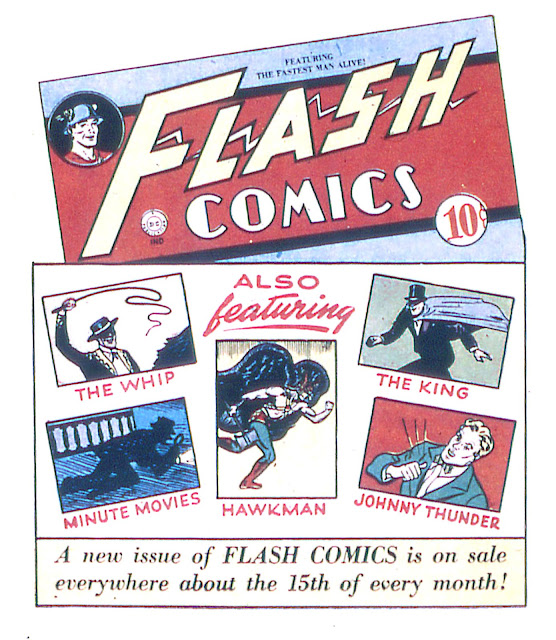
Ad for first issue.

In a chemistry lab, while breaking football training with a cigarette, Jay knocked over some beakers and further polluted his lungs by breathing in the fumes that turned him into the Flash.

As wish fulfillment, speed rated high with kids. Alacrity, fueled by their boundless energy, was after all the one area where children could outdistance the somewhat worn-out adults who talked down to them, punished them and generally looked after them. But just think what you might do with some real speed…

Artistic restriction can often be the parent of creativity, and the decade of the Flash’s initial run gave the writers plenty of time to come up with satisfying variations on the theme of speed. The Flash could run up the sides of buildings and across water. He could catch bullets, create multiple images of himself, become invisible and eventually even vibrate through walls. His one power turned out to make him nearly as omnipotent as Superman’s many. 

For me, the early adventures of this seminal superhero are difficult because of the underdeveloped, cartoony art. But by All-Flash 31 (Oct.-Nov. 1947), an artist named Carmine Infantino had arrived to make the Scarlet Speedster’s adventures a pure pleasure. Infantino would carry the character, in his second and even more successful incarnation, right through the 1950s and 1960s.